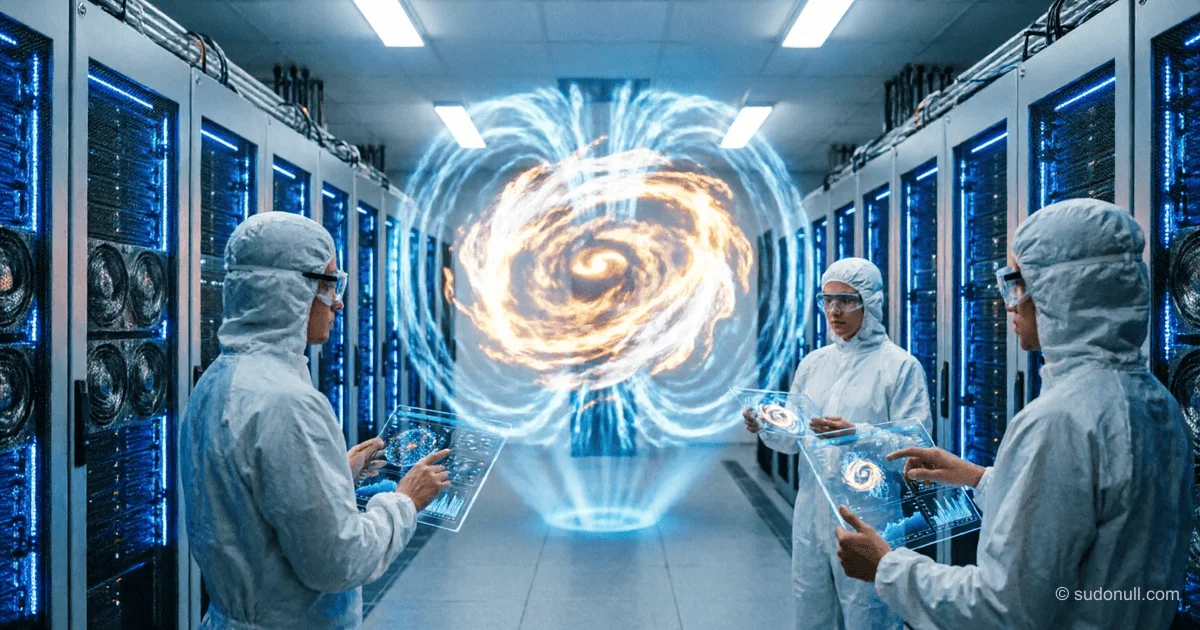
Scientists Train AI on Frontier Supercomputer to Model Space Storms for Fusion Energy
Researchers used the world's most powerful supercomputer, Frontier, to train an AI model capable of simulating magnetic plasma turbulence with unprecedented detail. This technology opens new avenues for studying supernovae and building next-generation fusion reactors.
Introduction: A Digital Breakthrough in the World of Chaos
Magnetohydrodynamic (MHD) turbulence is one of the most complex phenomena in physics. This chaotic motion of plasma under the influence of magnetic fields governs the formation of galaxies, the birth of supernovae, and the behavior of matter inside fusion reactors. For decades, simulating these processes remained beyond the reach of even the most powerful supercomputers.
In April 2026, a team of researchers from Argonne National Laboratory, led by Eliu Huerta, announced a breakthrough: they had created a hybrid AI model capable of reproducing MHD turbulence with unprecedented detail. The key tool was the Frontier supercomputer—the world's first exascale machine, capable of performing 2 quintillion operations per second.
This article analyzes the details of the event, its scientific and technological significance, the reaction of the scientific community, and the long-term prospects for astrophysics and fusion energy.
Event Details and Timeline
The Problem: Why Traditional Methods Failed
MHD turbulence manifests across multiple spatiotemporal scales simultaneously. Within a plasma flow, large structures shaped by the magnetic field coexist with thousands of small vortices, rapid oscillations, and local fluctuations. All these elements constantly interact, and even a slight loss of detail distorts the entire picture.
Traditional approaches, such as the Reynolds-averaged Navier–Stokes (RANS) method, average the flow behavior over time, which suffices for engineering tasks but is unsuitable for plasma physics. More accurate methods—direct numerical simulation (DNS)—require enormous computational resources. As Huerta notes, "The more chaotic the system, the harder it is to model, and traditional AI smooths out fine details, causing us to lose the knowledge we seek."
The Solution: Combining Two AI Models
The key innovation of the work, led by graduate student Semih Kaçmaz, lies in a two-stage strategy.
First stage: a physics-informed neural operator that learns to solve the equations of magnetohydrodynamics and reproduces the large-scale evolution of the plasma, establishing the mean flow. This type of AI does not merely seek statistical patterns but builds predictions based on fundamental physical laws.
Second stage: a score-based diffusion model—a generative AI that recovers the small-scale structures lost in the first stage. Diffusion models "learn" to reverse the process of adding noise to data, allowing them to reconstruct turbulent vortices, rapid fluctuations, and local flows with high accuracy.
These two models work in tandem: the neural operator provides the "skeleton" of the process, while the diffusion model restores the "texture"—all the missing details.
The Role of the Frontier Supercomputer
Training such a complex pair required generating thousands of high-precision simulations of MHD turbulence across a range from weak to extreme levels. Here, Frontier played a decisive role. "Frontier was a lifesaver for us," says Kaçmaz. "We used it to generate high-fidelity datasets to train the diffusion model and neural operators. These steps required massive computations that were our bottleneck, and Frontier made them practical."
The result exceeded expectations: the final system produces turbulence predictions in seconds and reduces error by more than half compared to previous methods, even when modeling extreme conditions.
The paper describing the research was published in the journal Machine Learning: Science and Technology (Volume 6, Issue 3, 035057).
Impact and Significance (for the World / Industry / Society)
For Astrophysics: A New Window into the Universe
MHD turbulence plays a central role in several astrophysical phenomena. It determines how supernovae explode, how stars and galaxies form, and even how solar flares affect Earth's magnetic field. More accurate modeling of these processes will allow astrophysicists to test new scenarios, improve predictions of cosmic events, and possibly revise some fundamental models of the universe's evolution.
Huerta emphasizes: "This capability has long been a dream of astrophysicists and many other scientists. For the first time, AI has reached this level of understanding of systems of such complexity."
For Fusion Energy: The Path to a Commercial Reactor
The most practical application of the new model is the development of next-generation fusion reactors. In tokamaks and stellarators, plasma turbulence directly affects two key parameters: energy confinement and burn stability. The stronger the turbulence, the faster the hot plasma touches the reactor walls, losing energy and damaging equipment.
The ability to accurately model MHD turbulence will allow reactor designers to optimize magnetic trap geometry, heating modes, and other parameters during the digital design phase. This is critical because building and operating experimental reactors like the international ITER requires tens of billions of dollars in investment and spans decades.
In the long term, as computing power increases, the model could be adapted for real-time plasma control, bringing closer the era of commercial fusion energy—a virtually inexhaustible and environmentally clean power source.
For Computational Science: A New Paradigm
The success of this research demonstrates the effectiveness of a hybrid approach: combining physical laws with generative AI achieves what neither method can accomplish alone. This methodology can be extended to other complex multiscale problems—from climate modeling to aerodynamics and biomedical fluid flows.
Reactions from Key Players
The scientific community greeted the news with enthusiasm. The official website of Oak Ridge National Laboratory published a detailed press release, highlighting that the research was funded by the Advanced Scientific Computing Research programs of the U.S. Department of Energy and the National Science Foundation.
A renowned theoretical physicist, commenting on the work (not named directly in publications), noted that "this is not just an acceleration of computations—it is a qualitatively new level of understanding plasma physics that was impossible just five years ago."
Specialized outlets such as HPCwire and Interesting Engineering called the breakthrough a "turning point" for the entire field of turbulence modeling.
Forecast and Conclusions
The researchers plan to extend the model to more complex systems, including full 3D high-resolution plasma simulations and more realistic astrophysical scenarios. The next step will be integrating the model into real tokamak experiments for validation and calibration.
Key takeaways:
- AI and physics are not competitors but allies. Hybrid models that preserve physical laws while using AI to fill computational gaps represent a new paradigm for scientific modeling.
- Exascale computing opens new horizons. Frontier has proven indispensable for tasks that would otherwise remain unsolvable. The next frontier is zettascale (a thousand exaflops) systems, expected to appear by 2030–2035.
- Fusion energy is getting closer. The ability to accurately model plasma turbulence will accelerate the design of more efficient and stable reactors, reducing development time and cost.
- Multiscale modeling is key to complex systems. The developed methodology can be applied to a wide range of problems where processes of different scales interact.
As Huerta summarizes: "By combining physics-informed neural operators with generative diffusion, we have created a framework that respects the equations while recovering the full complexity of the plasma." This statement could serve as an epigraph to a new era in computational physics—an era where artificial intelligence does not replace but complements the fundamental laws of nature, paving the way to solving problems that seemed impossible just yesterday.
— Editorial Team







No comments yet.