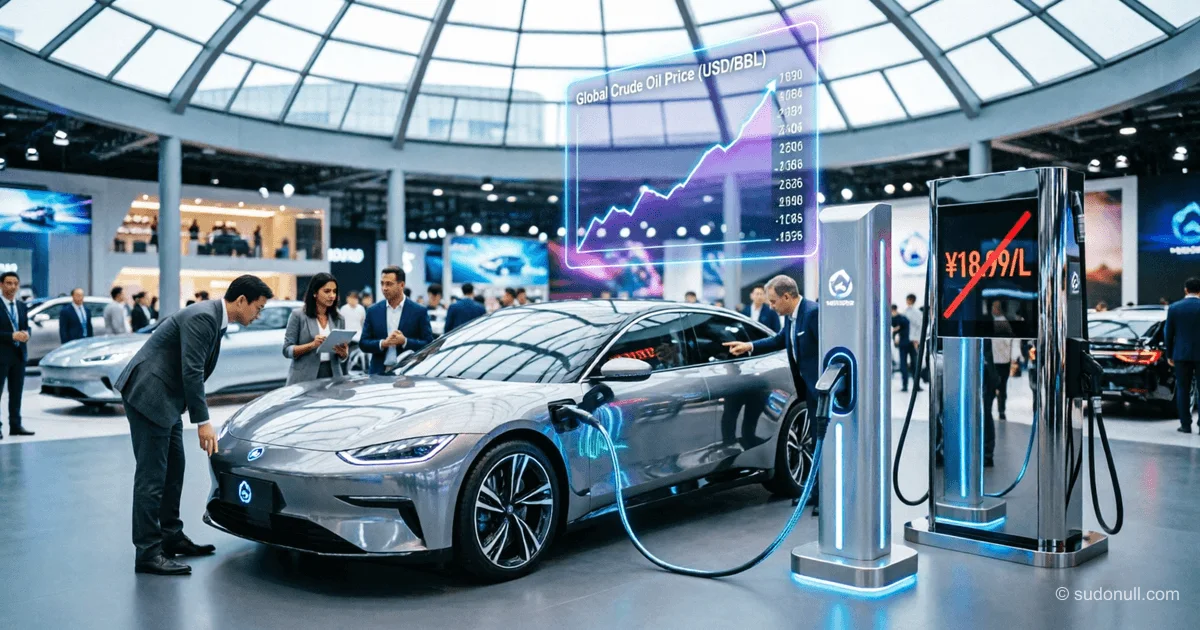
2026 Beijing Auto Show: Rising Fuel Prices Boost Demand for EVs in China
Amid instability in the Middle East, fuel costs are rising, making Chinese EVs with their low total cost of ownership and intelligent systems more attractive.
2026 Beijing Auto Show: Fuel Crisis Accelerates China's Green Transition
Introduction
The Beijing International Automotive Exhibition, the world's largest auto show, witnessed a historic shift in 2026. Spanning 380,000 square meters and showcasing 1,451 vehicles, the focus has shifted from horsepower and design to kilowatts, range, and charging costs.
The driver of this shift is geopolitics. The conflict in the Middle East, which triggered the largest oil crisis in history, is rapidly driving up fuel costs. Against this backdrop, Chinese EVs—already popular for their competitive prices, stylish design, and advanced technology—are gaining an additional demand boost, becoming not just a trendy choice but an economically rational one.
Event Details and Timeline
The 2026 Oil Shock
At the heart of the shift in consumer preferences are global energy figures. According to a World Bank report, energy prices in 2026 will rise by 24%, reaching their highest level since 2022. Attacks on infrastructure and the blockade of the Strait of Hormuz (through which about 20% of global oil trade passes) led to the largest oil crisis in history: in March, supplies collapsed by 10 million barrels per day.
Brent crude oil prices surged from $72 per barrel in late February to $118 in late March, a record monthly jump. Goldman Sachs forecasts Brent could reach $90 per barrel in Q4, and in a worst-case scenario, the World Bank allows for a peak of $115.
Reaction at the Auto Show
Against the backdrop of this energy storm, a completely different picture is unfolding in Beijing. Chinese companies, including BYD with its Formula S model, Li Auto with the L9 Livis, and NIO with the ES9, presented a wide range of new models.
The presence of foreign visitors is particularly noticeable. "With the current political situation, especially the conflicts involving the US, Israel, and Iran, oil and gas prices are rising sharply and are unlikely to fall anytime soon," said Jarosław Kochanowski, Managing Director of Polish car dealer NeoDrive, while sitting behind the wheel of a Zeekr 001 at the exhibition.
Impact and Significance
Economics of Use
For the average consumer, the price difference is becoming critical. A Beijing resident surnamed Wang, a NIO owner, calculated: "The energy cost per kilometer has dropped by more than 90%. My EV consumes 17 kWh per 100 km, costing about 7 yuan (roughly $1). My previous car consumed about 9.2 liters of fuel for the same distance, costing about 78 yuan."
Cui Dongshu, Secretary General of the China Passenger Car Association (CPCA), emphasized: "High oil prices significantly enhance the price advantage of new energy vehicles. As fuel costs for conventional cars rise noticeably, plug-in hybrids and fully electric models are increasingly demonstrating their efficiency."
Japan's Supply Chain Disruption
The domino effect of the conflict hit traditional auto giants. Toyota announced production cuts for Middle East export models by 20,000 units in March and 18,000 in April. Mazda will halt export production for the Middle East by the end of May.
This created a vacuum in Middle Eastern markets. "Inventory of popular Toyota models at local dealerships has been empty for a month; consumers are switching to Chinese brands, so 'I need to find more Chinese cars to fill the showroom,'" said Musa, a dealer from Riyadh.
Explosive Export Growth
The numbers confirm a tectonic shift. Data from the China Association of Automobile Manufacturers shows that in March 2026, NEV exports reached 371,000 units, more than double the figure from a year earlier. China's auto industry is not just meeting domestic demand; it is actively capturing global market share left by traditional brands.
Key Players' Reactions
New Markets for China
The auto show turned into a venue for global deals. An international operations manager at SAIC Maxus reported that on the first day of the exhibition, he received 6 groups of foreign agents from Spain, Italy, Middle Eastern countries, and Africa, all showing a "strong desire to become distributors."
Traditional European manufacturers are also closely watching. On the opening day of the show, Volkswagen's entire board of directors visited BYD's booth, and Mercedes-Benz Chairman Ola Källenius was spotted studying BYD and Huawei technologies. This is a visual testament to the recognition of China's technological leadership.
Analysis: 'Bubble' vs. Maturity
Despite positive signals, warnings are also sounding. Russian expert Sergey Arbuzov warns of a possible "Chinese auto bubble," pointing to prolonged price wars and massive R&D costs that have led to billion-dollar losses for companies like NIO. However, representatives from BYD and other leaders continue to aggressively expand their presence, betting on scale.
Forecast and Conclusions
World Bank analysts expect the oil market to return to surplus only by the end of 2026, as production recovers to 108.3 million barrels per day in the second half of the year, allowing Brent to fall to $70 in 2027.
The next few years will be decisive. Chinese manufacturers, who have gained a unique opportunity thanks to the geopolitical crisis, must consolidate their positions in the markets they have captured, addressing challenges related to charging infrastructure and after-sales service abroad.
Thus, the 2026 Beijing Auto Show captured a moment when high gasoline prices, a shortage of Japanese cars, and the technological maturity of Chinese EVs converged, changing the global balance of power in the auto industry. And while oil prices may fluctuate, consumer habits for cheap and technologically advanced transportation are likely to persist.
— Editorial Team










No comments yet.