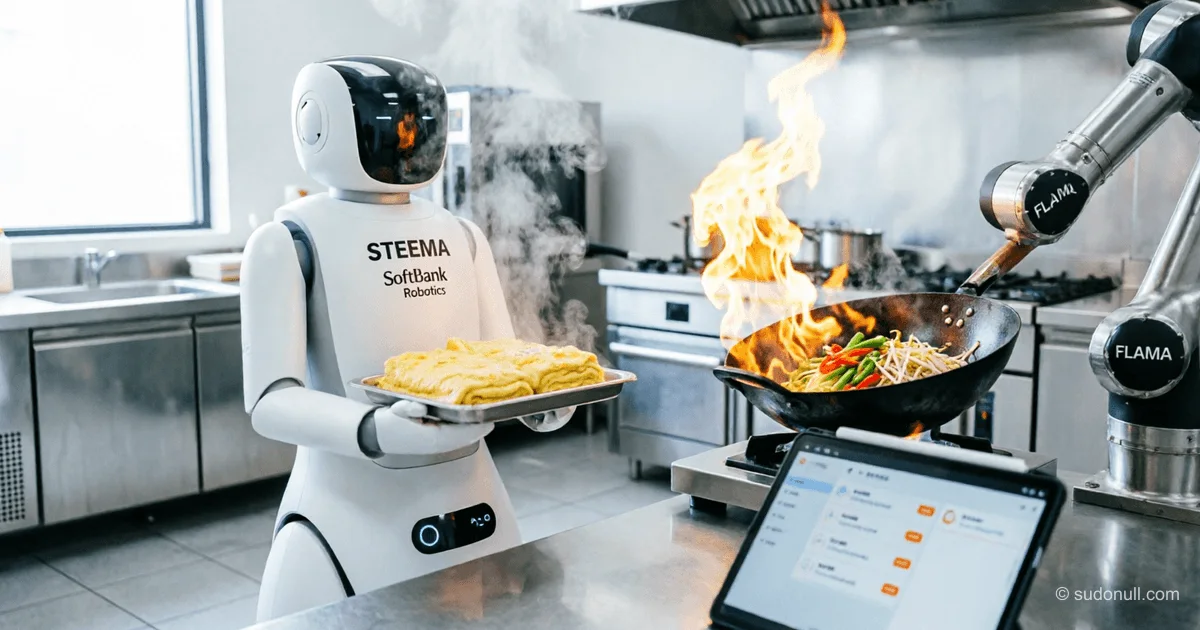
SoftBank Robotics Unveils STEAMA and FLAMA Robots for Autonomous Food Preparation in the US
The company announced the US market debut of two kitchen robots: STEAMA, which steams frozen noodles in 90 seconds, and FLAMA, which fully automates the frying and mixing process. The new products aim to address labor shortages and standardize quality in the restaurant industry.
Introduction: When Hunger Meets the Robot
The US restaurant industry stands on the brink of its biggest transformation since McDonald's introduced the assembly line in the 1940s. Only now, instead of people on the front line, robotic arms are taking over, and the key question is no longer "how do I find a chef?" but "which robot is cheaper?" In late April 2026, SoftBank Robotics officially announced the US launch of two kitchen robots: STEAMA and FLAMA. The first steams frozen noodles in 90 seconds, while the second fully automates frying and mixing processes. This event is not just another product announcement—it signals the start of a new phase in food service robotics, where the Japanese tech giant is applying its expertise in the world's most competitive market.
Event Details and Timeline
STEAMA: 90 Seconds to the Perfect Portion
The first robot, STEAMA, is designed to solve a specific but highly common task: fast, high-quality preparation of frozen egg noodles. The system operates on a "load and get results" principle: the operator places a portion of frozen semi-finished product into a special compartment, and the robot automatically calculates the steaming time and intensity. The entire cycle takes 90 seconds—faster than the average customer decides which sauce to choose.
STEAMA is primarily aimed at Asian cuisine restaurant chains and fast-food outlets that want to expand their menus without hiring additional chefs.
FLAMA: Full-Cycle Frying and Mixing
FLAMA is a more complex system—a robotic kitchen station capable of frying, stewing, and mixing ingredients. The device can work with various types of products, from vegetables and meat to sauces and grains. FLAMA automatically adjusts temperature, cooking time, and mixing intensity based on the task.
Both robots integrate into existing kitchen lines and require no special staff training. They are controlled via a touch interface, and key parameters can be set remotely—a network operator can manage all devices across locations from a single center.
Context of the US Market Entry
SoftBank Robotics chose the US market for its debut for a reason. According to market data, North America is the largest region for food robotics, accounting for about 40.8% of global growth in this segment. The food robotics market in the region reached nearly $924 million by 2025 and is projected to grow to $2.3 billion by 2035, with a compound annual growth rate (CAGR) of 9.6%.
Impact and Significance (for the World/Industry/Society)
Labor Crisis as the Main Driver
Behind SoftBank Robotics' announcement is not a technological whim but a harsh economic reality. In the US alone, the shortage of restaurant and cafe employees is estimated at about 1 million people, and by 2030, this deficit could grow to 6 million.
Former McDonald's CEO Ed Rensi stated the problem bluntly back in March 2026: "It's cheaper to buy a robotic arm for $35,000 than to hire an employee who will inefficiently bag fries for $15 an hour." According to him, policies demanding higher minimum wages only accelerate automation, not worker prosperity.
In this sense, STEAMA and FLAMA are not replacements for people but a response to a situation where there simply aren't enough workers.
Quality Standardization and Waste Reduction
Robots don't show up late, complain about fatigue, or get distracted by smartphones. This means consistent dish quality: every preparation strictly follows the recipe, without "a pinch of this" or "to taste." Additionally, digital kitchens can precisely portion ingredients, minimizing food waste—a factor that becomes especially important amid global food price increases. Fully automated systems are also easier to sanitize and can be programmed for self-cleaning between cooking cycles.
Restaurant Economics: From Loss to Predictability
The restaurant business is one of the most margin-volatile sectors. FLAMA and STEAMA offer a new approach: instead of variable labor costs (wages, taxes, sick leave, turnover), an establishment gets fixed operating expenses for equipment and its maintenance.
According to a study by the National Restaurant Association, 26% of operators already use AI tools, and 60% of them believe technology provides a competitive advantage. However, only 10% currently use kitchen automation—highlighting the scale of opportunity for SoftBank Robotics in the coming years.
Reactions from Key Players
From the Business Side
SoftBank Robotics is not a pioneer but a major player entering an already heated market. In California, restaurants where a robot assembles burgers in 27 seconds are already operating; in China, fully robotic restaurants with menus of over 100 dishes have opened, where machines handle the entire cooking process; Germany's Circus SE introduced the CA-1 system, capable of preparing up to 120 dishes per hour. Shanghai announced a program aiming for over 70% of food service establishments to integrate smart solutions by 2028.
Against this backdrop, SoftBank's US market entry with two specialized devices looks like a pragmatic move: the company isn't trying to cover everything at once but is targeting specific niches—quick noodle preparation and versatile mixing-frying operations.
From Workers and Unions
Public reaction is predictably mixed. A survey of developer companies showed that 67% of hospitality employees agree that robotics can reduce boring, dirty, and potentially dangerous work. However, on the other side are fears of job loss. The former McDonald's CEO directly stated that increased automation will lead to staff reductions nationwide, and social inequality will only grow. Shanghai's plan to transition to "humanless or minimal-staff" kitchens further fuels this debate.
Forecast and Conclusions
Short-Term Forecast (2026-2027)
In the coming years, the robotic kitchen market will grow explosively: analysts forecast a CAGR of 24.6% through 2030. SoftBank's STEAMA and FLAMA are among the early birds, but far from the last. Restaurant owners will view such systems as a business necessity, not an innovative toy. Mass adoption is expected in QSR (quick service restaurant) chains and dark kitchen formats, where space efficiency and staff reduction are critical.
Medium-Term Forecast (2028-2030)
By the end of the decade, the market will reach a point where the cost of preparing a dish by robot becomes lower than by a human, even without considering labor shortages. This will trigger a second wave of automation—now driven not by acute shortages but by pure economic advantage. As analysts note, 2026-2027 will be the tipping point for mass robot integration in food service. Restaurants that fail to invest in automation will face an insurmountable cost gap.
Long-Term Forecast (2030+)
Kitchen robotics will inevitably change employment structures. The least paid and least attractive jobs—line cooks, serving line staff, support personnel—will disappear. At the same time, demand will rise for robot maintenance technicians, IT specialists for kitchen networks, and food technologists who develop recipes for robotic execution.
For consumers, this means cheaper and more predictable food at chain establishments, but likely also further taste homogenization. True cuisine, with its improvisation and "chef's soul," will remain the domain of high-end restaurants.
Conclusion: Inevitability with a Human Face
SoftBank Robotics' STEAMA and FLAMA are not science fiction or an attempt to push humans out of the sacred art of cooking. They are a pragmatic engineering response to objective challenges: there aren't enough people, they are getting more expensive, and the demand for stable, affordable food is growing. Robots are coming to restaurants not because they are "better," but because the market leaves no choice. The question now is not whether robots will be in the kitchen, but how fast the familiar fast-food restaurant will turn into an automated assembly line. And SoftBank Robotics has just made a very significant bet in this race.
— Editorial Team






No comments yet.