Chinese Robots Move to Household Chores
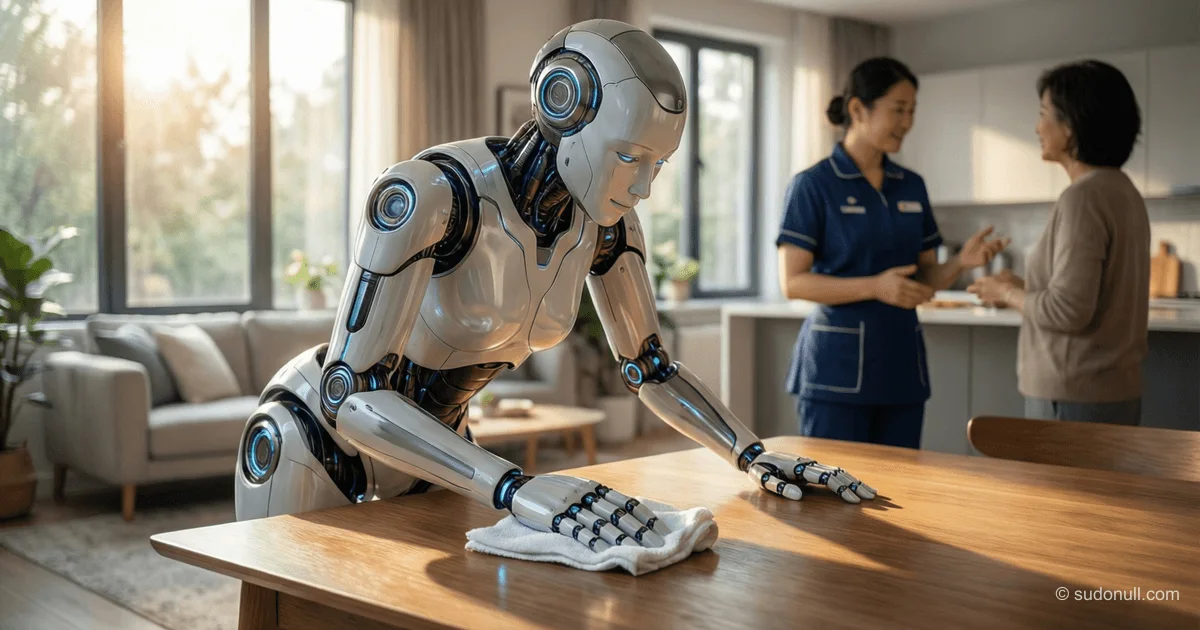
Startup X Square Robot unveiled humanoid robots capable of cleaning and sorting items using the Wall-B AI model trained on real household data, and is already offering cleaning services in Shenzhen.
From acrobatics to utility: How Chinese robots began their true conquest of the home front
Introduction
For years, humanoid robots impressed us with stunts: they ran marathons, danced, did backflips. But in real life, these million-dollar machines remained useless toys. Chinese startup X Square Robot decided to radically shift the paradigm: instead of flashy but meaningless demonstrations, its robots slowly but surely begin... picking up trash from the floor and wiping tables.
On April 24, 2026, at an event in Beijing, the company unveiled the Wall-B model — a humanoid robot trained on data from real households. But the main news is not even the technological breakthrough: X Square Robot is already offering a paid cleaning service in Shenzhen through a partnership with platform 58.com. This is the first time in the world that a humanoid robot has become not a lab prototype but a commercial product available to ordinary citizens for 149 yuan (about $22) for a three-hour cleaning session.
Event Details and Timeline
The roots of this breakthrough go back to March 2026, when X Square Robot, together with 58.com, launched a pilot project in Shenzhen. The service cost then was only 74 yuan ($10.70), half the price of regular cleaning without a robot. Demand was so high that the company announced a production ramp-up just a month later.
Key milestone — April 21, 2026: At an event in Beijing, CEO Wang Qian officially introduced the new generation of robots based on the Wall-B AI model. This is not just another update but a fundamental shift in architecture: Wall-B is built on the "World Unified Model" (WUM) architecture, which integrates vision, language, movement, and physical prediction into a single multimodal system.
Deployment timeline is impressively concrete:
- March 2026: Pilot project with 58.com, servicing real households in Shenzhen.
- April 2026: Official presentation of Wall-B and announcement of service expansion.
- End of May 2026: Launch of the new generation of robots in real homes (35-day window from presentation).
- Concurrently: The service was already operating in over 50 households by the time of the announcement.
It's important to understand: X Square Robot is not alone in this field. At the Consumer Electronics Show in January 2026, DYNA Robotics demonstrated a robot for folding laundry, and LG showed a machine for loading a washing machine. But no one except X Square has reached the stage of a paid service.
Impact and Significance
For global robotics: This is a moment of truth. As Wang Qian emphasizes: "The hardware is generally there. But the brain hasn't caught up yet." Indeed, running and dancing are tasks with predictable physics. House cleaning requires understanding chaos: where a 0.1 millimeter error can ruin the entire operation. X Square Robot proves that the "brain" — the Wall-B model trained on data from over 100 real households — is starting to work.
For the market and economy: The numbers are impressive. The CEO stated: "Household labor accounts for about 20% of GDP. So theoretically, this is a market the size of 20% of GDP." The potential market scale is colossal. Investors sense this: X Square Robot raised nearly 2 billion yuan ($276 million) in a Series B round with participation from Xiaomi, Alibaba, ByteDance, and Meituan. The company's valuation has already exceeded 10 billion yuan.
For society: The service operates on a "human + robot" model. A professional cleaner handles complex, judgment-requiring tasks (deep disinfection, client communication), while the robot performs structured work: wiping tables, collecting trash, helping fold sheets. This is not a replacement of humans but a scaling of their capabilities.
Robotics researcher Chris Paxton approves of this model, noting that it "naturally scales autonomy from 70% to 90% and up to 99%." For Shenzhen residents, this is already a reality: a three-hour cleaning session with a robot costs 149 yuan ($22) and is in high demand.
Reactions from Key Players
Investors have already voted with their money. The 2 billion yuan Series B round is not just funding; it's a strategic bet. The participation of Xiaomi (through its investment arm), Alibaba, ByteDance, and Meituan indicates that tech giants see X Square Robot not just as a startup but as a potential leader in the "embodied AI" category.
The professional community has responded with cautious optimism. Users (according to Reuters) note that the robot is still "slow and clumsy." But CEO Wang Qian himself does not deny this: "Sometimes it may put slippers in the kitchen or stop halfway while wiping a table to 'think.'" When problems arise, an operator can intervene remotely.
Social media accounts tracking robotics reacted with enthusiasm. Robohub wrote: "The future of home cleaning has just landed in Shenzhen and is entering your living room." CyberRobo emphasized: "It's happening: humanoid robots are officially joining cleaning crews in real homes. This is real teamwork."
International media (Reuters, Yahoo News, China Daily, People's Daily in German) widely covered the event. The symbolism is particularly emphasized: Shenzhen, the "Silicon Valley of robots," becomes a natural testing ground for the next generation of embodied AI.
Forecast and Conclusions
X Square Robot is at a crossroads where lab prototypes turn into commercial products.
Short-term forecast (through end of 2026): The key moment is the real-home testing scheduled for May 25. The success or failure of this stage will determine the further trajectory. If Wall-B can work stably in the "noisy" conditions of real households with pets, children, and chaotic item placement, trust in the technology will skyrocket. The company plans to scale the service in Shenzhen and likely in other Chinese megacities.
Medium-term forecast (2027-2028): The "human + robot" model could become the standard for cleaning services in China. Wall-B will learn from every interaction, becoming smarter day by day. The stated goal is to reach 90% autonomy. If this happens, the service economy will fundamentally change: robots can work 24/7, and human resources will be used only for quality control and complex operations.
Long-term forecast (2030+): If X Square Robot proves the model's viability, it will open the door for other applications: caregiver robots, indoor delivery robots, elderly care robots. But that is far off.
Main conclusion: The shift from flashy demonstrations to boring but useful work is not a loss of ambition but its realization. As Wang Qian aptly noted, "the brain hasn't caught up with the hardware." But Wall-B is taking the first steps to catch up. And these steps — slow, clumsy, sometimes putting slippers in the wrong place — are more important than any backflip. Because they lead not to a stage, but into our homes. And that is the only direction that truly matters for the future of robotics.
— Editorial Team








No comments yet.