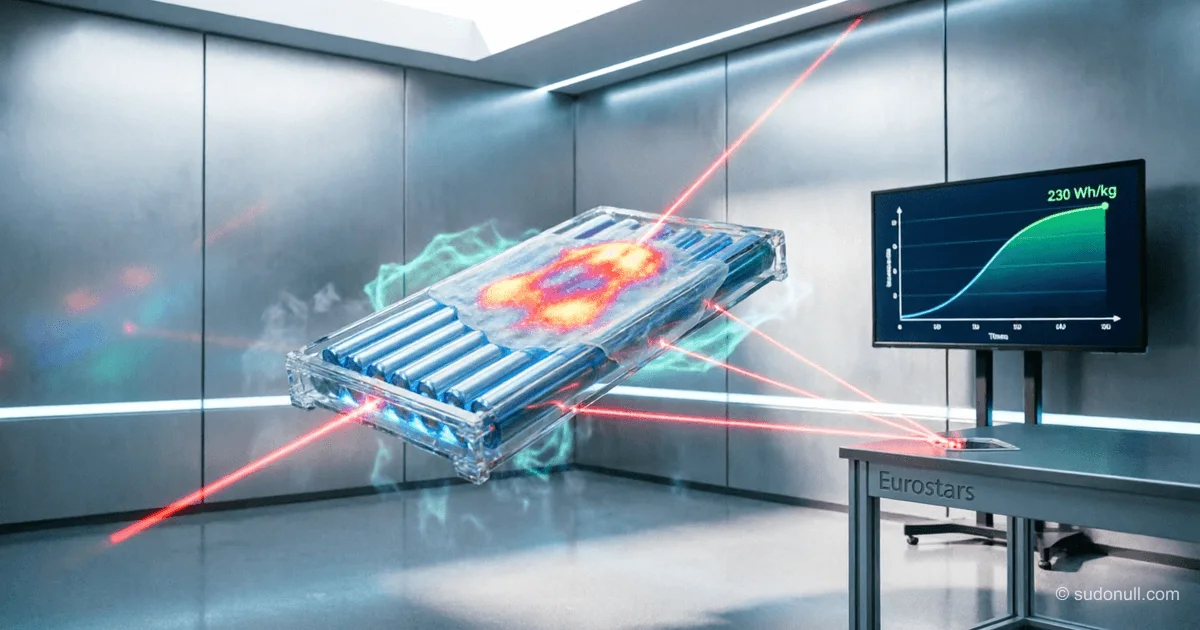
EU Develops Revolutionary High-Efficiency Batteries for Electric Vehicles
The RESiLiTE project has received critical cell samples for creating next-generation batteries with an extended temperature range and enhanced safety. The project aims to develop a prototype ready for industrialization to accelerate the transition to green transport in Europe.
Introduction: A New Era for European Batteries
The European Union has set an ambitious goal to become climate-neutral by 2050. Electric transport is central to this transition, but batteries remain the main technological barrier. Current batteries suffer from limited energy density, temperature instability, and safety issues, hindering the mass adoption of electric vehicles and making aviation electrification impossible.
The RESiLiTE project (Robust, Economical, Silicon-rich, Lightweight and Thermally Efficient battery packs), funded by the Horizon Europe program, aims to address these challenges. In March 2026, the consortium announced the receipt of critical battery cell samples—a major milestone toward creating next-generation batteries ready for industrialization. This article analyzes the project's technical details, its significance for European industry, and commercialization prospects.
Event Details and Timeline
Receipt of First Cell Samples
In March 2026, battery cell samples were delivered to the project coordinator's facilities—Kautex Textron in Bonn, Germany. Immediately after receipt, the samples were transferred for testing to RWTH Aachen University, one of Europe's leading research centers in battery technology.
The testing process allows the project team to gather data critical for fine-tuning battery monitoring and management systems. Special attention is given to optimizing charge and discharge cycles at high C-rates, ensuring efficient operation without damaging cells and preserving service life.
Technical Specifications of the Project
According to official project documentation, RESiLiTE sets ambitious targets:
| Parameter | Target Value | Comparison with Current Level |
|-----------|--------------|-------------------------------|
| Pack-level energy density | 230 Wh/kg | >19% above current level |
| Charge/discharge rate | >4.5C | Significant improvement |
| Cell type | Cylindrical 4695 | Optimized format |
| Housing material | Fiber-reinforced thermoplastics, recycled | Weight and cost reduction |
The key innovation is the Cell-to-Pack (C2P) approach, which eliminates intermediate modules and allows denser packing of cylindrical 4695 cells. This directly increases energy density at the battery pack level.
Project Timeline
The project started in July 2025 and runs for three years, ending in mid-2028. Key milestones for 2026 include finalizing the battery pack design and architecture. As Kautex Textron development engineer Stefano Piaquadio stated: "The project is on track to achieve all its KPIs, developing a prototype ready for industrialization."
Impact and Significance (for the World/Industry/Society)
For Electric Vehicle Manufacturers
Current battery energy density limits EV range. RESiLiTE aims to overcome this barrier: a 19% increase in density means that with the same battery weight, the vehicle can travel 19% farther, or with the same range, significantly reduce weight.
A charge rate >4.5C means a full charge is theoretically possible in under 15 minutes. This brings EVs closer to the convenience of refueling conventional cars and removes one of the main consumer objections.
For the Aviation Industry
RESiLiTE is one of the few projects that initially considers applying results first in cars and then in aircraft. Electric aviation imposes even stricter requirements: batteries must be lightweight, safe, and capable of handling high discharge currents during takeoff. The project's success could become the technological foundation for regional electric aircraft, fundamentally changing short- and medium-haul transport.
For European Industrial Policy
RESiLiTE is part of the BATT4EU Partnership strategy—a pan-European initiative to create a competitive, sustainable, and circular value chain for batteries in electric transport and stationary energy storage.
Currently, Asian manufacturers (CATL, BYD, LG, Samsung) dominate the battery market. Europe aims to build its own production base to reduce import dependence and ensure technological sovereignty. Projects like RESiLiTE are a necessary foundation for this strategy.
Reactions of Key Players
Industrial Partners
The project coordinator is Kautex Textron, a German company specializing in automotive components, including energy storage systems. Its involvement ensures the development is geared toward practical application and industrial production.
The consortium includes leading European players:
- Infineon Technologies Austria AG — developing chips for battery management systems
- Fraunhofer-Gesellschaft — applied research
- Pipistrel Vertical Solutions — Slovenian electric aircraft manufacturer
- TOGG — Turkish automaker
- RWTH Aachen — academic leader in battery technology
Academic Community
Cell testing is conducted at RWTH Aachen University, home to one of Europe's leading Battery Testing Centers. Nima Ghandili, head of the center, presented the project's technical details at the VDI conference in Braunschweig in March 2026. The university is responsible for multilevel testing and benchmarking.
Funding
The total project budget is approximately €6.2 million under the Horizon Europe program. This is a relatively small amount for ambitious goals, indicating that the project focuses on validating key technologies rather than building production facilities.
Forecast and Conclusions
Short-term Forecast (2026-2027)
In 2026, main efforts are concentrated on completing the battery pack design and continuing cell testing. The key milestone is the creation of the first functional battery pack prototype. By the end of 2027, the prototype is expected to be ready for real-world demonstration on partner vehicles (TOGG and others).
Medium-term Forecast (2028-2030)
Project completion in mid-2028 paves the way for industrial adoption. Over the following two to three years, technologies developed in RESiLiTE could be integrated into commercial products. Application is particularly promising in premium EVs, where higher energy density and charging speed are key competitive advantages. Aviation application will likely require additional certification and may take longer—until 2030-2032.
Long-term Forecast (2030+)
By the mid-2030s, if the technology proves effective, RESiLiTE could become a technological platform for a new generation of European batteries. The combination of high energy density (230 Wh/kg), fast charging (>4.5C), and improved temperature stability makes this development potentially competitive with the best global examples. Sustainability is particularly important—the use of recycled thermoplastics and the possibility of circular material flow align with the EU Green Deal principles.
Conclusions
RESiLiTE is not just another research project but a strategic element of European industrial policy in the battery sector. Receiving cell samples and testing them is a concrete step forward from ambitions to a real product. The involvement of leading industrial players in the consortium ensures a direct path to commercialization, and the focus on sustainability and circular economy makes the development consistent with long-term European priorities.
The challenge remains serious: competition with Asian giants that have already scaled production. However, RESiLiTE demonstrates that Europe is betting on technological innovation rather than price competition. If the project achieves its stated KPIs, the European automotive and aviation industries will gain a next-generation battery platform—safer, more efficient, and more sustainable.
— Editorial Team








No comments yet.