Japan to Test Humanoid Robots for Passenger Services at Haneda Airport
The project aims to address labor shortages: robots will handle baggage loading, cabin cleaning, and ground equipment operation without infrastructure overhaul.
Humanoid Robots at Haneda Airport: Japan Begins a New Era of Ground Handling
Introduction
Tokyo's Haneda Airport is one of the busiest in the world, serving over 60 million passengers annually. Behind its smooth operation are thousands of ground staff whose work remains invisible to most travelers. But this system is cracking: Japan faces a severe labor shortage amid a record tourism boom and rapid population aging.
This is where humanoid robots enter the scene. In April 2026, Japan Airlines (JAL) and GMO Internet Group announced the start of Japan's first experiment deploying humanoid robots for ground handling at Haneda Airport. This is not just another automation—it's an attempt to rethink the very organization of labor in aviation, using robots that can work within existing infrastructure without costly renovations.
Event Details and Timeline
Who Is Involved and What Is Happening
The project is led by two main partners:
- JAL Ground Service (JGS) — a JAL subsidiary responsible for ground operations, including baggage unloading and ground equipment management.
- GMO AI & Robotics Trading (GMO AIR) — a division of GMO Internet Group promoting AI and robotics deployment in the real economy.
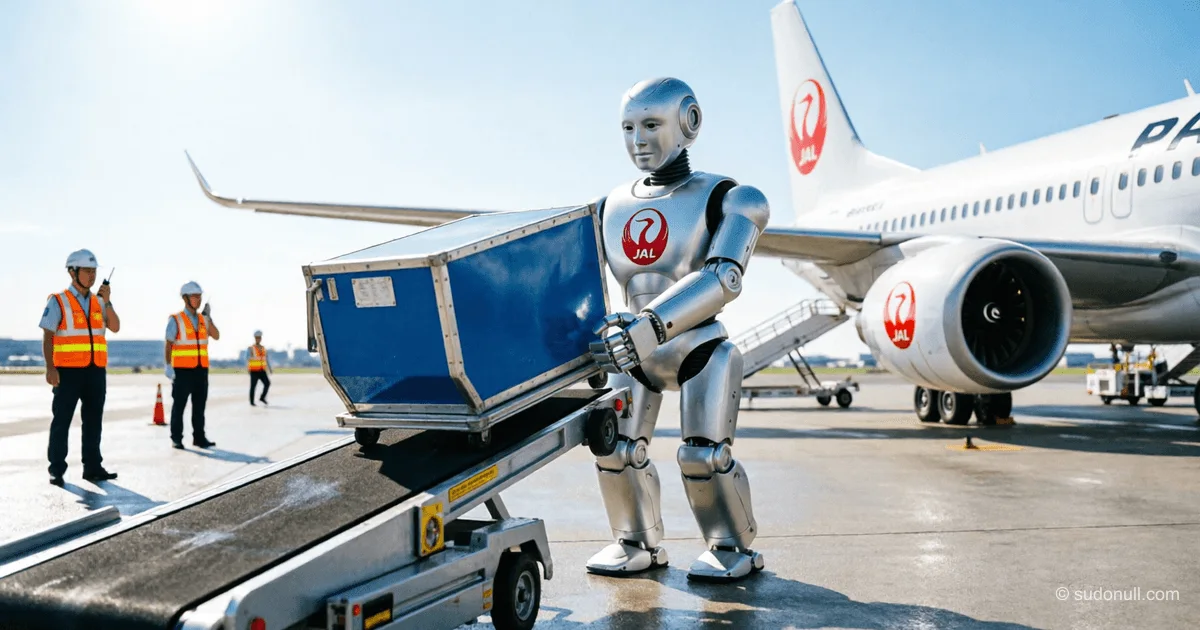
Trials will begin in May 2026 and run until 2028. Initially, robots will handle loading and unloading cargo containers with baggage and freight on the tarmac. Later, they are planned to also clean aircraft cabins and operate ground support equipment.
Robot Specifications
The robots are from Chinese company Unitree:
- Height: about 130 cm
- Battery life: 2–3 hours of continuous operation
- Capabilities: stable cargo handling, signaling to colleagues (gestures), navigation in confined spaces
At a media demonstration on April 27, 2026, a robot showed its ability to carefully move cargo onto a conveyor belt next to a passenger aircraft and even gesture signals, mimicking interaction with human coworkers.
Implementation Phases
The experiment will be conducted in stages:
- Operations analysis: identifying areas where robots can be safely integrated
- Simulation trials: repeated tests in near-real conditions
- Gradual expansion: from baggage handling to cabin cleaning and ground equipment operation
Impact and Significance
For Japan: Addressing the Demographic Crisis
Japan is at the epicenter of two powerful socio-economic trends:
Record tourist influx: In the first two months of 2026, over 7 million foreigners visited the country. The entire year 2025 set a historical record of 42.7 million tourists. Tourism is growing, and airports are struggling to cope.
Aging and shrinking population: Japan's working-age population is steadily declining. By 2040, the country is estimated to need over 6.5 million foreign workers to sustain economic growth. However, immigration policy remains strict, and the government faces political pressure to limit inflows.
In this context, automation becomes not just desirable but vital. JAL Ground Service President Yoshiteru Suzuki stated directly that using robots for physically demanding work "will inevitably reduce the burden on workers and bring tangible benefits to employees."
For the Industry: Evolution, Not Revolution
The key advantage of humanoid robots over traditional automated systems is their ability to work within existing infrastructure.
As GMO AI & Robotics President Tomohiro Uchida notes: "Although airports seem highly automated and standardized, their internal operations still rely heavily on human labor and face serious labor shortages."
Traditional conveyors and specialized robots require facility renovations, which are costly and time-consuming. Humanoids can navigate the same aisles as people, handle the same containers, and operate the same equipment. This makes them an ideal solution for airport "last-mile" logistics.
For Society: Rethinking the Human Role
Suzuki emphasized a key point: critical tasks, especially safety management, will remain with humans. Robots take over physically heavy, routine, and repetitive work. This is not about replacing humans but redistributing the workload—from exhausting physical labor to control, coordination, and decision-making.
GMO Internet Group has declared 2026 as "the first year of humanoids." This is not just a marketing gimmick but a signal of a long-term trend: humanoid robots are gradually entering areas once considered science fiction.
Reactions from Key Players
JAL and GMO: Cautious Optimism
Representatives from both companies describe the project as a necessary but still experimental step. Yoshiteru Suzuki stressed that safety remains in human hands, with robots only assisting. Tomohiro Uchida is more ambitious: his company aims to "create a sustainable operational structure through labor savings and reduced burden."
Global Context
Other Japanese airports already use robots for patrolling and retail services. However, aircraft ground handling is a much more complex and high-stakes environment. The success or failure of the Haneda experiment will influence the willingness of other airlines and airports worldwide to invest in humanoid robotics.
Forecast and Conclusions
The Next Two Years: A Stress Test
The experiment runs until 2028. During this time, key questions must be answered:
- How reliably do robots perform tasks in real, not demo, conditions?
- How do they interact with humans in the confined space around an aircraft?
- What is the actual economic impact—cost reduction, faster turnaround, fewer injuries?
Long-Term Trend: From Loader to Cleaner
Companies already plan to expand robot functions: first to cabin cleaning, then to ground equipment operation. If successful, Haneda could become a model for other major airports worldwide facing similar labor shortages and passenger growth.
Limitations and Challenges
Robots currently operate only 2–3 hours without recharging. For round-the-clock airport operations, this means rotating multiple robots or building infrastructure for quick battery swaps. Additionally, the cost of the robots themselves and their maintenance remains a high barrier to mass adoption.
Conclusions
The Haneda Airport project is not just a story about robot loaders. It's about how a technological giant (Japan), facing a demographic crisis, seeks a solution in robotics. It is a pragmatic, cautious, yet bold experiment.
"Although airports seem highly automated, their internal operations still rely heavily on manual labor"—this phrase from Tomohiro Uchida accurately describes the core problem. The solution proposed by JAL and GMO does not require building renovations or purchasing unique equipment. Instead, humanoid robots fit into the existing world designed for humans.
The future likely belongs to hybrid teams: humans handle control, coordination, and decision-making, while robots take over physically heavy, repetitive, and dangerous work. And Haneda is the first major venue where this principle will be tested in action.
— Editorial Team









No comments yet.