World's First Proof of Particle Polarization Preservation in Laser-Plasma Acceleration
Scientists have experimentally confirmed for the first time that the polarization of elementary particles is preserved during their acceleration in laser plasma, a critical step toward compact accelerators and medical devices.
Quantum Identity Survives the Inferno: How Particle Polarization Endured in a Laser-Plasma Accelerator and What It Means for Energy and Science
Introduction
Researchers from Heinrich Heine University Düsseldorf and Forschungszentrum Jülich have achieved a breakthrough that shatters long-standing theoretical concerns: they have experimentally demonstrated for the first time worldwide that the polarization of elementary particles is preserved during extreme acceleration in laser plasma. This discovery is not just a checkbox on a list of lab achievements. It opens the door to compact, relatively inexpensive accelerators for controlled nuclear fusion and fundamental research into dark matter.
Event Details and Timeline
The research team, led by Prof. Dr. Markus Büscher, reported their results in two papers published in late April to early May 2026: a review in Reports on Progress in Physics and an experimental study in High Power Laser Science and Engineering. The latter provided the direct evidence the community had been waiting for.
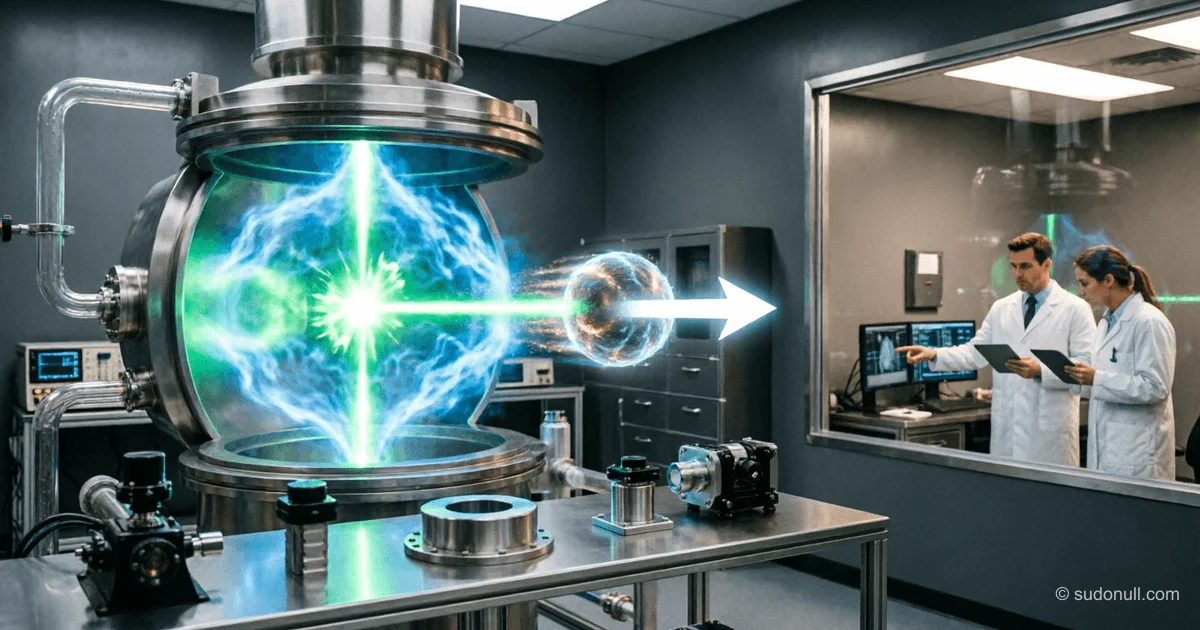
Testing the hypothesis was nothing short of a special operation. Each morning in Jülich, scientists prepared a precious cargo—pre-polarized gas of the helium-3 isotope (³He). This gas is not just fuel but a quantum-ordered medium where nuclear spins are aligned in a specific direction. The gas was then transported in a special container to the GSI Helmholtz Centre for Heavy Ion Research in Darmstadt. There, using the powerful PHELIX laser facility, helium ions were accelerated to high energies in plasma. The final step involved analyzing tracks on CR-39 detector plates, which showed that despite enormous accelerating gradients (about a thousand times higher than in classical accelerators), the spin orientation of the particles remained intact.
Impact and Significance
Why does this matter? It intertwines the interests of energy and fundamental science.
Betting on Nuclear Fusion. In controlled fusion, the probability of nuclear fusion reactions dramatically increases if the spins of the "fuel" are aligned. Prof. Büscher emphasizes: "In controlled nuclear fusion, the reaction probability—and thus the energy output of the reactor—increases significantly when the spins of the fusing nuclei are aligned in parallel." If laser-plasma accelerators can efficiently work with such "charged" fuel, it fundamentally changes the approach to inertial fusion. Instead of giant ring-shaped machines tens of kilometers long costing billions of dollars (e.g., building CERN cost about $4.75 billion), compact drivers can be created for substantially less money. The savings come from the enormous difference in equipment scale and construction work.
Hunting for Dark Matter and New Physics. Polarized beams are an ideal tool for probing the structure of matter. By scattering polarized electrons off protons and neutrons, physicists can look beyond the Standard Model. "They are particularly well-suited for investigating dark matter candidates such as axions," notes Büscher. This opens the prospect of a new generation of compact accelerator laboratories that could be housed not in international mega-centers but at individual universities with budgets in the tens of millions of dollars rather than billions.
Compactness and Accessibility. Laser-plasma accelerators can provide accelerating gradients three orders of magnitude higher than traditional radio-frequency accelerators. Now that we know they do not destroy the quantum state of the beam, they can be used for applied tasks—from medical physics to generating polarized positrons and gamma rays.
Reactions from Key Players
The scientific community has received the result with restrained but genuine enthusiasm. Until now, the preservation of nuclear polarization in plasma remained only a theoretical postulate on which many models were built, but experimental confirmation was lacking. Büscher's group has removed this uncertainty.
One of the co-authors of the work is C. Zheng, whose current affiliation is Artemis Targetra GmbH, a startup at the Collective Incubator in Aachen. This indicates that the technology is beginning to drift toward commercialization. If real investors and business interests are behind it, the timeline for applied solutions could be significantly shorter than for a purely academic project.
Related research, particularly at Osaka University and other centers, also focuses on generating polarized electron beams in laser wakefield acceleration. A full-fledged global direction is forming, in which the German group played the role of pioneers in experimental verification for ions. It is worth noting that the budget for such research in Europe typically comes from grants from national science foundations (DFG in Germany) and EU programs, where a typical project size ranges from €2 million to €5 million (equivalent to $2.2–5.5 million).
Forecast and Conclusions
The breakthrough achieved in Düsseldorf and Jülich is fundamental in nature, so its monetization will not be immediate, but the directions are already clear. In the next few years, we can expect an intensification of research into polarized nuclear fusion using laser-plasma drivers. If the energy output of a reactor can be increased by tens of percent even at current modest scales, it will be a powerful stimulus for private investment in the sector.
In the medium term (5–7 years), projects for compact sources of polarized particles for materials science and nuclear medicine will emerge. However, the main challenge is scalability: so far, the experiment was conducted with single "shots," but a real reactor or tomograph requires stable, high-frequency acceleration cycles.
The main outcome of the experiment is the removal of a psychological barrier. It was believed that the hellish conditions in plasma (temperatures comparable to stellar interiors and fields of millions of volts) would inevitably "scramble" spins. It turns out they do not—quantum coherence survives this storm. This gives physicists a blank check to design a new generation of accelerators capable of working with "quantum-pure" fuel and opening previously inaccessible areas of nuclear physics.
— Editorial Team










No comments yet.