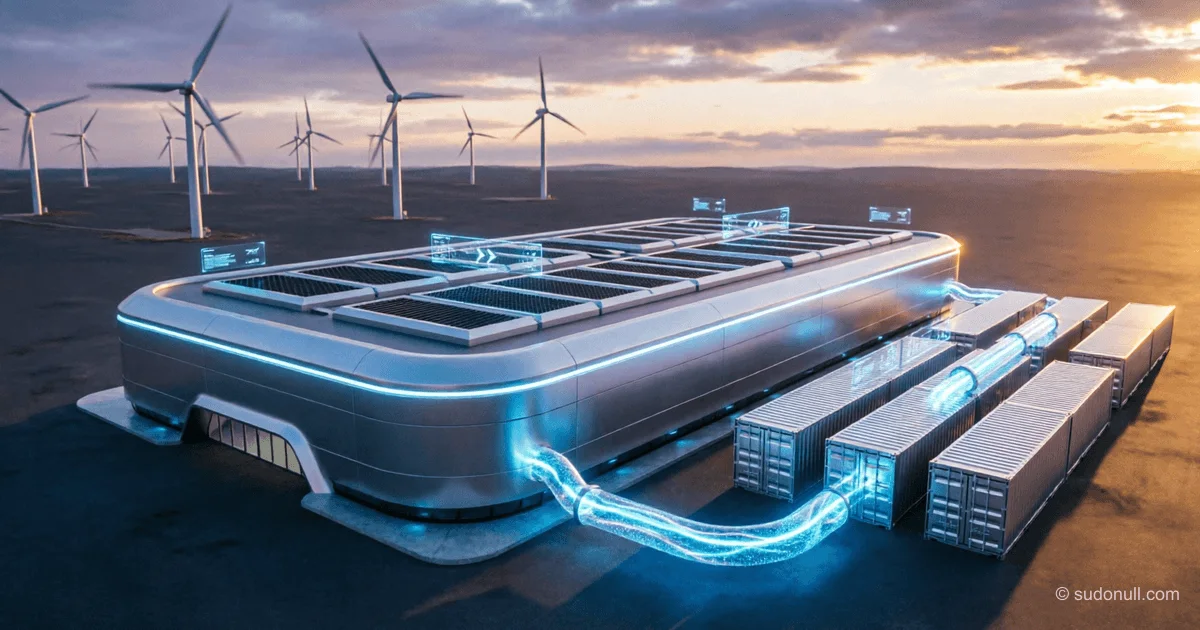
Meta Signs Deal with Noon Energy to Deploy Ultra-Long-Duration Energy Storage for Data Centers
The solid oxide fuel cell system can store energy for over 100 hours, providing clean power to data centers amid growing AI workloads.
Meta and Noon Energy: How Ultra-Long-Duration Energy Storage Is Changing the Game for AI Infrastructure
Introduction
In the race to build next-generation artificial intelligence, a new problem has emerged that is rarely discussed at tech conferences: energy. Meta's data centers already consume over 18,000 gigawatt-hours of electricity per year, and with each new generation of AI models, this figure is growing rapidly. The challenge is not just where to get so much energy, but how to ensure its uninterrupted supply when the sun isn't shining and the wind isn't blowing.
This is where Noon Energy enters the scene—a California-based startup promising a technology that could radically transform the energy landscape of data centers. In April 2026, Meta signed an agreement with Noon Energy to reserve up to 1 GW / 100 GWh of ultra-long-duration energy storage systems based on reversible solid oxide fuel cells and carbon storage. This is one of the largest commitments in the industry for long-duration energy storage, marking a shift in AI infrastructure toward a new level of energy independence.
Event Details and Timeline
Scale of the Agreement
The deal, announced in late April 2026, includes:
- Total reserved capacity: up to 1 GW power / 100 GWh storage capacity
- Pilot project: 25 MW / 2.5 GWh, expected to be completed by 2028
- Technology: reversible solid oxide fuel cells with energy storage in solid carbon
- Storage duration: over 100 hours of continuous operation
Noon Energy Technology: How It Works
Unlike lithium-ion batteries, which are optimized for 2–10 hours of storage, Noon Energy's technology addresses a fundamentally different challenge. The system works as follows:
- Charging: Renewable electricity is used to split carbon dioxide (CO₂) into oxygen and solid carbon. Oxygen is released into the atmosphere, and carbon is stored.
- Discharging: When energy is needed, the system takes oxygen from the air and combusts the stored carbon in a reversible solid oxide fuel cell, generating electricity.
Key advantages of this technology:
| Parameter | Noon Energy Technology | Lithium-Ion Batteries |
|----------|------------------------|----------------------|
| Storage duration | >100 hours | 2–10 hours |
| Use of critical materials | <1% of Li-ion | 100% (lithium, cobalt, nickel) |
| System cost | <$20/kWh | ~$100–150/kWh |
| Levelized cost of storage | ~$0.06/kWh | ~$0.10–0.15/kWh |
| System-level compactness | Higher than Li-ion | Baseline |
The system has already passed tests: in January 2026, Noon Energy demonstrated a 100 kW / 10 MWh prototype at a solar farm in Yolo County, California, supported by a $8.76 million grant from the California Energy Commission. The system operated for "thousands of hours" in real-world conditions.
Context: Meta's Second Energy Agreement
Notably, the deal with Noon Energy is not Meta's only energy agreement in April 2026. Simultaneously, the company partnered with Overview Energy, a startup that plans to collect solar energy on geosynchronous satellites and transmit it to Earth as an infrared beam, enabling round-the-clock generation. Both agreements involve reserving up to 1 GW of capacity and target pilot project launches in 2028.
Impact and Significance
For Meta: A Strategic Response to AI's Energy Crisis
These agreements reflect a deep strategy. As the company stated: "Developing AI at the speed and scale we aim for requires more energy, but current clean energy technologies have real limitations: solar depends on sunlight, wind on weather, and the grid still needs more storage to utilize both."
Meta has already contracted over 30 GW of renewable energy and supports geothermal and nuclear projects (including 7.7 GW of nuclear capacity through agreements with Vistra, TerraPower, Oklo, and Constellation Energy). But without ultra-long-duration storage, even the largest generation remains vulnerable to interruptions.
For the Industry: A New Model for Data Center Power Supply
Nat Sahlstrom, Meta's Vice President of Energy and Sustainability, emphasized: "Accelerating data center deployment requires rapid rollout of reliable energy sources. Our agreement with Noon Energy advances this goal with storage technology that provides grid resilience and firm power."
A key innovation here is modularity. Noon Energy's system is containerized, allowing storage capacity to scale proportionally with Meta's data center growth without building new infrastructure. For an industry where data centers are built for decades, this is a critical advantage.
For Society and the Environment
Noon Energy's system uses less than 1% of critical materials compared to lithium-ion batteries, reducing dependence on supply chains for lithium, cobalt, and nickel—resources whose extraction often involves environmental and social issues. Additionally, the technology uses CO₂ as feedstock, potentially opening a path to greenhouse gas utilization.
Chris Graves, co-founder and CEO of Noon Energy, called the partnership with Meta "a monumental step toward realizing why we founded Noon. We are collaborating with a company that is actively ensuring stable energy for the AI infrastructure of the future."
Reactions from Key Players
Noon Energy: From Prototype to Industrial Scale
For Noon Energy, this partnership is a breakthrough. The startup, founded in 2018 and initially funded by ARPA-E (the U.S. Department of Energy's Advanced Research Projects Agency-Energy) with $500,000, is now moving to an industrial level. Graves stated that the company will focus on expanding manufacturing capacity and building a complete supply chain for ultra-long-duration energy storage.
Investors and the Industry at Large
Meta's agreement with Noon Energy is "one of the largest commitments in the industry for ultra-long-duration energy storage, setting an example for how tech companies can power AI and cloud infrastructure with storage to maximize energy availability."
Experts note that the deal could catalyze the entire LDES (Long Duration Energy Storage) industry. Until now, the main barrier to ultra-long-duration storage was not technological but economic: customers were unwilling to pay for a system that might be needed only a few times a year. Meta has shown that for AI data centers, where downtime is unacceptable, this technology becomes critical.
Context: Meta's New Data Centers
Alongside energy agreements, Meta began construction of a new data center in Tulsa, Oklahoma, with investments exceeding $1 billion. The data center will be fully optimized for AI workloads, equipped with a closed-loop liquid cooling system that consumes zero water for most of the year, and its energy consumption will be fully offset by clean sources, including over 1,500 MW of new renewable energy capacity in Oklahoma. It is for such facilities that Noon Energy's technology is intended.
Forecast and Conclusions
Near Term (2026–2028)
The 25 MW / 2.5 GWh pilot project is planned for completion by 2028. If successful (and early tests of Noon Energy's system were positive—"thousands of hours" of real-world operation), scaling to the full 1 GW / 100 GWh will follow.
Long-Term Impact (2028–2030+)
Four key trends this partnership will shape:
- Standardization of ultra-long-duration storage for AI data centers. If the technology proves effective, other major tech companies (Google, Amazon, Microsoft) will follow Meta's lead, creating a mass market for LDES.
- Cost reduction. Noon Energy already claims system costs below $20/kWh and levelized costs around $0.06/kWh—making the technology economically competitive with lithium-ion batteries even without considering its duration advantages.
- Transition to fully renewable energy for AI. The combination of space-based solar power (Overview Energy), geothermal and nuclear energy with ultra-long-duration storage (Noon Energy) creates a model where AI data centers can run on 100% clean energy 24/7/365.
- Reduced dependence on critical materials. Noon Energy's technology uses less than 1% of critical materials compared to lithium-ion batteries, which is especially important amid global competition for lithium and cobalt.
Challenges and Limitations
Scaling questions remain: Can Noon Energy fulfill the 1 GW / 100 GWh order by the early 2030s? It will require building new manufacturing capacity and supply chains from scratch. Additionally, Overview Energy's orbital demonstration is planned for 2028, and it is far from certain that space-based solar power technology will work at commercial scale.
Conclusions
Meta's agreement with Noon Energy is not just a battery supply contract. It is a strategic move by a major tech company recognizing that the future of AI depends not only on chips and algorithms but also on the physics and chemistry of energy storage.
Chris Graves called the partnership "a monumental step." And that is no exaggeration. If Noon Energy's technology lives up to expectations, it will become the missing link between renewable generation and round-the-clock AI infrastructure, paving the way for truly sustainable and reliable artificial intelligence. For Meta, this means not just reducing its carbon footprint but achieving energy independence—an asset that, in an era of rising energy prices and geopolitical instability, could prove invaluable.
— Editorial Team









No comments yet.