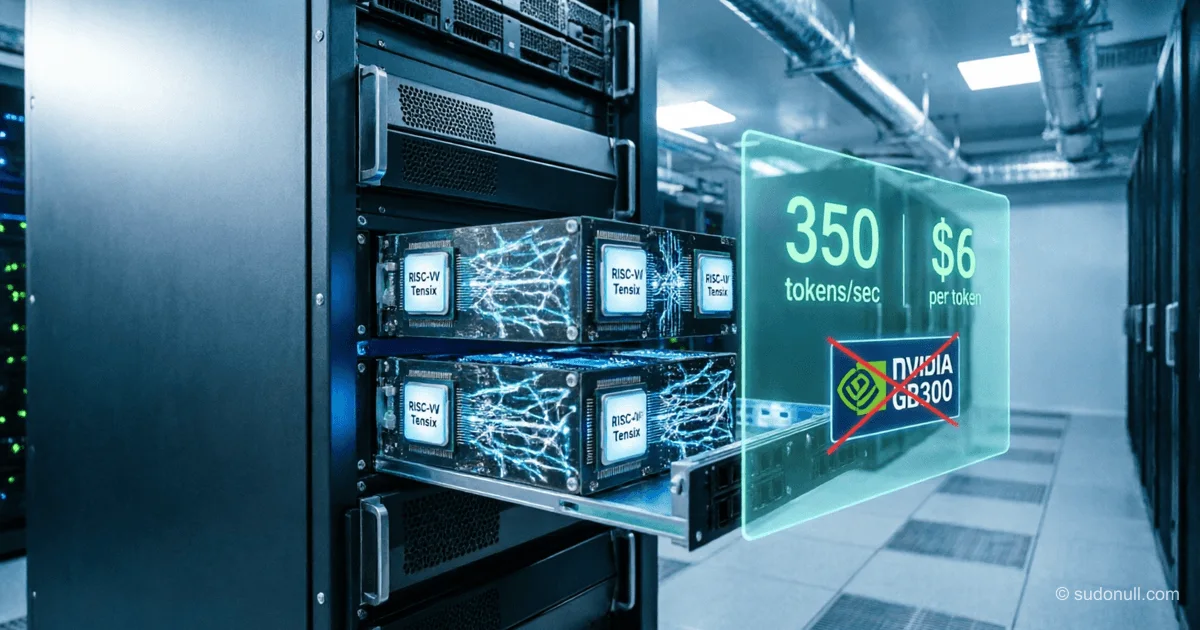
Tenstorrent Shows Its RISC-V Galaxy Blackhole Server Outperforms Nvidia GB300
Tenstorrent has demonstrated how its new Galaxy Blackhole server systems, built on the RISC-V architecture, can directly compete with and outperform Nvidia's most powerful GPUs, including the GB300 models, across several metrics.
RISC-V Challenges the Throne: How Tenstorrent's $110,000 Server Changes the Game Against Nvidia GB300
Introduction
For decades, one architecture and one manufacturer have dominated the AI accelerator market. Nvidia, with its GPUs and proprietary CUDA ecosystem, seemed to leave no room for real competition. However, on April 28, 2026, startup Tenstorrent, led by legendary chip architect Jim Keller, officially announced the availability of the Galaxy Blackhole platform—a server system based on the open RISC-V architecture that not only catches up to but surpasses Nvidia's latest GB300 solutions in several key metrics, with a fivefold advantage in total cost of ownership.
Event Details and Timeline
On April 27, 2026, during its online presentation TT-Deploy Live, Tenstorrent unveiled a full-stack AI infrastructure based on Galaxy Blackhole servers. Unlike traditional GPU accelerators connected to separate CPU hosts, Galaxy is a fully integrated system. Each server in a 6U chassis contains 32 Blackhole chips connected in a unified mesh network with an aggregated bandwidth of 100 Tbps. This entire package is priced starting at $110,000 for a single server and $440,000 for a basic supercluster of four servers.
The technical specs are impressive: 23 petaflops of performance in FP8 mode, 1 TB of GDDR6 memory with 16 TB/s bandwidth, 6.2 GB of on-chip SRAM with a fantastic 2.9 PB/s speed, and 56 ports of 800G Ethernet for scaling. At the heart of the system is the Blackhole chip based on Tensix cores, each containing five RISC-V processors with matrix multipliers, vector units, and local SRAM.
But the real sensation is not the hardware itself, but the software-hardware performance that Tenstorrent demonstrated live. The company ran the large language model DeepSeek-R1-0528 671B—one of the most complex MoE models today—and showed results that are hard to describe as anything but provocative.
Impact and Significance
Tenstorrent struck first at the most sensitive metric: inference performance. In Blitz Mode, optimized for latency-sensitive tasks, Galaxy Blackhole delivers up to 350 tokens per second per user. This is enough to outperform not only traditional GPU systems but also specialized inference platforms from Groq and Cerebras. Moreover, the system processes a 100k context and outputs the first token in under 4 seconds—equivalent to comprehending 166 pages of text almost instantly.
The second front is cost. Tenstorrent claims that the cost per token on Galaxy is about $6 compared to roughly $30 for competitors on GPUs, including GB300. In terms of total cost of ownership, this translates to an advantage of up to five times. And this comes with a server price of $110,000—three to five times lower than Nvidia's eight-accelerator DGX systems.
The third area is video generation. Galaxy Blackhole generates a 5-second video of 81 frames at 720p resolution in 2.4 seconds—faster than real time. Tenstorrent claims a tenfold advantage over GPU solutions in this class of tasks. This opens the door to cost-effective industrial-scale video generation applications, from film production to simulations.
The significance goes beyond mere benchmarks. RISC-V is an open architecture with no licensing fees, unlike x86 (Intel/AMD) and ARM. If the Tenstorrent ecosystem proves mature, the AI industry will gain its first truly accessible path to reducing monopoly dependence on Nvidia. "Ninety percent of models from Hugging Face just work on Tenstorrent," the company claims, hinting that the software compatibility problem that has killed many competitors is being solved.
Reactions from Key Players
Jim Keller did not mince words during the presentation: "We will crush everyone in everything, including AI." This is not just bravado. Keller is the architect behind AMD Zen, Apple's A4/A5 chips, and Tesla's autonomous driving system, and his words carry weight.
Nvidia has not officially commented on Tenstorrent's direct challenge, but data from independent analysts SemiAnalysis and Signal65, published in February-March 2026, shows that the GB300 NVL72 has achieved a 50x performance increase and a 35x reduction in cost per token compared to the previous Hopper generation. Major cloud providers—Microsoft, CoreWeave, Oracle Cloud Infrastructure—are already deploying GB300 NVL72 in data centers for low-latency and long-context scenarios, such as agentic coding.
Industry analysts are cautious, noting that Tenstorrent has not disclosed the batch size in its benchmarks—a critical scalability metric for production environments. It is one thing to serve a single user at 350 tokens per second, and quite another to maintain that speed for 64 parallel requests. Nevertheless, the fact remains: RISC-V has burst into the top tier of AI accelerators and made a compelling statement.
Forecast and Conclusions
Tenstorrent has executed a classic "end run" against Nvidia. Instead of a head-on attack on peak performance, the startup redefined the evaluation criteria: what matters is not so much peak FLOPS, but sustained throughput, memory efficiency, and scalability of the Ethernet network fabric—a technology familiar to every data center administrator.
The coming year will be critical. Galaxy Blackhole is already available for order and is being deployed by initial customers, including Cirrascale, Equinix, and Japanese provider ai&. If the software ecosystem, open from the TT-Forge compiler to the low-level SDK TT-Metalium, proves stable across a wide range of models, Tenstorrent has a chance to capture a significant share of the inference market.
The architectural choice of RISC-V also makes the platform attractive for organizations pursuing "sovereign AI": the open stack allows auditing every level from the model graph to core execution. In an era of tightening AI regulation, this advantage is hard to overstate.
Victory over Nvidia will not come quickly—Nvidia has a powerful ecosystem, a 50x efficiency gain in its new generation, and control over HBM memory supply chains. However, Tenstorrent has shown that architectural monopoly in AI accelerators is no longer a given. If the trend toward openness and lower token cost continues, the main beneficiary will be the consumer—from a startup testing a new model to a corporation deploying a production system. The era of democratized AI hardware appears to have begun.
— Editorial Team










No comments yet.