Russian Scientists Replace Gold Nanoparticles for Laser Cancer Treatment
Russian researchers have found a way to replace expensive gold nanoparticles used in photothermal cancer therapy with more affordable alternatives. This will make it possible to safely destroy tumors that are inoperable due to their proximity to vital organs.
Therapy without gold: how Russian physicists made cancer treatment more precise, affordable, and safer
Introduction
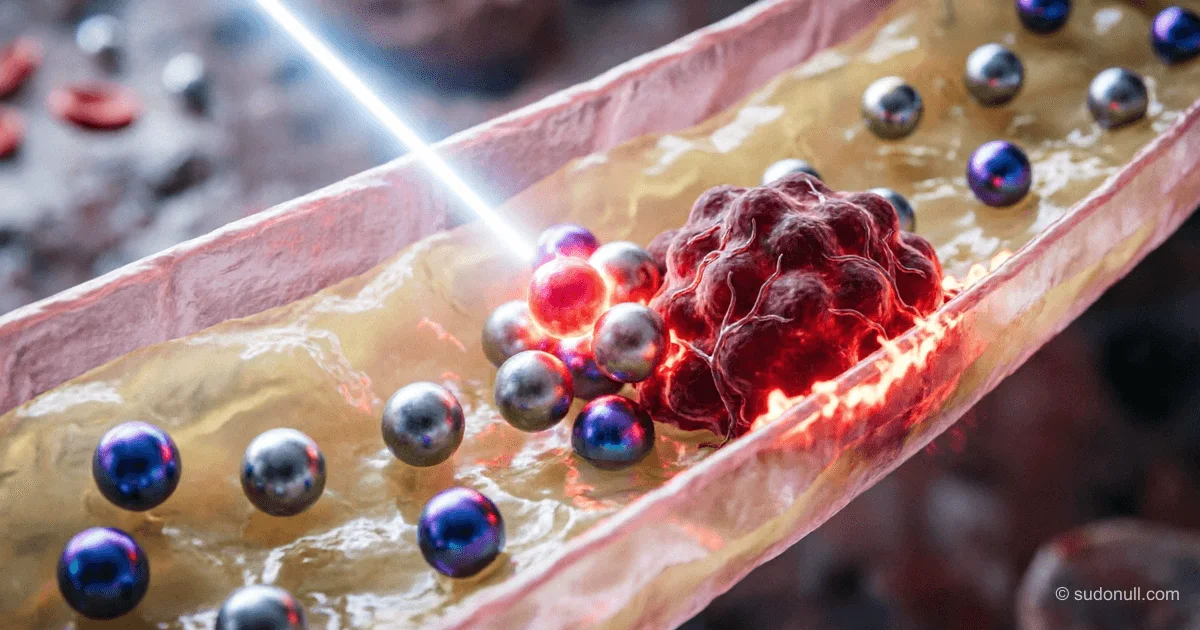
Imagine a tumor growing into the optic nerve or wrapping around the carotid artery. A surgeon cannot remove it without blinding the patient or triggering a stroke. Chemotherapy attacks the entire body indiscriminately, not distinguishing between healthy and diseased cells. In such cases, medicine turns to photothermal therapy—a method where nanoparticles are injected into the tumor, which heat up under laser irradiation and literally burn the cancer from within. It sounds like science fiction, but this approach is already used in clinics. The problem is that until recently, the "consumables" were gold and silver—expensive, unsafe with long-term accumulation, and requiring complex chemical processing. Russian scientists from Perm Polytechnic and the Moscow Center for Advanced Studies, together with colleagues from the UAE and France, found a solution: they created nanoparticles from tungsten diselenide and palladium diselenide, which turned out to be cheaper, safer, and more effective than gold ones.
Event Details and Timeline
The study, published in the journal Applied Surface Science, was the result of an international collaboration uniting physicists, chemists, and materials scientists from Russia, the United Arab Emirates, and France. A key role in the project was played by Professor Alexander Syuy, Doctor of Physical and Mathematical Sciences, from the Department of General Physics at Perm National Research Polytechnic University (PNRPU).
For the first time in the world, scientists synthesized spherical nanoparticles from transition metal dichalcogenides—tungsten diselenide and palladium diselenide—using ultrashort laser pulses. The duration of the flash used for synthesis is measured in femtoseconds—millionths of a billionth of a second. Crucially, the synthesis method is "clean": nanoparticles form directly in water, without adding toxic stabilizers typically required to prevent particle aggregation. Their own electric charge keeps the spheres separate, and their perfectly round shape allows them to circulate safely in the bloodstream and penetrate the leaky vascular walls of tumors.
The results are impressive. The efficiency of converting infrared radiation into heat reached 71% for tungsten-based particles and 81% for palladium-based particles. But the main finding is not in the efficiency numbers, but in the discovered "switch" effect. Two very similar materials behave fundamentally differently under laser irradiation. Tungsten diselenide heats up strictly at one wavelength (770 nm)—if the laser is detuned, heating almost stops. Palladium diselenide, on the other hand, absorbs light equally efficiently across a broad range from 650 to 950 nm. This gives the doctor an unprecedented choice: pinpoint heating for tumors near nerves and blood vessels, or broad heating for large neoplasms—all within the same technological platform.
Impact and Significance
The significance of this development extends far beyond a laboratory publication. It attacks three key limitations that have held back the spread of photothermal therapy for decades—and attacks them simultaneously.
Cost. Modern nanoparticles for photothermal therapy are mainly made of gold. The market for gold nanorods was estimated at about $185.9 million in 2024 and is growing at about 10% annually, largely due to oncology applications. Gold nanoshells cost about $200 per gram, with an annual production volume of about 300 kg. Tungsten is an industrial metal used in incandescent lamps; palladium is cheaper than gold. Replacing precious metals with more affordable compounds could radically reduce the cost of a therapeutic course, which today runs into thousands of dollars per procedure.
Toxicity. Gold is inert in bulk, but in nanoparticle form it oxidizes over time and releases ions that accumulate in the liver and spleen. Worse—to prevent nanoparticles from clumping in solution, they are coated with stabilizers, many of which are toxic to cells. Silver oxidizes even more actively than gold. The new nanoparticles are synthesized in pure water without any additional reagents—the problem of coating toxicity is completely eliminated.
Controllability. Gold heats only from the surface, so engineers have to give particles complex shapes—stars, spikes, rods. This complicates and increases production costs. The new materials heat throughout their entire volume, which not only increases efficiency but also makes the particles technologically simpler. And the ability to switch between pinpoint and broad heating simply by choosing a different material is a new quality entirely unavailable with gold prototypes.
For oncology, the practical significance is that tumors currently considered inoperable—those that have grown into vital structures—now have a realistic chance of treatment without damaging surrounding tissues. For the medical nanotechnology market, this means the emergence of an alternative to gold-oriented supply chains, which are currently controlled by a limited circle of precious metal producers.
Reactions of Key Players
Information about the development was officially disseminated through the press service of the Russian Ministry of Education and Science and picked up by major Russian media—Interfax, Argumenty i Fakty, Gazeta.Ru, Nauchnaya Rossiya. Publication in the peer-reviewed international journal Applied Surface Science ensured the results' legitimacy in the global scientific community.
Professor Alexander Syuy himself, in comments to the press, emphasized the key advantage of the method: "This is a big advantage over gold and silver particles, which have to be coated with toxic substances to prevent them from sticking together. And the spherical shape was chosen for a reason: unlike sharp fragments or flat flakes, spheres travel safely through the bloodstream and easily penetrate the tumor without damaging healthy tissue."
International co-authorship—researchers from the UAE and France—further strengthens the credibility of the results. Such collaboration reduces the risk that the development will be perceived solely as a local project and opens the door to further joint clinical trials in different jurisdictions.
At the same time, it is worth noting that interest in laser synthesis of nanoparticles for biomedicine is not isolated. At MEPhI, work is also underway to create "super-contrast" nanoparticles for MRI and CT diagnostics, as well as radiosensitizers for radiation therapy—all using femtosecond lasers. A whole direction is emerging in which Russian scientific schools have serious competencies.
Forecast and Conclusions
The development is still at the laboratory research stage, and this is important to emphasize. A long path lies ahead before clinical application: preclinical trials on animals, then phases of clinical trials on humans, and obtaining regulatory approvals. Experience shows that this process takes from 5 to 10 years even under an optimistic scenario.
However, the direction is clearly set. Photothermal therapy is ceasing to be a niche, expensive procedure and is beginning to move toward mass accessibility. When industrial materials synthesized in water with a single laser flash are proposed instead of gold with its volatility and growing demand (the market is growing by 10% per year), the economic equation changes dramatically.
The discovered "switch" effect—changing the type of heating simply by replacing the material—seems particularly promising. In the future, this could lead to the creation of a whole palette of nanoparticles with predetermined optical properties, tailored to a specific anatomical situation—personalized nanomedicine in the truest sense.
The main challenge is scaling. Femtosecond laser synthesis produces ideal particles of laboratory quality, but whether the technology can produce them in volumes sufficient for clinical practice while maintaining low cost remains an open question. Nevertheless, the international team and publication in a high-ranking journal give reason to believe that the project will receive the resources needed to answer this question.
Russian science has once again made its mark in a field combining physics, materials science, and medicine—and has proposed a solution that could make cancer treatment not only more effective but also significantly more affordable for patients worldwide.
— Editorial Team










No comments yet.