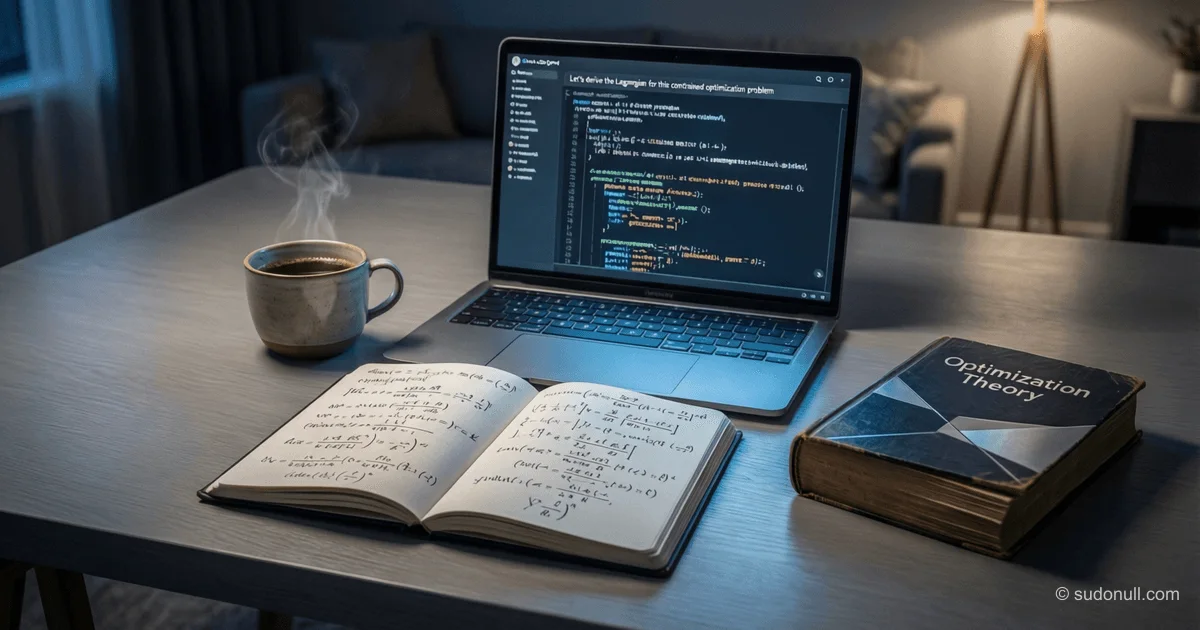
OpenAI Mathematical Breakthrough: AI Solves 42-Year-Old Scientific Problem in 12 Hours
OpenAI reports that researchers used ChatGPT to solve a mathematical problem that had remained unsolved for 42 years in just 12 hours, marking a significant step toward AI capable of conducting long-term research at a human level.
AI Revolution in Science: How ChatGPT Solved a 42-Year-Old Mathematical Problem in 12 Hours
Introduction
In April 2026, an event occurred that could become a turning point in the history of scientific research. A problem that had stumped mathematicians for 42 years was solved in 12 hours. The tool that achieved this breakthrough was not a new supercomputer architecture or a brilliant mathematician, but a human conversation with ChatGPT.
This achievement goes far beyond academic curiosity. For the first time, a large language model demonstrated the ability to engage in sustained, coherent, and productive reasoning at the level required for real research work. While AI was previously seen as a tool for information retrieval or generating simple answers, it is now beginning to act as a full-fledged scientific partner. This article analyzes the details of this event, its significance for the world of science and technology, the reactions of key industry players, and predictions for the future.
Event Details and Timeline
The Problem That Had Remained Unsolved for 42 Years
At the heart of the story is a problem in optimization theory related to the convergence of a classical algorithm. For over four decades, mathematicians had unsuccessfully attempted to prove certain properties of this algorithm, which is fundamental to machine learning, signal processing, and economics. The problem was well known in narrow circles but was considered extremely difficult and resistant to existing methods.
The 12-Hour Dialogue: How It Happened
The key figure in the event is Ernest Ryu, a senior researcher at OpenAI. In a company podcast, he described a three-day process that took a total of about 12 hours of pure interaction time with ChatGPT. The workflow was radically different from typical chatbot use:
- Iterative Nature of Work: Ryu did not ask a question and receive an instant answer. Instead, he engaged in a dialogue with the model, constantly pointing out errors, refining the direction of reasoning, and adjusting the approach.
- Navigating a Maze: Ryu compared the process to navigating a maze, where at each turn you need to evaluate a hypothesis, test its validity, and either move forward or backtrack. He acted as the captain who "holds the map" (overall strategy), while the model generated dozens of possible paths and intermediate steps.
- The Decisive Moment: On the third day of work, the model made a small but critically important change in its reasoning. As Ryu noted, the new argument "looked different." It was this "different" direction that broke the logical deadlock and completed the proof.
After the proof was obtained, Ryu personally verified it several times, then asked students to double-check every step. All tests confirmed the absolute correctness of the result.
Impact and Significance
For the Scientific World: A Shift from Tool to Participant
This event marks a paradigm shift in understanding the role of AI in science. Just two years ago, models often made mistakes in simple arithmetic tasks or schedule planning. Today, they are participating in solving research-level problems.
According to OpenAI's report "AI as a Research Scientist," scientists' use of ChatGPT differs dramatically from that of the average user. The average scientist writes 3.5 times more messages, and the number of queries related to programming and debugging exceeds typical rates by 12 times. This indicates deep integration of AI into the workflow: from searching for ideas in the literature to generating code for simulations and mathematical derivations.
For Industry and Technology: What Lies Behind the Breakthrough
Skeptics might ask: isn't this just a lucky coincidence or an exaggeration? However, analysis of the method reveals a fundamental technological shift.
According to Sébastien Bubeck, a researcher at OpenAI, the main breakthrough is not that the model became "smarter" at a single moment, but in its ability to maintain sustained and coherent reasoning. Previous models worked well with short chains of thought (Chain-of-Thought), but "lost the thread" on complex, multi-step tasks.
Modern systems, including those used by Ryu, are capable of:
- Metacognition: The model can evaluate its own intermediate conclusions and revisit them if it finds an error.
- Search and Synthesis: By generating code, formulas, and text blocks, AI can access "external memory" (dialogue context or files) to avoid losing important details.
For Society: Accelerating Scientific Progress
OpenAI's predictions, voiced by Vice President of Science Kevin Weil, sound ambitious but are taking concrete shape: "achieving the level of scientific development of 2050 by 2030."
Practical examples already extend beyond mathematics:
- Physics: Theorist Alex Lupsasca spent months deriving equations for quantum black holes. GPT-5 Pro reproduced the same result in 18 minutes.
- Biology: In collaboration with RetroBioSciences, OpenAI created a specialized model, GPT-4B Micro, which designed new proteins for cell rejuvenation, outperforming the best manual designs.
For society, this means potential acceleration in the development of cancer drugs, creation of sustainable materials, and solving climate problems by orders of magnitude faster.
Reactions of Key Players
The reaction from the scientific and technological community was mixed: from euphoria to harsh criticism, highlighting the complexity of the moment.
The mathematical community expressed both admiration and concern. When OpenAI claimed to have solved 15 unsolved Erdős problems, it turned out that in some cases the model did not so much "solve" them as find forgotten solutions in archives from 20 years ago. Renowned mathematician Terence Tao noted that "many of the simple Erdős problems are now more likely to be solved by AI methods than by human ones." At the same time, he warned about the "industrialization of mathematics," where AI acts as a powerful but oversight-needing assistant.
OpenAI's competitors reacted sharply. Demis Hassabis, head of Google DeepMind, called OpenAI's loud but insufficiently verified claim about a record number of solved problems "shameful." This underscores the high stakes in the race to create "scientific AGI" and the unacceptability of communication errors.
The academic community is initiating institutionalization. In the US, the "Genesis" mission has been launched—a government program to create a unified AI platform for scientific discovery, combining national laboratories, universities, and data centers. This means AI in science is no longer a toy for private corporations but becomes a matter of national competitiveness.
Predictions and Conclusions
Solving a 42-year-old problem in 12 hours is not the final point, but only the beginning of a new era. It demonstrates that we have entered a phase where AI is capable not only of processing information but also of generating new knowledge in dialogue with humans.
However, the future will not be cloudless. OpenAI's research has shown that AI hallucinations are mathematically inevitable. The model will always generate incorrect data with some probability. Completely eliminating hallucinations would make AI too slow and uncertain for mass use. Therefore, the human-in-the-loop principle will remain in science. The scientist's role shifts from routine equation solving to problem formulation, result verification, and direction selection.
Conclusions:
- AI is becoming a research scientist, not just a search engine. It is penetrating the very heart of the creative process—mathematical proof.
- Requirements for scientists are changing. Key skills become critical thinking and the art of "prompting" (the ability to ask the right questions to the model).
- Acceleration awaits us. Decades of scientific progress could be compressed into years, but ultimate responsibility for truth and research direction will remain with humans.
Ernest Ryu himself, impressed by the result, left his academic position and joined OpenAI to develop synthetic data for training models. His story is the best proof that technology is changing not only tools but also the life trajectories of people leading science forward.
— Editorial Team








No comments yet.