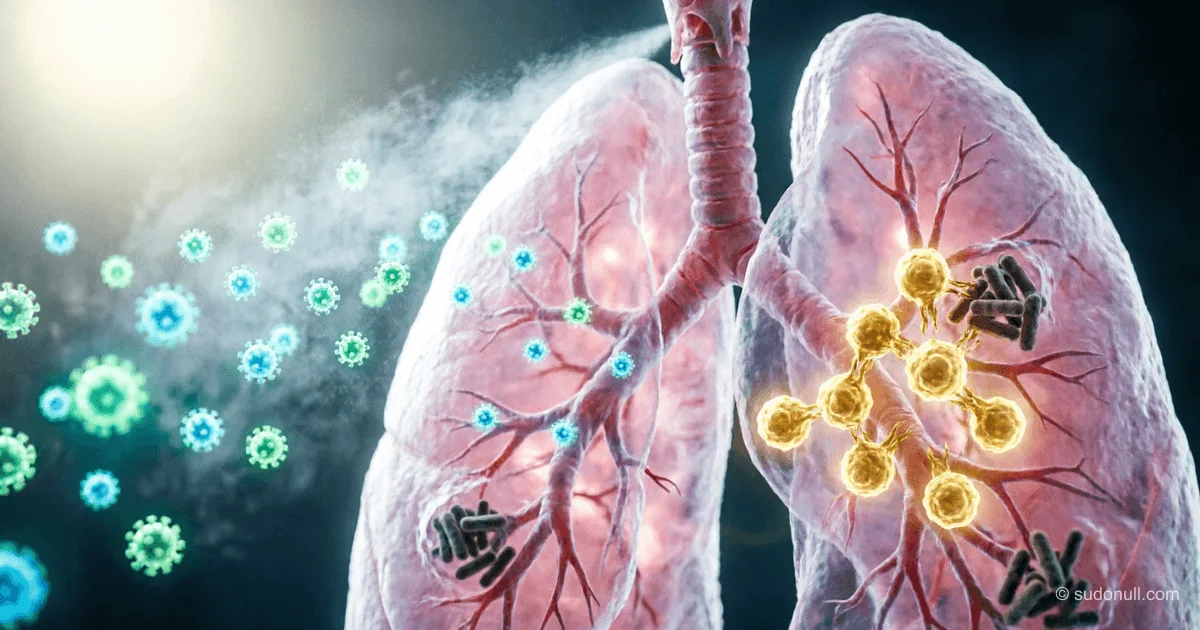
Johns Hopkins Scientists Develop Nasal TB Vaccine That Accelerates Recovery
An innovative DNA vaccine (Mip3α/relMtb) administered through the nose, combined with antibiotics, helped mice clear lung infections faster. The vaccine also enhanced the effectiveness of drugs against drug-resistant tuberculosis and elicited a durable immune response in primates.
Introduction: A New Strategy in the War Against the "Silent Killer"
Tuberculosis remains one of the deadliest infections in human history. According to the World Health Organization, about a quarter of the world's population—approximately 2 billion people—are carriers of the latent form of the disease. In 2024, over 10 million people fell ill with active tuberculosis, and 1.2 million died, making TB the leading cause of death from a single infectious disease worldwide.
The main challenge of modern therapy is not so much eliminating actively multiplying bacteria as combating so-called "persisters": mycobacteria that enter a "dormant," drug-tolerant state and can cause relapse months or years after seemingly successful treatment. Traditional antibiotics are powerless against these elusive targets.
In late March 2026, researchers from Johns Hopkins Medicine and the Bloomberg School of Public Health at Johns Hopkins University published in the Journal of Clinical Investigation the results of developing an innovative therapeutic DNA vaccine, Mip3α/relMtb, administered through the nose, capable of destroying these persisting bacteria.
Event Details and Timeline
Publication of the Study
On March 31–April 1, 2026, an article led by Dr. Styliani Karanika from the Johns Hopkins University Center for Tuberculosis Research was published in the Journal of Clinical Investigation (JCI). The work was supported by grants from the US National Institutes of Health (NIH) and several private foundations.
Vaccine Design: Fusion of Two Genes
The key innovation is a hybrid DNA vaccine combining two genes with different but complementary functions.
The first component—relMtb—is taken from the Mycobacterium tuberculosis bacterium itself. This gene encodes the RelMtb protein, which the mycobacterium uses to survive adverse conditions: exposure to antibiotics, low oxygen, or nutrient limitation. Paradoxically, the very mechanism that allows the bacterium to enter a "dormant" state was used as a "beacon" for the immune system.
The second component—Mip3α (also known as CCL20)—is a gene encoding a chemokine that attracts immature dendritic cells—key coordinators of the immune response. Dendritic cells capture pathogen proteins, "present" them to T cells, triggering a targeted attack on the bacteria.
The fusion of these two genes creates a dual effect: it attracts professional antigen-presenting cells precisely where the bacteria are located and "teaches" them to recognize the most resilient forms of the pathogen.
Intranasal Route of Administration
The vaccine is administered through the nose—this route was chosen deliberately. Tuberculosis is a respiratory infection, and intranasal delivery focuses the immune response directly in the respiratory tract and lung mucosa, generating both local (mucosal) and systemic immunity. This is a fundamental difference from the intramuscular administration of the traditional BCG vaccine, which does not provide reliable protection of lung tissue.
Results in Mouse Models
In experiments on immunocompetent mice, the vaccine in combination with standard first-line therapy showed:
- Accelerated bacterial clearance from the lungs compared to controls;
- Reduced lung inflammation;
- No relapse after treatment completion.
Particularly important was that the vaccine enhanced the effect of the "heavy artillery"—the combination of bedaquiline, pretomanid, and linezolid used to treat drug-resistant forms of tuberculosis.
Vaccination led to increased recruitment and activation of dendritic cells, improved their spatial organization with T cells in the lungs, and generated durable RelMtb-stimulated responses from both CD4+ T helper cells and CD8+ T killer cells.
Primate Data—Gold Standard of Preclinical Testing
A critical step was testing in rhesus macaques, whose immune system is closest to humans. The vaccine elicited measurable and durable (at least six months) T-cell responses against tuberculosis, both in blood and bronchoalveolar lavage fluid.
An important limitation: these experiments measured only immune activation, not protection against actual infection. Nevertheless, as Dr. Karanika emphasizes, "these data provide an important translational bridge between efficacy studies in mice and the additional preclinical work needed before human trials."
Impact and Significance (for the World/Industry/Society)
For Patients and Healthcare Systems
Current tuberculosis treatment requires months of multiple antibiotics, leading to adherence problems and promoting resistant strains. If the vaccine proves effective in humans, it could:
- significantly shorten treatment duration;
- reduce the risk of relapse;
- improve the effectiveness of therapy for drug-resistant forms.
Paradigm Shift: From Antibiotics to Immunotherapy
The fundamental novelty of the approach is shifting focus from purely antibacterial therapy to enhancing the patient's own immunity against persisting forms of the pathogen. As the authors note, their results "support a broader strategy to combat TB persisters through immunotherapy rather than relying exclusively on antibiotics to kill actively replicating bacteria."
Platform Technology for Other Infections
DNA vaccines have several practical advantages: they are relatively stable, do not require a complex cold chain, and can be produced more quickly than traditional protein vaccines. If successful, this approach could be extended to other chronic infections involving persisting bacterial forms.
Reactions of Key Players
Scientific Community
Publication in the Journal of Clinical Investigation—one of the most prestigious journals in translational research—is itself a mark of recognition. The accompanying JCI podcast featuring an interview with Dr. Karanika was released on April 10, 2026. The study attracted attention from both specialized and mainstream science media in France, Kazakhstan, Russia, and China, reflecting global interest.
WHO Position
Importantly, the development was in response to the WHO's direct call for therapeutic vaccines that can be used alongside drug therapy to shorten treatment courses and improve outcomes.
Funding Organizations
The project was supported primarily by federal funding (NIH grants) as well as several foundations, including the Gilead HIV Research Scholar Award and the Willowcraft Foundation. The absence of a major industry sponsor at this stage indicates that the development is at an early stage, supported by government and academic institutions.
Forecast and Conclusions
Limitations of the Current Stage
It is important to emphasize that the work is at the preclinical stage. As Dr. Karanika directly states, "additional research is needed before clinical trials in humans can be approved." In primates, only immune activation was measured, not protection against infection, leaving the question of real-world efficacy open.
What's Next?
Next steps should include:
- Primate studies with lethal challenge to confirm protective efficacy.
- Toxicology studies to assess safety.
- Phase I clinical trials in healthy volunteers.
Even in the most favorable scenario, it could be years before the vaccine reaches clinical practice.
Potential Role in Therapy
If efficacy is confirmed, the vaccine will likely be used not as monotherapy but as an adjuvant to standard antibiotics—to accelerate elimination of persisters and prevent relapse. This is especially relevant for:
- patients with multidrug-resistant and extensively drug-resistant TB (MDR/XDR-TB);
- HIV-coinfected individuals (with caution, given contraindications to BCG);
- contacts from high-risk groups.
Conclusions
The Johns Hopkins team's development is not just another vaccine candidate. It is a fundamentally new approach that attacks tuberculosis's Achilles' heel—its ability to "sleep" and wake up years later. By using the bacterium's own evolutionary mechanism against itself (the relMtb gene) and delivering the vaccine directly through the respiratory tract, the researchers have created a tool that can complement antibiotics where they are powerless.
It is too early to declare victory over tuberculosis. But this step is one of the most promising in recent decades. And if subsequent stages confirm success, humanity will for the first time have a therapeutic vaccine capable not only of preventing but also of "finishing off" what antibiotics failed to eliminate. That means millions of lives saved and a real chance to eliminate tuberculosis as a global threat.
— Editorial Team









No comments yet.