DARPA Selects Three Companies to Develop Mission for Ice Detection on Low Lunar Orbit
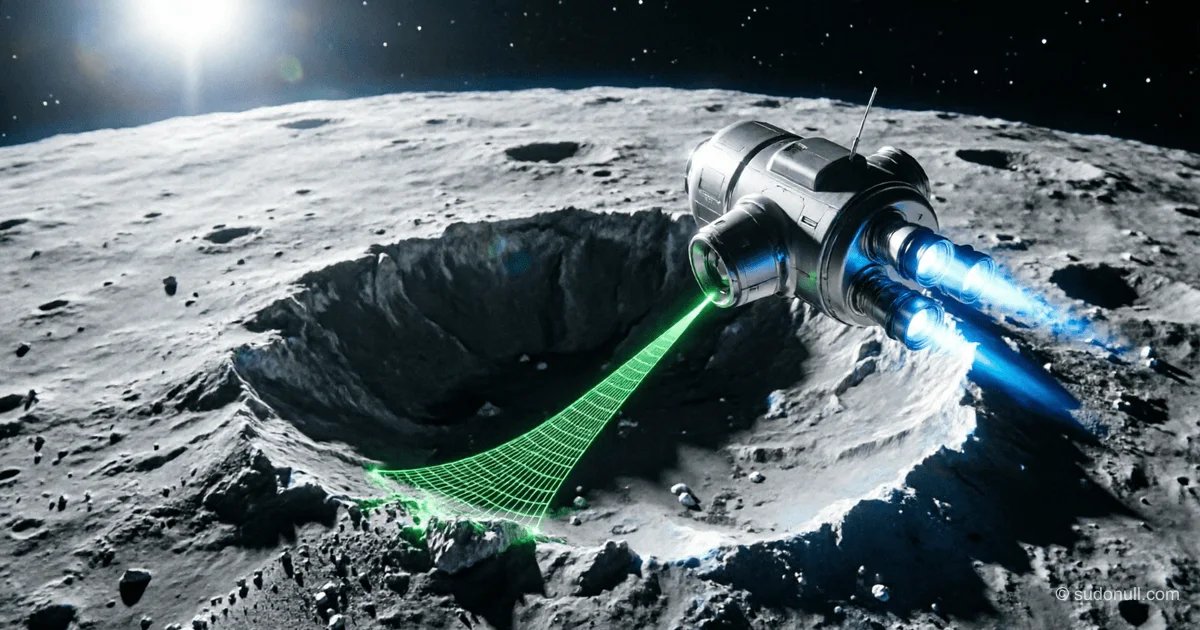
The US Defense Advanced Research Projects Agency (DARPA) has selected three contractor companies to build spacecraft that will search for and map water ice on record-low lunar orbits.
Lunar resource hunt: Why DARPA is sending satellites to a deadly orbit in search of water
Introduction
On April 30, 2026, the US defense agency DARPA announced contracts to three companies for developing a mission to find water ice on the Moon. The program, named LASSO (Lunar Assay via Small Satellite Orbiter), involves building small satellites capable of operating on extremely low orbits—a regime that most spacecraft simply do not survive. The stakes are high: found ice could become fuel for future lunar bases and interplanetary missions, and the maneuvering technologies developed during the program will benefit the Pentagon for operations in cislunar space.
Event Details and Timeline
The LASSO program was announced by DARPA last year, and on April 30, 2026, an agency representative confirmed the selection of three contractors for the first phase: Benchmark Space Systems, Quantum Space, and Revolution Space. The contracts follow a phased structure: Phase 1A is a six-month concept study, Phase 1B is an 18-month phase advancing the project to a critical design review. This may be followed by Phase 2, involving actual construction and launch of the spacecraft.
The technical requirements for the LASSO program are exceptionally challenging. The spacecraft must operate on a very low lunar orbit while simultaneously mapping areas where water ice concentration exceeds 5%. This figure is not arbitrary: according to experts, 5% is the threshold below which the energy and infrastructure costs of extraction exceed any reasonable economic return. Data previously obtained by the Lunar Reconnaissance Orbiter (LRO) showed that hydrogen (an indicator of water) is unevenly distributed across polar regions, with higher concentrations on slopes facing the poles, where permanent shadow protects volatiles from evaporation.
Program participants have already revealed some details of their proposals. Benchmark Space Systems, previously known as a propulsion system supplier, presented an architecture called Sapphire. The project combines chemical and electric engines with terrain-relative navigation and collision avoidance systems. For Benchmark, this is a strategic move—an attempt to transition from a component supplier to a prime contractor for complex space missions.
Quantum Space is betting on the Ranger platform, which is already under development. The company last year acquired assets of Phase Four, a startup specializing in hybrid chemical-electric engines, which now appears as a targeted preparation for LASSO requirements. Quantum Space's President and CEO Kerry Wisnosky emphasized that the contract reflects the growing importance of cislunar space for US national security.
The third participant, Revolution Space, has not yet disclosed details of its project.
The technical complexity of the mission stems from the physics of low lunar orbits. The Moon's gravitational field is extremely uneven due to mass concentrations beneath the lunar maria, and these anomalies perturb low-altitude spacecraft on timescales of weeks. Without active orbit correction, the satellite will either rise, deviate from course, or crash into the surface. Sustained operation requires high fuel efficiency and autonomy to respond to perturbations faster than ground operators can.
Impact and Significance
The LASSO program is important across several dimensions—scientific, economic, and military. Scientific data obtained during the mission is planned to be shared with both NASA and commercial operators. For Artemis, NASA's program to return humans to the Moon, a precise map of water ice is critically necessary: water is not only a drinking resource but also potential raw material for producing rocket fuel and oxygen.
The economic aspect relates to the 5% threshold. If a satellite can only detect ice at 20% concentration, it will miss most real deposits. A spacecraft capable of distinguishing 5% deposits with spatial resolution achievable only from ultra-low orbits creates a map suitable for practical use.
From a national security perspective, LASSO is part of a broader DARPA strategy for cislunar space, including the nuclear thermal engine program DRACO and a series of studies under the 10-Year Lunar Architecture. The common theme is maneuverability. The space volume between Earth and the Moon is vast, slow to traverse, and becoming increasingly competitive. Spacecraft that can efficiently change orbits, operate close to surfaces, and act without constant intervention from Earth are a prerequisite for any military operations beyond geosynchronous orbit.
There is also an international context. China's Chang'e-7 mission also aims to search for lunar resources, and the data it collects could influence the geopolitics of lunar resource claims. Thus, LASSO is also an element of the space race for control over strategic assets.
Reactions of Key Players
The contractor companies view the contracts as an important opportunity to strengthen their positions in the rapidly growing sector. Benchmark Space Systems called the contract a significant milestone on the path to sustainable operations on ultra-low lunar orbit. Quantum Space linked the win to the growing importance of the cislunar domain for US national security.
Industry analysts note that DARPA will likely use Phase 1 to identify the strongest architecture and quietly phase out the other participants. This is standard agency practice—funding competing concepts at an early stage to then focus on the most viable option. Phase 1A will conclude around the end of 2026, and critical design reviews under Phase 1B are expected in 2027–2028.
Experts also highlight the engineering complexity of the task. The main challenge is not just engines, but the combination of engines, autonomous navigation, and onboard decision-making algorithms. At ultra-low altitudes, the signal travel time from Earth is still significant compared to the timescale on which the satellite must respond to a gravitational perturbation or terrain feature. The spacecraft must manage itself.
Forecast and Conclusions
The LASSO program is in its early stages, but its significance extends far beyond a single demonstrator. If the project succeeds, it will lay the foundation for a whole class of low-altitude lunar mappers capable of detailed surveying of the Moon's resource potential.
Over the next six months, three companies will develop competing concepts, and then over 18 months, advance them to the level of critical design review. Not all contractors will reach the construction stage, but the selection process itself will allow DARPA to identify the most promising architectures for sustained operation in extreme orbital conditions.
The main question is whether LASSO can create not just one demonstration spacecraft, but a whole line of lunar scouts that make routine what is today considered nearly impossible: stable operation on orbits where the Moon's gravity tries to destroy the satellite every few weeks. If the program works, the spacecraft itself will be less interesting than the capabilities it will unlock for future missions—from resource extraction to military operations in cislunar space.
— Editorial Team










No comments yet.