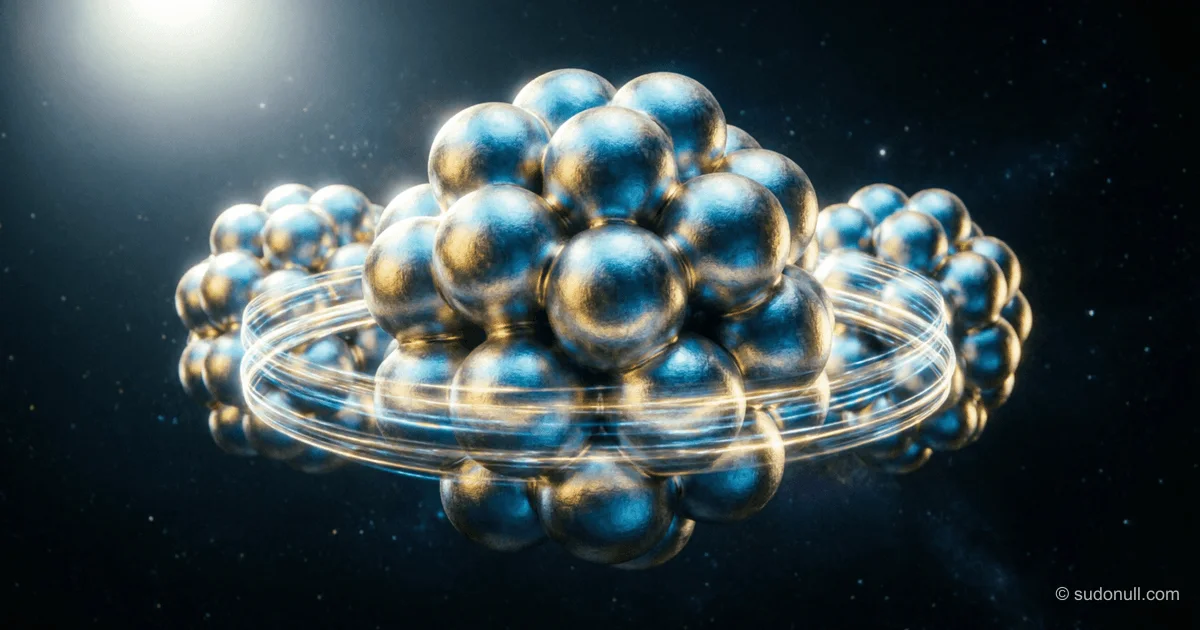
Breakthrough in Quantum Computing: 'Giant Superatoms'
Scientists at Chalmers University of Technology have proposed a new 'giant superatom' concept, merging two approaches to tackle the decoherence problem, enabling the preservation of quantum entanglement and lossless information transfer.
«Giant Superatoms»: A New Toolkit for a Quantum Future
Introduction
Quantum computers promise a revolution in drug discovery, cryptography, and artificial intelligence, but they have an Achilles' heel—decoherence. Quantum bits, or qubits, are so fragile that even minuscule electromagnetic interference can destroy their mysterious states, turning a supremely powerful computational tool into a useless collection of ordinary bits.
In February 2026, researchers at Chalmers University of Technology (Sweden) proposed an elegant theoretical solution to this fundamental problem. By merging two previously independent concepts in quantum physics—'giant atoms' and 'superatoms'—they created a theoretical model of 'giant superatoms'. This new construct not only suppresses decoherence but also opens avenues for creating entangled states over large distances, which is considered the key to truly scalable quantum systems.
This work, published in the prestigious journal Physical Review Letters, is not just another scientific paper but, in the words of the authors themselves, a new "toolkit" for the engineers of the future.
Event Details and Chronology
The concept of 'giant atoms' was first proposed by Chalmers scientists over a decade ago and has since become a standard term in this field of physics. The idea was to create an artificial atom—a qubit—that couples to a light or sound wave at multiple, physically separated points, rather than just one.
However, this technology had a significant drawback: giant atoms were poorly suited for creating quantum entanglement—the phenomenon where multiple qubits share a single state and operate as a coordinated system.
Researchers from Chalmers, including Lei Du, Anton Frisk Kockum, and Janine Splettstoesser, proposed combining giant atoms with the concept of superatoms—groups of ordinary atoms that collectively behave like a single large artificial atom. Thus was born the idea of the 'giant superatom'—a complex quantum structure that combines the best properties of both approaches.
The key feature of such a system is the 'self-interaction' of waves leaving one connection point and returning to the atom at another point. Anton Frisk Kockum compares this effect to hearing the echo of your own voice before you have finished speaking. This 'memory of past interactions' reduces decoherence and allows quantum information to be preserved.
The researchers described two configurations for practical application:
- Dense Coupling — several giant superatoms are placed close together, allowing them to transfer quantum states without information loss.
- Remote Coupling — the atoms are far apart but connected in such a way that light or sound waves remain in phase, enabling directed transmission of quantum signals and the distribution of entanglement over large distances.
Impact and Significance
The significance of this work for the scientific world is difficult to overstate. "Giant superatoms open up completely new possibilities for controlling quantum information, enabling us to do what was previously extremely difficult or even impossible," said co-author Janine Splettstoesser.
For the quantum industry, this signals a practical path toward creating scalable systems. Previously, a key challenge was that as the number of qubits increases, the complexity of the control electronics grows exponentially. "A giant superatom can be thought of as many giant atoms working together as a single unit. This allows you to store and control quantum information from several qubits in one block, without the need for increasingly complex surrounding circuitry," explains Lei Du.
For society, the consequences are indirect but monumental. Stable quantum computers will be able to crack modern cryptosystems (necessitating the creation of post-quantum cryptography), simulate complex molecules for designing new drugs at unprecedented speeds, and solve optimization problems that are intractable even for the most powerful supercomputers.
Interestingly, the giant atoms created by scientists can reach sizes of several millimeters and be visible to the naked eye, while remaining fully-fledged quantum objects—vividly demonstrating just how bizarre quantum reality can be.
Reaction from Key Players
The Chalmers work was published in Physical Review Letters (PRL)—one of the most prestigious physics journals in the world, which in itself is a mark of high recognition from the scientific community.
The international press, including EurekAlert! (the science news portal of the American Association for the Advancement of Science) and Yahoo News, widely covered this achievement. Chinese state media, notably the "Science and Technology Daily" under the PRC Ministry of Science and Technology, also published detailed analytical pieces, signaling an acknowledgment of the work's importance even at the state level in a country actively investing in quantum technologies.
The Chalmers research community itself views this work as a major step forward. Anton Frisk Kockum highlights the growing interest in 'hybrid approaches', where different types of quantum systems work together: "Our research shows that smart engineering can reduce the need for increasingly complex hardware, and giant superatoms bring us one step closer to practically applicable quantum technology."
It is important to note that the authors themselves are not getting carried away with euphoria. They clearly state that the current work is purely theoretical, and the next stage is a transition to experimental realization.
Forecast and Conclusions
'Giant superatoms' represent a promising theoretical breakthrough, but not a panacea. The Chalmers team now plans to move from theory to the creation of a real quantum system. Despite the elegance of the proposed concept, enormous engineering work lies ahead.
Short-term forecast (1–3 years): Experimental verification of the concept under laboratory conditions. Likely, the creation of a prototype system with several giant superatoms, demonstrating the claimed properties.
Medium-term forecast (3–7 years): If experimental validation is successful, the beginning of development for the first quantum processors based on the new architecture. The possibility of integrating this technology with other quantum systems is of particular interest.
Long-term forecast (10+ years): The emergence of the first industrial prototypes of quantum computers using giant superatoms could shift the balance of power in the quantum technology race, where superconducting qubits from Google and IBM, trapped ions from IonQ, and photonic systems from Chinese researchers currently lead.
The main conclusion is this: the problem of decoherence long seemed like a fundamental limitation for quantum computing. The work of the Swedish scientists demonstrates that the nature of this problem can not only be circumvented but turned into an advantage, using the 'quantum echo' effect to create systems with memory. 'Giant superatoms' open up a completely new approach to protecting, controlling, and distributing quantum information. If this concept finds confirmation in experiment, it could become the missing link that transforms quantum computers from laboratory curiosities into practical, world-changing tools.
— Editorial Team










No comments yet.