AtkinsRéalis and Oxford Join Forces to Deploy 'Physical AI' in Nuclear Energy
Development of autonomous robots for inspection and maintenance of nuclear facilities aims to improve safety and efficiency at sites like Sellafield.
'Physical AI' in Nuclear Energy: How AtkinsRéalis and Oxford Are Changing the Safety Rules
Introduction
Nuclear energy has always walked a tightrope: it provides humanity with nearly carbon-free power, but operates under conditions where human error or physical access become critical constraints. High-radiation zones, hard-to-reach areas, and the need to work in personal protective equipment all slow down maintenance and increase risks.
In April 2026, engineering and construction company AtkinsRéalis and the Oxford Robotics Institute (ORI) announced a strategic partnership that aims to radically change this situation. The focus is on large-scale deployment of what the partners call 'Physical AI' — systems combining simulation, machine perception, decision-making, and real-world validation so that robots can autonomously work in safety-critical environments.
The agreement builds on already successful trials at the Sellafield site — one of the world's most complex nuclear facilities — and aims to commercialize these technologies for international customers.
Event Details and Timeline
What Has Been Done: The Sellafield Experience
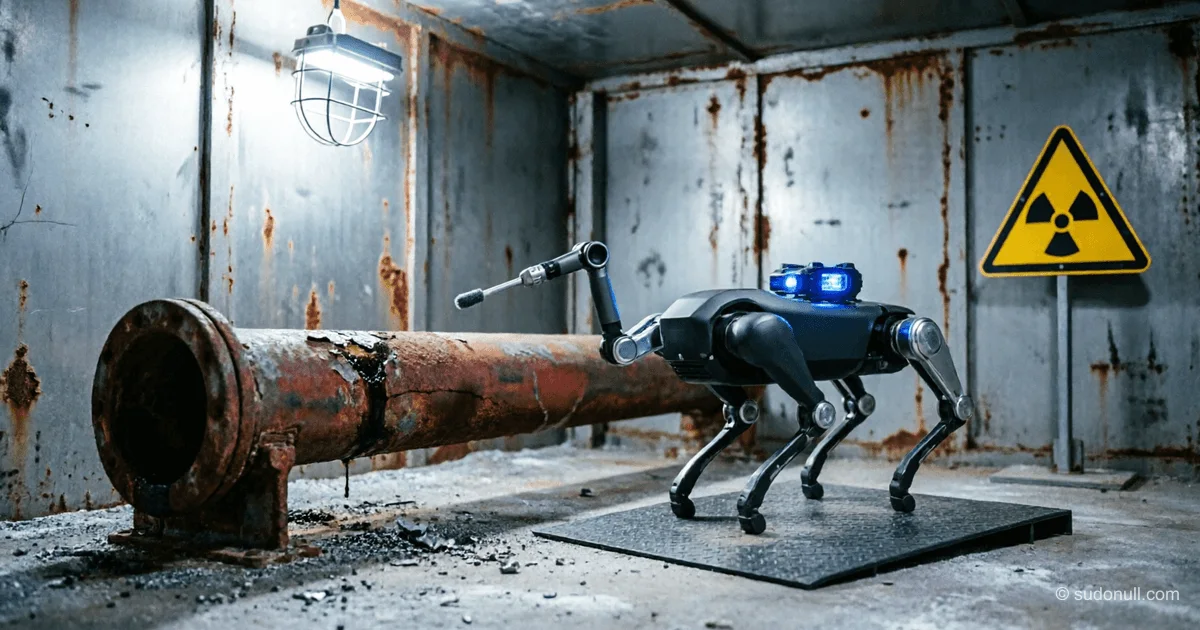
Sellafield in the UK is not just a nuclear plant; it is a massive decommissioning complex where radioactive waste has accumulated for decades. Working there is difficult and sometimes deadly. For several years, Sellafield Ltd has been actively deploying Boston Dynamics Spot robots (the famous 'robot dogs') for inspections, mapping, and radiological data collection. In 2025, a breakthrough was achieved in partnership with AtkinsRéalis: Spot was remotely operated from outside the licensed nuclear zone for the first time — the operator was many kilometers away from the hazardous site. And in early 2026, Sellafield successfully tested a robot with a manipulator for taking swabs from contaminated surfaces — a routine but potentially dangerous task for humans.
New Phase: From Demonstration to Product
The new agreement between AtkinsRéalis and ORI is a logical continuation of this work. Previously, Oxford systems had already been integrated into AtkinsRéalis platforms for autonomous navigation, mapping, and detection of radiation 'hot spots.' Now the partners intend to turn these proven solutions into ready-made products for international clients.
The process will be two-stage:
- Testing and refinement in ORI laboratories using 'digital twins' of nuclear facilities.
- Preparation for field trials and commercialization through AtkinsRéalis' engineering capabilities.
What Is 'Physical AI'?
Unlike conventional industrial robots programmed to repeat the same motions, Physical AI implies the ability to adapt. The robot must interpret changing lighting, navigate around unexpected obstacles, and make decisions in dark, smoky, or debris-filled rooms. Essentially, it is a combination of advanced perception (sensors, computer vision), simulation (digital twins), and real-world validation.
Impact and Significance
Reducing Human Risk
The primary goal of deploying robots in the nuclear sector is to remove people from hazardous areas. At sites like Sellafield or conventional nuclear power plants, inspections are often conducted in high-radiation environments where human exposure time is strictly limited. A robot can work there for hours, transmitting quality data without health risks. Additionally, the use of personal protective equipment (PPE) is reduced, thereby decreasing the volume of radioactive waste.
Increasing Efficiency
Physical AI can accelerate decommissioning processes. Robots can perform repetitive inspections with high precision, without fatigue or distraction. They collect real-time data that can be immediately integrated into digital 3D models (digital twins) for subsequent analysis by engineers.
International Scaling
The key word in the agreement is 'global.' AtkinsRéalis operates in nuclear markets of many countries (UK, Canada, China, Romania). The successful experience at Sellafield, where the system has already undergone a 'baptism by fire,' allows the company to offer reliable autonomous solutions worldwide.
Connection to the AI Boom
Paradoxically, the resurgence of interest in nuclear energy is partly driven by the development of artificial intelligence. Data centers for training large models consume enormous amounts of energy, and nuclear power is seen as a stable 'green' source. Now, the same AI technology is returning to the nuclear industry in the form of robots servicing these very reactors.
Reactions from Key Players
AtkinsRéalis: Pragmatism and Speed
'This partnership allows us to rapidly move autonomous robotics from research to operational deployment at nuclear power plants around the world,' said Sam Stevens, Head of Digital at AtkinsRéalis' Nuclear Division. The company has already built an entire ecosystem: collaboration with NVIDIA (simulation), Canadian manipulator manufacturer Kinova, and now Oxford (algorithms and testing).
Oxford Robotics Institute: Academic Foundation for Industry
Professor Nick Hawes, Director of ORI, sees this collaboration as a model for the future: 'Our partnership with AtkinsRéalis demonstrates how academic research transforms into practical solutions for the nuclear sector.' For the university, this is an opportunity to test its developments in real, extremely challenging conditions and receive feedback from industry.
Sellafield and RAICo: Living Laboratory
Sellafield Ltd acts not just as an observer but as an active participant and customer. Together with the RAICo collaboration (bringing together UKAEA, NDA, and universities), they have already tested the robot for swab sampling. 'Demonstrating that a quadruped robot can remotely deploy swab sampling equipment shows significant potential for improving safety and efficiency,' noted Deon Bulman from Sellafield.
Forecast and Conclusions
From One-off Demonstrations to Routine
In the next 1-2 years, we will see these systems transition from 'innovative trial' status to standard equipment at nuclear plants. The first public demonstrations are expected in the coming months.
Integration and Specialization
Robots will become not just 'eyes' (cameras) but also 'hands' (manipulators) for repair and maintenance. Remote control systems with haptic feedback will develop, as already tested in swab sampling.
Expansion to Other Industries
Although the starting point is nuclear energy, Physical AI technologies are universal. They can be applied in deep-sea mining, space, chemical disaster response — anywhere the environment is deadly for humans.
Conclusion
The signing of the agreement between AtkinsRéalis and the Oxford Robotics Institute is a significant step on the path from 'robots as toys' to 'robots as indispensable colleagues' in high-risk industries. Leveraging developments tested at one of the planet's most dangerous sites (Sellafield), the partners aim to make nuclear energy not only safer today but also technologically ready for the major renaissance the industry is experiencing in the era of rising AI energy consumption. This is a rare case where personnel safety goes hand in hand with economic efficiency.
— Editorial Team









No comments yet.