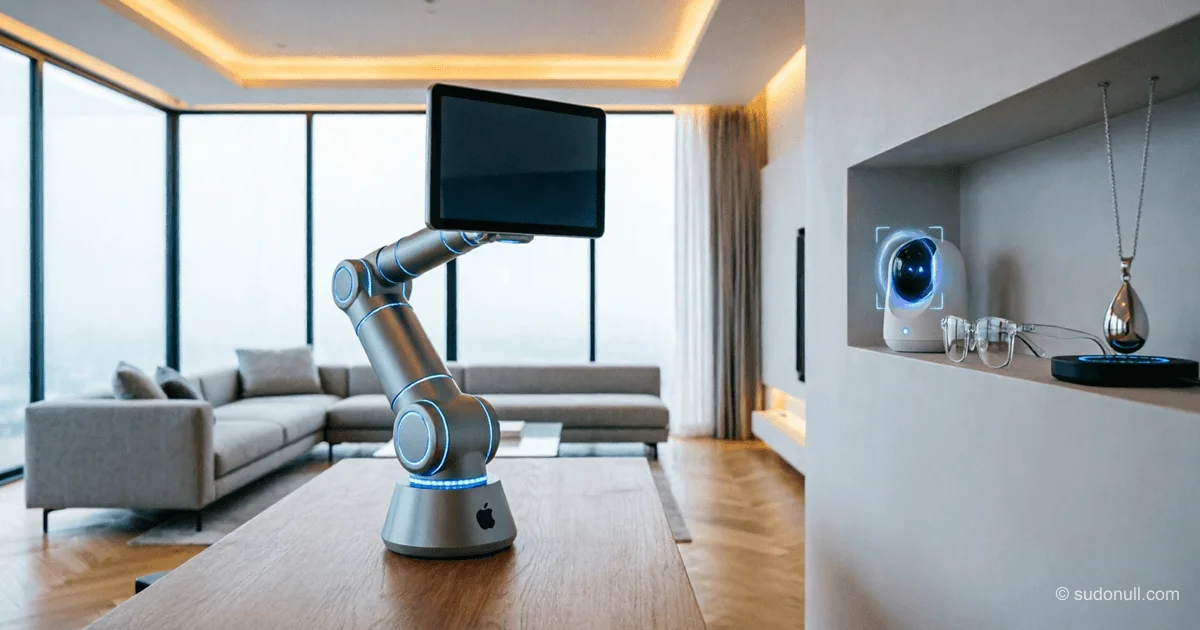
Apple is Working on Six New Product Categories, Including Smart Glasses and a Robot
According to Mark Gurman, the company is developing an AI headset, "smart" glasses, a wearable pendant, a "smart" camera, a home display, and a desktop robot. These devices aim to reduce the company's reliance on iPhone sales by expanding its ecosystem of wearable and home electronics.
Introduction: The Era of "Post-Innovation Stagnation" is Ending
For the past few years, Apple has often been accused of lacking new ideas. Since the launch of the Apple Watch in 2015, AirPods in 2016, and Vision Pro in 2024, Tim Cook's company hasn't introduced a single truly new product category. Against the backdrop of rapid AI and wearable device development by competitors, this began to look like a systemic problem.
In spring 2026, the situation changed dramatically. Renowned analyst Mark Gurman from Bloomberg reported that Apple is simultaneously developing six new product categories. This is not just an update of existing lines, but a strategic expansion of the ecosystem toward wearable electronics and smart home. And although rumors about individual devices have circulated for years, their appearance in a single list allows us to see the complete picture of how Apple envisions its future.
Most notably, this portfolio of new products coincides with a change in leadership: in 2026, John Ternus, the current head of hardware division, will become CEO. According to Ternus himself, Apple is "about to change the world."
Event Details and Timeline
What Exactly Apple is Developing
According to Mark Gurman, the six new product categories include:
| Product | Device Type | iPhone Dependency | Estimated Timeline |
|---------|---------------|----------------------|----------------------|
| AirPods with built-in cameras and AI | Wearable / Audio | Dependent | 2026-2027 |
| Smart Glasses (Apple Glasses) | Wearable / AR | Dependent | Late 2026 – Early 2027 |
| Wearable Pendant (Pendant) | Wearable / AI | Dependent | Not specified |
| Smart Display (HomePad) | Home Control Hub | Independent | Fall 2026 |
| Desktop Robot | Home / Robotics | Independent | 2027–2028 |
| Security Camera / Smart Doorbell | Home Security | Independent | 2026 |
Details of Key Devices
AirPods with AI and Cameras — perhaps the most unexpected item. The earbuds will feature low-resolution cameras that collect visual data about the surrounding environment. This information is fed into the AI system to provide contextual reminders and improved navigation.
Smart Glasses — a direct response to the success of Meta Ray-Ban. The device will use built-in cameras for media recording and data collection for AI. It is being developed in four frame variants, including a model similar to Tim Cook's glasses.
Wearable Pendant (Apple Pendant) — a device that can be worn around the neck or as a brooch. It is equipped with a computer vision system, but unlike the failed Humane AI Pin, it does not have a projection display. Essentially, it serves as "eyes and ears" for the iPhone, working through Siri.
HomePad — a smart display with a 7-inch screen, built-in speaker, and camera. It supports FaceTime and remote gesture control. It can be mounted on a stand or on a wall.
Desktop Robot — essentially a larger version of the HomePad with a 9-inch screen attached to a robotic arm. The screen can move, following the user or rotating to display content.
Security Camera — a device with Face ID support, capable of recognizing faces for automatic door unlocking. Apple aims to compete with Ring and Google Nest, emphasizing privacy.
It's important to note: Gurman highlighted these six categories as "major new directions," but Apple is simultaneously developing at least four more products: a foldable iPhone (expected fall 2026), a foldable iPad with a 20-inch screen, a MacBook with a touch screen, and full AR glasses (for 2028–2030).
Impact and Significance (for the World / Industry / Society)
For Apple: Reducing Dependence on iPhone
The iPhone remains Apple's core business: in the last reported quarter, it generated a record $85.2 billion in revenue. But any company whose well-being is tied to a single product is vulnerable. The smartphone market is saturated, and upgrade cycles are lengthening.
Apple's new strategy is to create a "family" of devices that either expand the iPhone's capabilities (pendant, glasses, AirPods) or gradually prepare the ground for the post-smartphone era (HomePad, robot, camera). As analysts note, these devices should "reduce dependence on the iPhone by expanding the ecosystem of wearable and home electronics."
For Users: From "Tool" to "Invisible Layer"
One of the main trends of the next decade is the disappearance of technology as an object requiring conscious interaction. Instead of "going online," we will live inside it. Instead of picking up a phone to find something out, information will appear exactly when it's needed.
Apple's wearable devices — pendant, glasses, AirPods — work precisely on this paradigm: they don't require the user to look away from the world and stare at a screen. They augment reality, not replace it.
For Competitors: Apple Enters New Territories
Apple's entry into the smart camera and doorbell market is a direct blow to Amazon (Ring) and Google (Nest). In the smart display segment, HomePad will compete with Echo Show and Nest Hub. Smart glasses challenge Meta and Ray-Ban. The desktop robot is a product with almost no analogues today, which could create an entirely new category.
For the industry, this means one thing: Apple is not just catching up, but intends to redefine the rules of the game in several segments simultaneously.
Reactions of Key Players
Tim Cook: iPhone Remains the Center
Despite ambitious expansion plans, outgoing CEO Tim Cook emphasizes that the iPhone will remain "the center of people's digital lives." In a March interview in New York, he stated: "We still have a lot to do with the iPhone... I think it will continue to be the center of people's digital lives."
This is important: Apple does not see new devices as replacements for the smartphone. They are its companions and, perhaps, gradual predecessors of what will come next.
John Ternus: A Change of Eras
It is no coincidence that the announcement of the new lineup coincides with the CEO change. In 14 years at the helm, Tim Cook launched only three new categories: Watch, AirPods, and Vision Pro. The main focus was on iterative improvement of the iPhone. According to Bloomberg, John Ternus intends to sharply accelerate the pace of innovation.
Internal sources report that Ternus will personally present the foldable iPhone and oversees the development of the robot and glasses. For him, these products are a chance to prove that the era of "boring" updates is over.
Industry and Analyst Response
The professional community received the news with cautious optimism. On one hand, Apple's ambitions are impressive. On the other hand, some analysts recall the fate of Vision Pro: a technically revolutionary product, but too expensive and niche to become mainstream.
There is also the question: can Apple successfully launch six new categories simultaneously without spreading resources too thin? History shows examples where even one new category (like HomePod) did not achieve expected results.
Forecast and Conclusions
Short-Term Forecast (2026–2027)
The next two years will be a period of "soft launch" for the new strategy:
- Fall 2026 — expected presentation of HomePad and, likely, the security camera. Probably alongside the iPhone 18.
- Late 2026 – Early 2027 — debut of Apple Glasses.
- 2027 — AirPods with cameras and AI, as well as the first showing of the desktop robot (possible delay to 2028).
Medium-Term Forecast (2028–2030)
By the end of the decade, Apple could have a fully formed ecosystem of 10+ product lines. The key question is which new product will become the "next iPhone"? Analysts point to AR glasses as the main candidate: they could replace the need to constantly look at a smartphone screen by overlaying an interface on the real world.
The desktop robot, if Apple can make it useful rather than a toy, could create an entirely new category — the "home AI companion."
Long-Term Forecast (2030+)
By the early 2030s, if predictions come true, we could live in a world where:
- Technology is "dissolved" in clothing (pendant, glasses) and the home (displays, cameras, robots)
- The iPhone remains, but as the "brain" of the ecosystem, not its sole interface
- Privacy becomes an even more acute issue: wearable cameras and AI that knows everything about the user create unprecedented risks
Conclusions
Apple's six new product categories are not just a gadget announcement. They are a manifesto for a new era. An era in which the company finally stops being "an iPhone maker that sometimes does something else" and becomes an architect of post-smartphone reality.
Whether Apple will succeed in this transition remains to be seen. But the very fact that the company is betting on such a broad expansion speaks volumes. After a decade of incremental updates, Cook is handing over to Ternus a company ready to take risks again. And these risks, if they pay off, will change not only Apple's portfolio but also how billions of people interact with technology every day.
— Editorial Team










No comments yet.