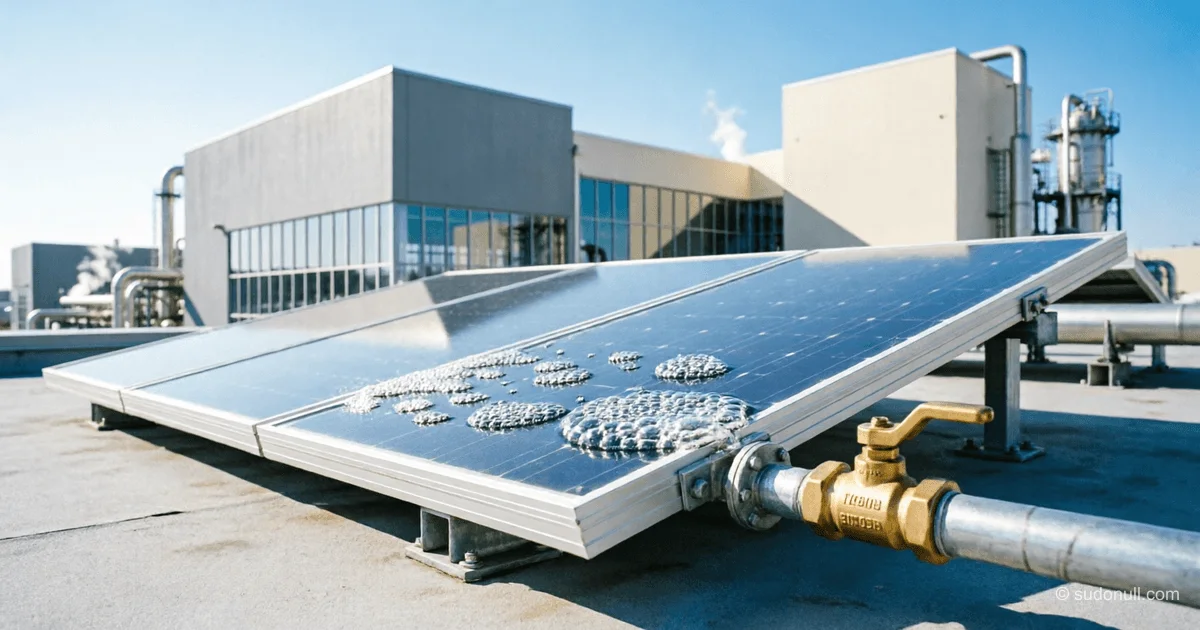
German Scientists Create Panel That Produces Hydrogen Directly from Sunlight
In Germany, a photoelectrochemical panel has been developed that directly converts sunlight into hydrogen. The technology is expected to make the production of 'green' fuel significantly simpler and cheaper.
Direct Path to Hydrogen: How the German Photreon Panel Turns Sun and Water into Fuel Without Electricity
Introduction
Green hydrogen has long been hailed as the fuel of the future, capable of replacing fossil resources in industry, transport, and energy. However, until now, its production has resembled a complex dance: solar panels generate electricity, which then powers an electrolyzer that splits water into hydrogen and oxygen. Double energy conversion means double losses and double costs. The startup Photreon, spun out from the Karlsruhe Institute of Technology (KIT), has proposed an elegant solution—a photoreactor panel that does the same thing in a single step, without an electrolyzer, without electricity, and without grid connection.
Event Details and Timeline
Photreon's technology is based on the principle of direct photocatalytic water splitting. Unlike the traditional 'photovoltaics → electrolysis' chain, here photosensitive semiconductor materials directly absorb solar energy and enter an excited state. The resulting charge carriers immediately break water molecules—hydrogen is released on one side of the panel and oxygen on the other.
'We avoid the detour through electrical electrolysis, producing chemical energy directly from sunlight and water,' explained Photreon co-founder Paul Kant from KIT's Institute of Microstructure Technology (IMVT).
The public premiere of the development took place at the Hannover Messe from April 20–24, 2026, where Photreon presented a working prototype with an area of one square meter. The panel is designed so that the internal geometry of the reactor optimally combines light transport, chemical reaction, and product removal—a balance the team refined over several years.
KIT has already filed a patent application for the photoreactor design. The development was funded under the institute's internal program, with a three-year project budget of €3.4 million (approximately $3.7 million). Importantly, the project is geared toward mass production: standard manufacturing processes and readily available materials are used, and the modular architecture allows scaling from rooftop mini-panels to hectare-sized hydrogen farms.
Impact and Significance
The significance of Photreon's development can hardly be overstated. First and foremost, it reduces capital costs for green hydrogen infrastructure. A traditional system requires purchasing and maintaining at least three separate components: solar panels, inverters, and electrolyzers. Photreon combines all of these in a single device. For an average industrial plant that consumes hydrogen as a feedstock (e.g., in specialty chemicals, food processing, or metalworking), this means the ability to place the fuel source right on the factory premises, eliminating costly logistics and dependence on grid tariffs.
The technology also removes geographical constraints. Regions with high solar insolation but weak grid infrastructure—the Middle East, North Africa, parts of Latin America—now have a chance to become hydrogen producers without prior multibillion-dollar investments in power lines and electrolysis plants. Instead of giant centralized stations, distributed networks of photoreactor panels can be deployed, scaling capacity as demand grows.
From an environmental perspective, Photreon makes hydrogen truly green. In the classical chain, even when using renewable electricity, some energy is inevitably lost during conversion and transport. Direct photocatalysis eliminates these losses, and the panel materials do not require scarce or toxic elements, which favorably distinguishes the development from some competing technologies that use platinum or iridium.
Alongside Photreon, other approaches are also being developed in Germany. For example, an international team of scientists from Helmholtz-Zentrum Berlin (HZB), Cambridge, Caltech, and the Fraunhofer Institute for Solar Energy Systems (ISE) recently achieved a record conversion efficiency of 19.3% for a photoelectrochemical cell based on III-V semiconductors and rhodium nanoparticles. And researchers from the Universities of Ulm and Jena have created a 'solar battery' based on a copolymer that can store light energy for several days and release hydrogen 'at the push of a button'—even in the dark. These projects do not compete but rather complement each other, forming a strong German cluster in the field of solar hydrogen.
Reactions from Key Players
The industrial audience at the Hannover Messe greeted Photreon with notable interest. The one-square-meter prototype, clearly demonstrating direct hydrogen output, became one of the central exhibits in the hydrogen technology section. For manufacturers tired of energy price volatility and tightening carbon quotas, the idea of an autonomous hydrogen source on their own roof sounds like a business solution, not a scientific experiment.
KIT, for its part, shows confidence in the project: the institute has not only filed a patent application but is also actively supporting the startup through its technology transfer program. This is part of Germany's broader strategy to maintain leadership in green technologies. Funding through Fraunhofer PREPARE and other government programs indicates that Berlin views direct photocatalysis as a strategic direction.
The scientific community's reaction is also positive. Professor Roel van de Krol, who heads the Institute for Solar Fuels at HZB, has previously published work showing that increasing pressure in photoelectrochemical cells to 6–8 bar can halve energy losses and boost overall efficiency. These findings could be integrated into Photreon's architecture, creating potential for further efficiency gains.
Forecast and Conclusions
Photreon is at a point where laboratory success is beginning to turn into an engineering product. The prototype has proven the concept's viability. The next step is pilot projects at real industrial sites, which will gather performance data under various climatic conditions and confirm economic feasibility.
The main question to be resolved is the final cost per kilogram of hydrogen. If Photreon can achieve a price below $2 per kilogram (the US Department of Energy's target for competitive green hydrogen), the technology will see rapid adoption. Given current progress rates and the use of inexpensive materials, this is a realistic goal within a 3–5 year horizon.
In a broader perspective, Photreon illustrates a fundamental shift in clean energy philosophy: from centralized megaprojects to distributed, modular, locally adapted solutions. A solar panel that outputs not electricity but directly chemical fuel represents a new class of devices at the intersection of photovoltaics and chemical engineering. And judging by the reaction of industrialists in Hannover, the market is already ready for such a class.
— Editorial Team










No comments yet.