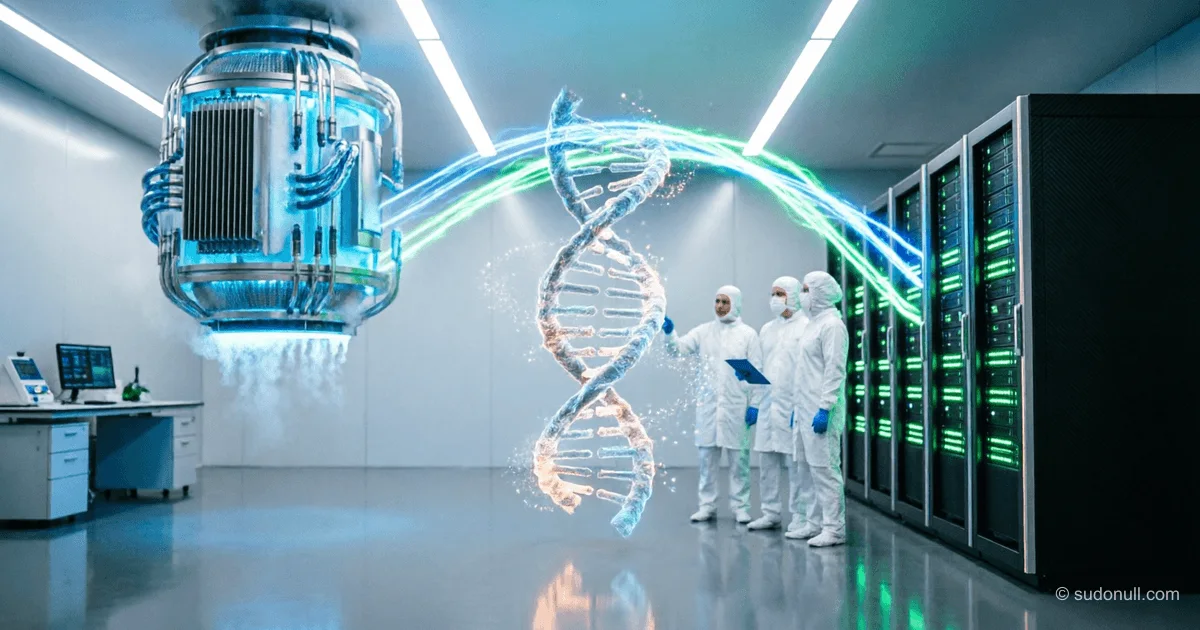
MIT and IBM Launch Joint Center for Hybrid AI and Quantum Computing
The new MIT-IBM lab will focus on building hybrid computing systems that combine AI, algorithms, and quantum computers to tackle challenges in materials science, chemistry, and biology.
MIT and IBM have created a new computing center: the era of the hybrid future
Introduction
Over eight years of collaboration between MIT and IBM through the MIT-IBM Watson AI Lab have yielded thousands of scientific papers and hundreds of research projects. But technology doesn't stand still, and what seemed cutting-edge in 2017 is now mainstream. Artificial intelligence has fully moved from labs into the real sector, quantum computers are no longer purely theoretical curiosities, and classical computing systems have hit physical limits.
On April 29, 2026, MIT and IBM officially announced the launch of the MIT-IBM Computing Research Lab—a new research laboratory designed to define the next stage of computing technology. The name change is not just a rebranding. The Watson brand has disappeared from the name, replaced by the neutral and much broader concept of "Computing Research." This is a symbolic gesture: the old era, when AI was an exotic technology, is over, and it is being replaced by the era of hybrid systems where AI, algorithms, and quantum computing work in tandem.
Event Details and Timeline
From Watson AI Lab to Computing Research Lab
The starting point was 2017, when MIT and IBM founded the MIT-IBM Watson AI Lab. At that time, IBM was actively promoting the Watson brand, promising a revolution in medicine, finance, and business analytics. By 2020, Watson's commercial ambitions had faded, but the academic collaboration continued to bear fruit: over eight years, the lab funded more than 210 research projects involving over 150 MIT faculty and more than 200 IBM researchers. The result was over 1,500 peer-reviewed publications and support for more than 500 students and postdocs.
The new lab, announced on April 29, 2026, expands the focus. Instead of one direction—AI—there are now three: artificial intelligence, algorithms, and quantum computing.
Structure and Key Figures
The lab is jointly managed:
- Co-chairs: Jay Gambetta, Director of IBM Research and IBM Fellow, and Anantha Chandrakasan, Provost of MIT, who, even as Dean of the School of Engineering, was instrumental in founding the Watson AI Lab.
- Co-directors: Aude Oliva, Senior Research Scientist at MIT CSAIL, and David Cox, Vice President of IBM Research for AI Foundations.
- Three research directions are led by specialists from MIT and IBM:
- AI: Jacob Andreas (MIT) and Kenny Ng (IBM)
- Algorithms: Vinod Vaikuntanathan (MIT) and Vasilios Kalantzis (IBM)
- Quantum Computing: Aram Harrow (MIT) and Hanhee Paik (IBM)
Technical Goals
The lab's research agenda includes:
- Hybrid computing systems—combining quantum hardware with classical HPC systems and advanced AI methods.
- Development of quantum algorithms for materials science, chemistry, and biology.
- Research into the mathematical foundations of machine learning, optimization, Hamiltonian simulations, and partial differential equations.
- Practical applications, including weather and turbulence forecasting, financial risk assessment, protein structure prediction, and supply chain optimization.
Impact and Significance
For the World: Solving Problems Beyond Classical Reach
Modern computers have reached impressive heights, but there is a whole class of problems that remain intractable. Modeling complex molecules for new drugs, accurate climate forecasting decades ahead, and discovering new superconductors all require computations that on classical systems are either prohibitively time-consuming or simply impossible.
The hybrid approach—quantum processors for specific tasks (e.g., simulating quantum systems) and AI for optimization and interpretation of results—could change this. MIT and IBM have set an ambitious goal: "to unlock new computing approaches that go beyond the capabilities of today's classical systems."
Practical examples cited by the lab:
| Field | Potential Application |
|---|---|
| Meteorology | More accurate weather and turbulence forecasts |
| Finance | Reduced risk and improved market predictions |
| Medicine | Protein structure prediction for targeted therapy |
| Logistics | Optimization of global supply chains |
For the Industry: IBM's Bet on a Quantum Future
IBM does not hide its ambitions. The company aims to create the world's first fault-tolerant quantum computer by 2029. The new lab with MIT is a key part of this strategy. As an analyst at Investing.com notes, IBM "continues to aggressively invest in next-generation computing technologies."
For MIT, this collaboration provides a stable source of funding for fundamental research and a pipeline for training students who will then go into industry. Over eight years, the Watson AI Lab trained more than 500 students and postdocs.
For Society: A Shift in Technological Paradigm
The institutionalization of the new research center is an acknowledgment that the future of computing will be hybrid. AI alone, no matter how good, runs into the limitations of the classical von Neumann architecture. Quantum computers on their own are too specialized and not yet ready for widespread use. But their combination—where AI helps manage quantum systems and quantum accelerators solve subproblems that are intractable for neural networks—is the direction in which major players are investing serious resources.
Reactions from Key Players
Official Position of MIT and IBM
Representatives from both sides speak of a "transformed technology landscape" and that AI has "entered the stage of mainstream deployment," while quantum computing is "rapidly moving toward practical application."
Jay Gambetta, lab chair from IBM, stated: "We expect the MIT-IBM Computing Research Lab to become one of the world's leading academic and industrial platforms accelerating the future of computing. Together, we will rethink how models, algorithms, and systems are designed for an era that will be defined by the sum of possibilities unlocked by combining AI and quantum computing."
Anantha Chandrakasan, Provost of MIT, emphasized continuity: "A decade of collaboration between MIT and IBM has produced cutting-edge research and innovation. Incredible technical achievements set a high bar for our joint work over the next ten years."
Dan Huttenlocher, Dean of the MIT Schwarzman College of Computing, linked the new lab to the college's mission: "The expanded focus highlights the growing connections between AI, algorithms, and quantum computing—these are not just three separate directions."
Independent Analysis: A Skeptical View
Alongside enthusiastic official announcements, more cautious assessments have emerged. Analysts from the publication "Ping Value Anxiety" point out several issues:
- Disappearance of the Watson brand: "The name was removed from the title. Watson was an iconic brand from the Ginni Rometty era... Now they have abandoned it—IBM has learned to avoid risks and not create inflated expectations."
- Uncertainty of funding: "The press release says nothing about the budget. In 2017, IBM promised $240 million over 10 years. That term is coming to an end. Is the new agreement an expansion, maintenance, or reduction of the budget? Silence is an answer."
- Dynamics of technology cycles: Analysts note the shift in narrative: "In 2017, they told a story about cognitive computing and Watson. In 2020, that story had to be rolled back. In 2026, they are telling a story about hybrid AI+quantum computing. Will it work better?"
They also point out that Google and Microsoft have chosen a different strategy: they do not tie themselves to a single university but distribute collaboration across multiple research centers, giving them more flexibility.
The Lab's Position Among Competitors
While Google bets on quantum supremacy in partnership with UCSB and other universities, and Microsoft invests in topological qubits with Delft University of Technology, IBM chooses deep integration with MIT. This gives IBM access to elite research talent and a strong academic brand, but also creates dependence on a single institution.
Forecast and Conclusions
The Next 3-5 Years
In the foreseeable future, we are unlikely to see immediate breakthroughs. Research in quantum algorithms and their integration with AI is work for years, not months.
However, the lab is already setting a direction:
- Development of small, efficient language models (small, efficient, modular language model architectures) instead of endlessly scaling parameters—a response to market demand for cheaper and faster AI solutions.
- Focus on reliability and transparency of enterprise systems indicates that IBM is targeting not the consumer market but corporate clients who value predictability.
- Research in optimization and differential equations could yield practical results in logistics and finance much sooner than a full-fledged quantum computer.
Strategic Importance for IBM
For IBM, the new MIT-IBM Computing Research Lab is not just a research center but also an important brand element. While NVIDIA dominates AI accelerators and Google and Microsoft control cloud platforms, IBM is trying to maintain its status as a technology leader by investing in the "next big thing"—quantum computing.
IBM has a roadmap: a fault-tolerant quantum computer by 2029. The new lab center should help navigate this path by providing a flow of fresh ideas and talent.
Conclusions
The launch of the MIT-IBM Computing Research Lab is not an ordinary event. It is an acknowledgment that the era of "AI for everything" is ending, and the era of "AI + quantum computing for problems that cannot be solved otherwise" is beginning. This is a shift from marketing promises to fundamental research at the intersection of disciplines.
Skeptics are right about one thing: specific KPIs and timelines are absent from the announcement, and the funding for the new lab is an open question. But the very fact that MIT and IBM are publicly betting on a hybrid future sets the tone for the entire industry. Competitors will be forced either to follow this example or to explain why they think otherwise.
For the scientific community and industry, this is a long-term endeavor. MIT and IBM are laying the foundation for computing systems that may well define the technological landscape of the 2030s. The question is not whether hybridization will happen, but how quickly and in what form. The new lab is one of the platforms where that answer will be sought.
— Editorial Team










No comments yet.