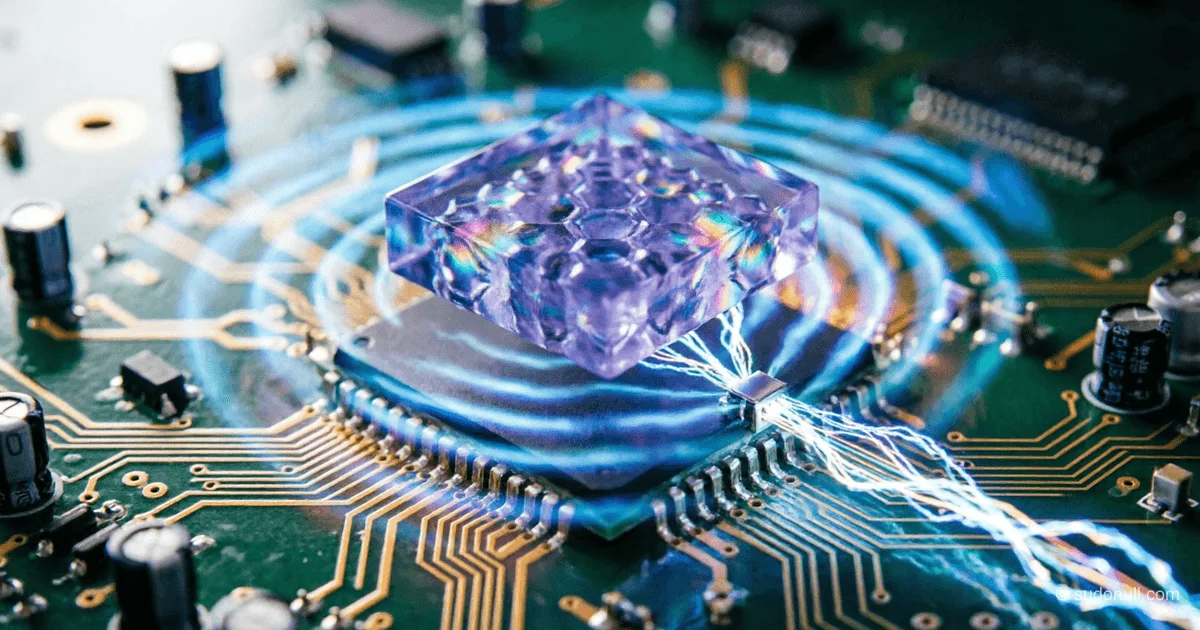
Physicists Discover Quantum Effect That Could Power Microchips from Thin Air
An international team of scientists has discovered a new nonlinear Hall effect in bismuth telluride that can convert electrical signals into current. While the technology won't replace batteries yet, in the future it could power ultra-low-power autonomous sensors and chips directly "from thin air" without bulky components.
Introduction: Energy from Nothing
Imagine a world where sensors on remote pipelines, wearable devices, and Internet of Things elements never need battery replacements. A world where low-power electronics draw energy directly from the surrounding space—from Wi-Fi signals, radio and TV broadcasts, cellular communications—without bulky rectifiers and diodes.
In February 2026, an international team of scientists from Queensland University of Technology (Australia) and Nanyang Technological University (Singapore) published a study in the journal Newton that brings this scenario closer to reality. The researchers discovered that a quantum effect known as the nonlinear Hall effect (NLHE) operates stably at room temperature in the semiconductor bismuth telluride (Bi₂Te₃), potentially allowing alternating signals to be converted into direct current without traditional components.
The authors themselves caution: this discovery will not replace batteries, let alone power electrical grids. But it opens the path to a new class of devices—"self-powered" microsystems that harvest energy literally from the air.
Event Details and Timeline
What Is the Nonlinear Hall Effect?
The classical Hall effect, known for over a century, occurs when a current-carrying conductor is placed in a magnetic field: a voltage appears perpendicular to the current. The nonlinear Hall effect is a relatively new variant with a unique property: it occurs without an external magnetic field and behaves the same when moving forward and backward in time—a property called "time-reversal symmetry."
In terms of energy conversion, this means that an alternating electrical signal (e.g., from ambient radio-frequency sources) can be directly rectified into direct current without traditional diodes, which lose efficiency at high frequencies.
The Material—Bismuth Telluride
The researchers focused on bismuth telluride (Bi₂Te₃)—a well-known topological insulator that has long been studied for thermoelectric applications. This material retains its quantum properties up to room temperature, which is critical for practical use.
Key Discovery: Control Through Scattering
The team's most important finding is that they identified how different "scattering" mechanisms (electron deflection due to collisions with defects and phonons) can control the direction and strength of the generated voltage.
At low temperatures (2–25 K), scattering by impurities and crystal lattice defects dominates. Upon heating, phonons—quanta of lattice vibrations—come into play. At around 230 K (slightly below room temperature), a sign inversion occurs—the voltage changes direction. This is not a problem but an opportunity: knowing these dependencies, engineers can design devices where the effect operates optimally in a given temperature range.
The study was published in February 2026 in the journal Newton (Volume 2, Issue 4), where the article was presented under a Creative Commons license. In March–April 2026, the news was picked up and disseminated by popular science outlets, including 3DNews, Popular Mechanics, AZoQuantum, and others.
Impact and Significance (for the World, Industry, Society)
For the Internet of Things and Sensors
The most realistic and promising application of NLHE is powering ultra-low-power autonomous devices. Imagine a network of thousands of sensors for air quality, soil moisture in agriculture, or vibration monitoring on industrial sites. Today, each such device requires a power source—a battery that must be periodically replaced. On the scale of the Internet of Things, this means enormous operating costs and mountains of spent batteries.
"A more realistic scenario is that NLHE could become a useful auxiliary technology for distributed self-powered electronics and autonomous microsystems, rather than a replacement for batteries or traditional grid infrastructure," explains one of the study's authors, Xueyan Wang.
For Wearable Electronics
The next generation of smartwatches, fitness trackers, and medical sensors (e.g., continuous glucose monitors) could partially power themselves from ambient radio-frequency fields, extending battery life or reducing battery size. As Professor Dongchen Qi notes, "Once you understand what's happening inside the material, you can design devices to take advantage of it. That's when quantum effects stop being abstract and start becoming useful."
For Ultra-Fast Wireless Networks (6G)
One of the most intriguing applications is creating ultra-fast rectifiers for millimeter-wave and terahertz ranges, which will be used in 6G networks. Traditional diodes are inefficient at such frequencies, and a quantum rectifier based on NLHE could become the "holy grail" for future communication systems.
Limitations: What This Effect Cannot Do
It is important to emphasize: the discovery does not mean our smartphones or laptops will soon work without charging. The power available for "harvesting" from ambient electromagnetic fields is extremely small. As Xueyan Wang warns, "The NLHE signals recorded are still relatively weak in many material systems," and temperature fluctuations can suppress the signal.
The effect is not intended for powering grids—that requires high power, low cost, and stability. This is a technology for niche but critically important applications where autonomy and miniaturization outweigh performance.
Reactions from Key Players
The scientific community received the publication with interest. Professor Dongchen Qi from QUT emphasized that the work provides "a foundation for designing high-performance devices based on NLHE." Of particular value is the quantitative description of three different scattering channels (impurities, phonons, and their hybridization), which was previously poorly understood.
Leading popular science outlets, including Popular Mechanics, noted that the discovery points the way to "self-powered sensors that don't need batteries." At the same time, journalists carefully note the researchers' caveats, preventing hopes from turning into unwarranted expectations.
Interestingly, the phenomenon has attracted attention not only from physicists but also from engineers in energy conservation and green technologies. If the technology can eliminate even a portion of disposable batteries, the environmental impact could be significant: in the European Union alone, about 231,000 tons of portable batteries were sold in 2023.
Forecast and Conclusions
Near-Term Outlook (2026–2028)
The technology is currently at the "proof-of-principle" stage in the lab. The next steps are:
- Reducing scattering: researchers need to minimize effect losses that depend on temperature and material quality.
- Creating perfect materials: for stable operation at room temperature with a more consistent output signal, ultra-high-quality crystals are required.
- Integration into a device: moving from demonstrating the effect on a crystal piece to a working prototype of an integrated chip.
As Xueyan Wang says, it would be overly optimistic to claim that NLHE will replace batteries. "A more realistic expectation is that NLHE could serve as a supplementary technology for small, distributed, low-power systems."
Medium-Term Outlook (2028–2032)
If materials work succeeds, we may see the first commercial products:
- Sensors for monitoring the condition of buildings and bridges, operating without battery replacement.
- Implantable medical sensors (e.g., for intraocular pressure monitoring) that recharge from ambient mobile phone signals.
- Smart home elements (smoke detectors, motion sensors) using NLHE as an auxiliary power source to extend the main battery's life.
Long-Term Outlook (2030+)
In the next decade, under favorable circumstances, NLHE could become a standard "supplementary technology" for all kinds of low-power distributed electronics. However, any broader energy role (e.g., charging smartphones) remains "a long-term and highly speculative possibility."
Conclusion
The discovery of the nonlinear Hall effect in bismuth telluride is not a revolution that will change our daily lives tomorrow. It is a fundamental step forward in our understanding of how the quantum world can serve practical engineering tasks.
The researchers have not discovered a "perpetual motion machine" but a tool—potentially powerful, yet requiring many more years of work to become reliable and commercially viable. Nevertheless, the very goal of harvesting energy literally from the air, using fundamental properties of matter at the quantum level, reflects a crucial trend in modern science: the shift from energy extraction to energy harvesting from the environment. And in this shift, NLHE may play its—modest but very useful—role.
— Editorial Team










No comments yet.