Dreame Launches Global Market Air Purifier with World's First Self-Cleaning Pet Hair System
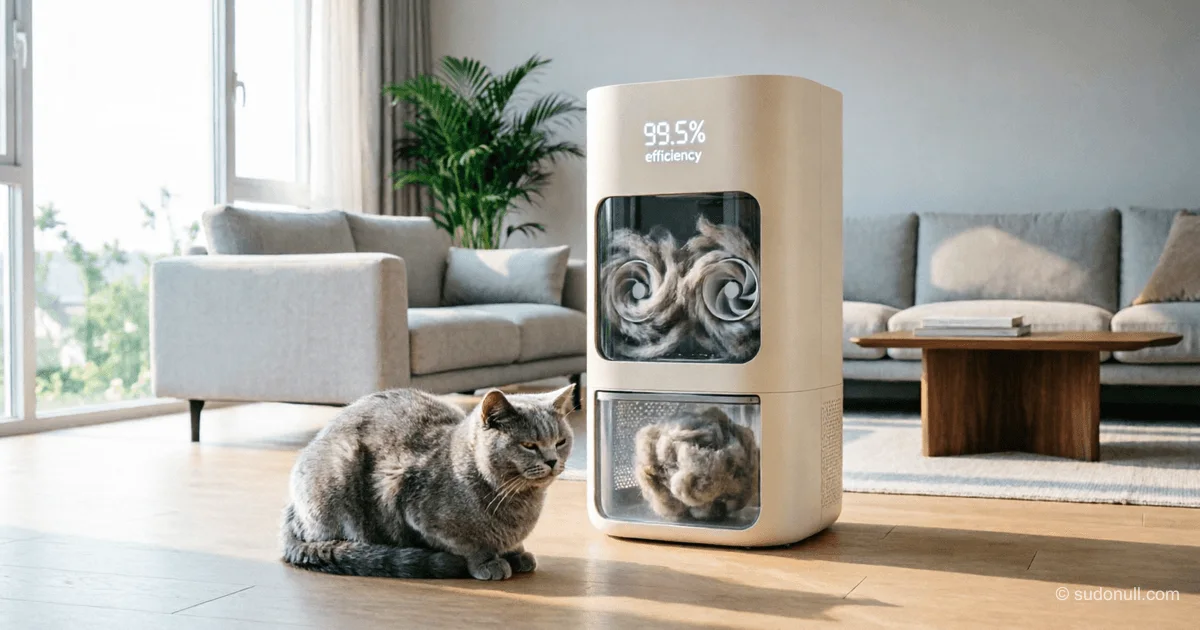
Dreame unveiled the FP10 air purifier at its San Francisco event, featuring an active roller self-cleaning system certified by Frost & Sullivan. The new device captures 99.5% of pet hair in a sealed container.
A robot vacuum for the air: How the Dreame FP10 with self-cleaning technology is rewriting the rules of the climate control market
Introduction
The home air purifier market has evolved along the same trajectory for decades: denser HEPA filters, quieter motors, more compact housings. But all faced one fundamental problem—the filter clogs and needs manual cleaning. For pet owners, this becomes a daily battle with fur that renders expensive devices ineffective within weeks. At the DREAME NEXT event in San Francisco on April 30, 2026, Dreame Technology showcased a solution that breaks this vicious cycle: the FP10 Furcatch air purifier with the world's first active roller self-cleaning system.
Event Details and Timeline
The FP10 premiere was part of the large-scale DREAME NEXT event held in San Francisco from April 27 to 30, 2026—the first-ever presentation week in Silicon Valley organized by a Chinese technology company. During the event, Dreame introduced three new products for creating home ambiance: the FP10 air purifier, the MF10 bladeless fan, and the combined Dreame Halo device. However, the FP10 attracted the most attention from both industry experts and consumers.
The key innovation of the FP10 is the Furcatch technology. It features a mechanism with two rotating rollers that actively separate hair and large particles from the filter surface during operation and compress them into a sealed 460 ml container. The claimed hair collection efficiency reaches 99.5% in a 30-square-meter room. According to Frost & Sullivan, the technology is the world's first in the "active roller self-cleaning for air purifiers" category.
By the time of the May presentation in San Francisco, the FP10 already had an impressive track record of recognition. At CES 2026 in January, the device received a CES Innovation Award. Earlier, in 2025, it was awarded the IFA Best Design award. Digital Trends added its Publisher Award to the list of accolades. Thus, Dreame built a three-tier external validation system for the product: technological, design, and user.
The device's filtration system is based on an H13 HEPA filter that captures 99.97% of particles as small as 0.3 microns. An additional CataFresh layer contains activated carbon with 2.5 times the volume of previous models and a metallic catalytic layer that chemically breaks down odor molecules rather than just adsorbing them. The clean air delivery rate (CADR) is 350 m³/h, allowing it to serve rooms up to 125 square meters.
Impact and Significance
The FP10's launch affects several market aspects beyond the niche "air purifiers for pet owners" category. From a technological evolution standpoint, Dreame made a conceptual shift: the air purifier is no longer a passive filtering device but an active self-maintaining system. Drawing a parallel with robot vacuums, this is akin to the transition from bagged vacuums to units with automatic dust emptying into a dock—a fundamental change in user experience.
The economic significance of the invention is also substantial. The FP10 filter is claimed to last two years without any maintenance. In comparison, in regular air purifiers, pet owners are advised to clean the pre-filter weekly and replace the HEPA filter every 6–12 months. Replacement filters for premium devices like Dyson cost between $70 and $90. Over a two-year cycle, savings on consumables alone could range from $140 to $270. Meanwhile, the starting price of the FP10 in Japan is set at 50,300 yen (approximately $335), whereas the Dyson HushJet sells for about $400 in the US, and the Shark NeverChange for $350. As Mashable senior reviewer Leah Stoddart notes, "The FP10 cleans six times the area of the Dyson HushJet and costs only $150 more."
For the consumer market as a whole, the FP10 sets a new standard of expectations. The self-cleaning feature, once seen as an unnecessary luxury, is now a marker of a modern device. Competitors that do not offer similar solutions risk ending up like button phone manufacturers after the iPhone launch.
Key Player Reactions
Mashable journalist Leah Stoddart, who tested the device for two weeks in an apartment with two cats, rated the FP10 4.9 out of 5. Her verdict: "This is the best air purifier for multi-pet homes if you have enough floor space." She praised its near-silent operation in sleep mode, built-in LED lighting, and aesthetic cream-colored design that "doesn't look like plastic junk."
Frost & Sullivan, one of the most authoritative international consulting firms, officially certified the technology as "the world's first active roller self-cleaning for air purifiers." This is particularly significant because Frost & Sullivan is known for its cautious wording—a "world's first" certification means the company conducted a patent search and found no analogs.
From a marketing positioning perspective, Dreame has bet on the "Multi-Scenario Environmental Solutions" strategy, which business head He Xingwei discussed at CES 2026. The strategy's essence is a shift from individual products to an integrated ecosystem where the air purifier, fan, and other devices are united by a common approach to environmental management. This is a direct challenge to Dyson, which traditionally holds the status of the most expensive and technologically advanced brand in climate control.
The MF10 bladeless fan, introduced alongside the FP10, has already taken the number one spot in Amazon's new releases category, confirming Dreame's ability to quickly convert presentation hype into commercial results.
Forecast and Conclusions
The Dreame FP10 is not just "another air purifier for pet owners." It is a device that closes the long-standing gap between climate control manufacturers' promises and actual user experience. The roller self-cleaning technology solves the category's main problem—performance degradation due to clogged filters—and does so without human intervention.
It is expected that within the next 12–18 months, competitors will attempt to create similar systems. Dyson, Sharp, Xiaomi, and other major players are unlikely to leave the new subcategory unanswered. However, patent protection, which Dreame has likely secured, and a two-year lead in field testing give the company a comfortable head start. The next logical step for Dreame would be to integrate self-cleaning technology into more compact and affordable models—currently, the FP10, with its height of 62 cm and diameter of 37 cm, is positioned as a device for large rooms.
For consumers, the long-term effect boils down to a simple formula: less maintenance, stable performance, longer filter life. When a technology that solves a real household problem simultaneously wins an innovation award at CES and receives Frost & Sullivan certification, it is highly likely that we are looking at a working solution, not a marketing gimmick. The FP10 is a case where engineers found a way to make the machine clean up after itself, and that is perhaps the most compelling argument for the device.
— Editorial Team








No comments yet.