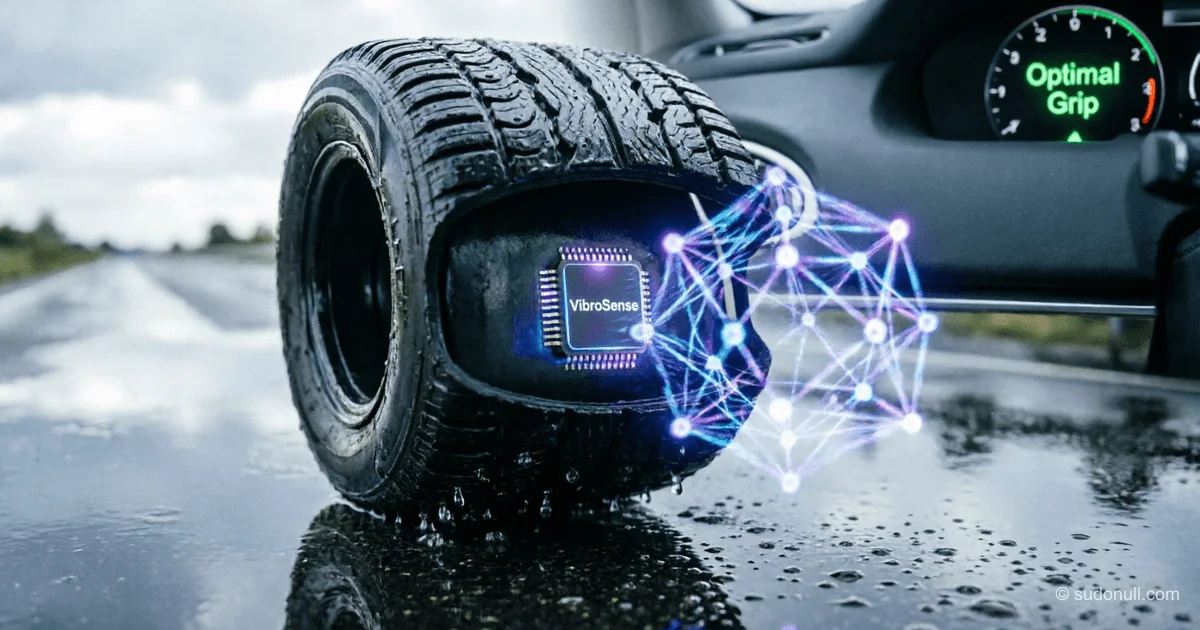
POLYN Technology and GlobalFoundries Create Neuromorphic Chip for Tire-Road Friction Monitoring
Developed the VibroSense™ chip with an analog neuromorphic core for ADAS and autonomous driving, which processes accelerometer data directly inside the tire. The AI-based system evaluates the friction coefficient on wet roads or asphalt in real time, significantly enhancing the safety of autonomous vehicles.
Introduction: When the Car Gains a Sense of Touch
Modern autonomous driving systems have one paradoxical flaw: they see the road but cannot feel it. Cameras, lidars, and radars can detect lane markings, other vehicles, and pedestrians, but they are powerless against black ice or aquaplaning—phenomena that do not change the visual scene but radically alter the physics of motion. A car may perfectly "see" wet asphalt yet have no idea how slippery it is.
In late April 2026, POLYN Technology, together with GlobalFoundries, announced the VibroSense™ chip—the world's first analog neuromorphic device designed to be installed directly inside a tire. The chip processes accelerometer data in real time and estimates the road friction coefficient, giving the car what it has been missing: a tactile sense of the road.
Event Details and Timeline
Tapeout: The First Step Toward Commercialization
The key milestone was the tapeout—completion of the engineering sample design for the VibroSense™ chip, marking its readiness for production. This is POLYN's first proprietary chip, developed in collaboration with GlobalFoundries using advanced process technologies, including the 22FDX® platform, specifically designed for low-voltage, high-reliability automotive applications.
The development is based on over two years of research and validation. POLYN had already released the VibroSense™ evaluation kit in March 2025, allowing manufacturers to test the technology on real vehicles. By the time of the tapeout announcement, the system had undergone extensive testing on certified tracks with leading tire manufacturers, collecting vibration data on various surfaces: asphalt, concrete, wet roads, and aquaplaning conditions.
How It Works: Neuromorphic Architecture
At the heart of VibroSense™ lies Neuromorphic Analog Signal Processing (NASP)—an analog neuromorphic signal processing technology inspired by the architecture of the human brain. Unlike traditional digital processors that handle data sequentially, NASP uses analog circuits to create thousands of artificial neurons and synapses that work in parallel and asynchronously.
Key chip characteristics:
- Microwatt-level power consumption—enough for continuous operation inside a tire without frequent battery replacement
- Microsecond latency—critical for decision-making at high speeds
- Edge processing—the chip computes the Peak Friction Coefficient (PFC) directly inside the tire, sending only the final result to the vehicle, not the raw data stream
The system is trained on real data collected from various vehicles, tires, and surfaces, covering 10 friction coefficient levels—from 0.1 (black ice) to 0.9 (dry asphalt).
Impact and Significance
For Safety: From Reactive to Proactive Control
Modern safety systems—AEB (Automatic Emergency Braking), ESC (Electronic Stability Control)—operate on a reactive principle. They detect loss of traction only after it has already occurred and respond to the consequences.
VibroSense™ changes the paradigm. By receiving friction data before the car begins braking or maneuvering, the system can proactively adapt behavior: reduce speed, adjust braking force, correct the trajectory. This is especially important for autonomous vehicles, which lack human intuition and must rely solely on sensor data.
For the Industry: Closing a Critical Gap
POLYN CEO Alexander Timofeev stated directly that indirect calculations and virtual sensors cannot provide the required accuracy for friction estimation in rapidly changing road conditions, especially in autonomous driving scenarios.
Cameras and lidars see the road but cannot measure its slipperiness. Existing systems that estimate friction based on wheel slip receive information too late. VibroSense™ provides, for the first time, a direct, cause-based (rather than effect-based) assessment of the friction coefficient.
For Automotive Electronics: A New Class of Devices
Placing a chip inside a tire imposes extreme requirements on power consumption, temperature stability, and vibration resistance. NASP technology solves these problems: analog neurons consume orders of magnitude less power than digital processors, enabling always-on monitoring without compromising battery life.
POLYN has confirmed that the solution is compatible with existing TPMS (Tire Pressure Monitoring System) nodes and can be integrated without modifying vehicle equipment.
Reaction from Key Players
Integration with Infineon
POLYN's collaboration with GlobalFoundries for chip production is just the tip of the partnership ecosystem. As early as December 2023, Infineon, one of the largest automotive semiconductor manufacturers, selected POLYN's technology for its TPMS solutions. As Henry Hu from Infineon's automotive division stated, "the combined Infineon and POLYN tire monitoring solution will be particularly suitable for the fleet and autonomous vehicle market."
Interest from Tier 1 and OEMs
According to Timofeev, POLYN is actively working with Tier 1 suppliers and automakers who seek real-time tire-road friction assessment. The VibroSense™ evaluation kit, released in 2025, is already being used for testing and integration.
Regulatory pressure is also driving interest: upcoming Euro NCAP 2026 protocols are beginning to require higher effectiveness of safety systems on low-friction surfaces, creating direct market demand for solutions like VibroSense™.
Forecast and Conclusions
Short-Term Forecast (2026-2027)
Following the tapeout, engineering samples will be tested and integrated into real automotive platforms. Commercial availability of the chip is expected in 2027. Early adopters will likely be premium automakers and tire manufacturers offering "smart tires" as an option.
Medium-Term Forecast (2028-2030)
As production costs decrease and real-world operational data accumulates, the technology will begin penetrating the mass market. Adoption will be especially rapid in electric vehicles, where traction control directly affects energy efficiency and range. POLYN also mentions applications such as tire wear monitoring and rolling resistance management for fleet operations.
Long-Term Forecast (2030+)
NASP technology is not limited to automotive. POLYN is developing similar chips for voice processing (NeuroVoice) and communications (NeuroComm). The success of VibroSense™ will serve as proof that analog neuromorphic processing is a commercially viable approach for edge AI—artificial intelligence running on the device without relying on the cloud.
Conclusion: Tactile Internet of Things
VibroSense™ is not just an automotive chip. It is a demonstration of how analog neuromorphic architecture can solve problems that traditional digital electronics cannot. In a world where more and more devices become "smart," the ability to sense the physical world as keenly as (or more keenly than) a human becomes a competitive advantage.
For the automotive industry, VibroSense™ closes the last sensor gap: after vision (cameras, lidars), hearing (radars, ultrasound), and proprioception (wheel position sensors), the car finally gains a sense of touch. And this ability to feel the road may be the missing element that transforms autonomous driving from an impressive demonstration into reliable everyday transportation.
— Editorial Team








No comments yet.