SaxonQ Unveils World's First Portable Dual-Core Quantum Computer
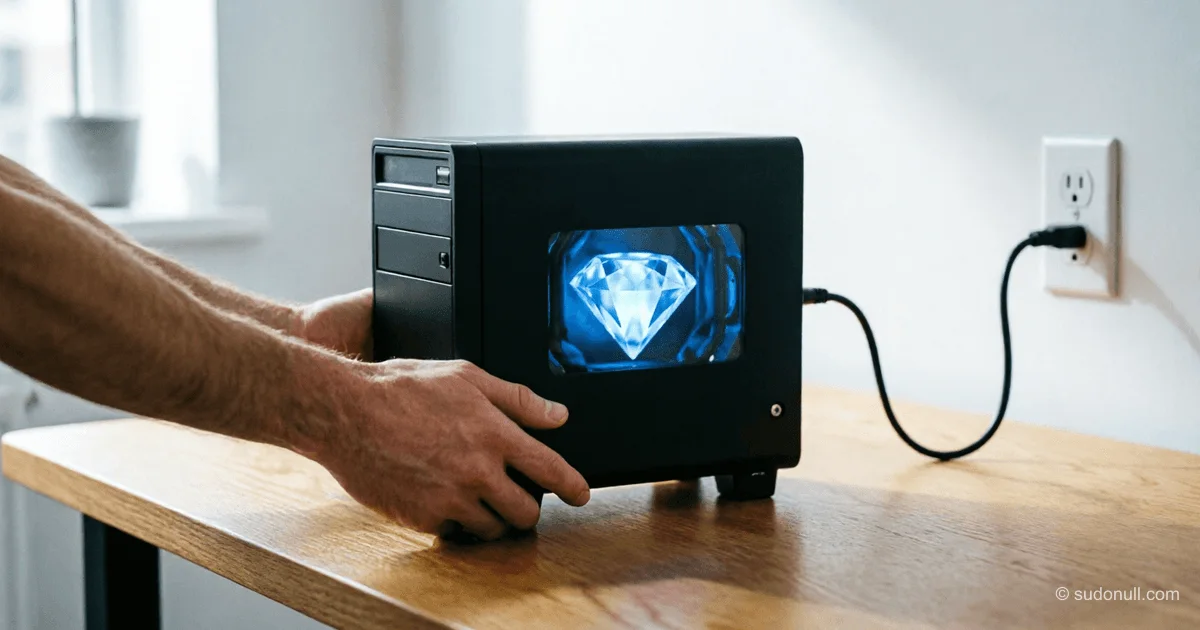
At the Hanover Fair, German startup SaxonQ showcased the QC2026 Dual Core quantum computer with two parallel processors (5 qubits each). The device operates at room temperature on diamond chips and can be plugged into a standard wall outlet.
Introduction: A Quantum Computer from a Wall Outlet
For years, the quantum computer has been associated with a sci-fi image: giant cooling chandeliers, temperatures near absolute zero, and labs accessible only to a select few corporations. German startup SaxonQ, founded in 2021 as a spin-off from Leipzig University, has been steadily breaking this stereotype. In April 2026, at the Hanover Fair, the company unveiled the QC2026 DUAL CORE — the world's first portable dual-core quantum computer.
The device contains two parallel quantum processors, each with 5 qubits, operates at room temperature on diamond chips, and plugs into a standard wall outlet. This event marks the transition of quantum computing from fundamental science to real-world industrial applications, where mobility and accessibility matter as much as raw computing power.
Event Details and Timeline
QC2026 DUAL CORE: Third Generation and First Dual
The presentation took place in April 2026 at the Hanover Fair, one of the world's largest industrial exhibitions. The QC2026 is the third generation of SaxonQ's mobile quantum computers, but the first to feature a dual-processor architecture. The system is equipped with two independent quantum processors, each operating 5 qubits.
The key innovation lies not just in the increased number of qubits, but in how they are organized: the two cores can work in two modes. In "fusion" mode, they combine to accelerate computations; in "parallel work" mode, each core performs independent tasks, which is critical for result verification since modern quantum computers remain error-prone.
Diamond Technology with NV Centers
The device is based on NV technology (nitrogen-vacancy centers in diamond). A chip just 2 millimeters in size contains defects in the diamond crystal lattice that act as qubits.
Advantages of this approach:
- No need for cooling — the system operates stably at room temperature, unlike superconducting quantum computers from IBM and Google that require complex cryogenic equipment.
- Mobility — the device fits into a compact housing and can run from a standard household outlet.
- Noise resistance — diamond qubits demonstrate record stability even in non-laboratory industrial conditions.
Currently, only a few companies worldwide use NV technology, and SaxonQ is one of the pioneers in its industrial application.
The Path to Multi-Processor Systems
The dual-core architecture of the QC2026 demonstrates a scaling path. As stated by co-CEO and co-founder Professor Marius Grundmann, the company aims to build multi-processor systems with any number of cores. SaxonQ plans to further increase the number of qubits per chip and the number of processor cores in the system, which could lead to a "quantum computer on a chip" within a few years.
Impact and Significance
For Industry: Democratizing Quantum Computing
Until now, access to quantum computing has been a privilege of giants like IBM, Google, or Amazon, offering remote access to their cryogenic systems via the cloud. SaxonQ is changing the paradigm: the quantum computer becomes a device that can be placed directly on the enterprise premises.
"We are not talking about theory or devices that only work in ideal lab conditions," said CEO Dr. Frank Schlichting. "We are demonstrating that this technology will soon provide a decisive advantage in energy supply, medical research, artificial intelligence, and many other industries."
SaxonQ devices are already used in real industrial settings:
- Fraunhofer IWU in Dresden (Institute for Machine Tools)
- DLR Innovation Center in Ulm (German Aerospace Center)
For Europe's Technological Sovereignty
The emergence of a room-temperature, scalable quantum computer in Europe is an important signal. In the quantum technology race dominated by the US and China, SaxonQ offers an alternative technological path that does not require complex infrastructure. As analysts from Business Saxony note, for a Central European industrial region, having its own quantum competence is critical for competitiveness.
For Future Applications: From AI to Smartphones
SaxonQ's most ambitious forecasts involve full miniaturization. The company claims it sees a path to creating a quantum processor that could be integrated into a smartphone within a few years. In the near term, the QC2026 and its successors will find applications in:
- Artificial Intelligence — accelerating neural network training
- Medical Research — simulating molecules for new drugs
- Energy Supply — optimizing grids and modeling materials for batteries
- Autonomous Driving — processing complex scenarios in real time
Reactions from Key Players
Information about SaxonQ's breakthrough appeared simultaneously on several platforms. The company's direct press releases were published on April 20-21, 2026. The presentation at the Hanover Fair attracted the attention of the professional community, including the German publication Oiger, which covered the technology and the startup's plans in detail.
The fact that the news was picked up and translated by the Chinese specialized resource "量科网" (Quantum Science Network) indicates international interest in the development. The official economic promotion organization of Saxony, Business Saxony, also published a detailed report on the achievement, emphasizing its significance for the region.
The academic community's reaction has been more reserved so far, which is expected for a breakthrough that requires verification. However, the fact that the development is based on research from Leipzig University — one of the centers of German quantum science — lends scientific legitimacy to the project.
Forecast and Conclusions
Short-Term Forecast (2026-2027)
In the coming years, SaxonQ will focus on increasing the number of qubits per core and the number of cores in the system. The company has published a roadmap through 2030 that includes creating multi-core systems and further miniaturization. Initial industrial deployments will follow the current pilot projects.
Medium-Term Forecast (2028-2030)
By the end of the decade, if SaxonQ executes its roadmap, we could see:
- 50+ qubits on a single chip while maintaining room temperature
- Standardization of NV technology as an alternative to superconducting systems
- The emergence of "quantum accelerators" for data centers — compact devices that accelerate specific classes of tasks
"The path to a quantum computer on a chip — and thus to widespread industrial application — has become much shorter thanks to the dual-core system," summarizes Dr. Schlichting.
Long-Term Forecast (2030+)
SaxonQ's boldest scenario is integrating a quantum processor into everyday devices. If the company can maintain its pace of miniaturization while preserving stability, the emergence of quantum-enhanced mobile devices in the next decade will no longer be science fiction.
Conclusions
The SaxonQ QC2026 DUAL CORE is not just another quantum computer model. It demonstrates that there is an alternative, practically feasible path for quantum technology development that does not require giant cryogenic installations. A fundamentally different technological choice (diamond instead of superconductors) has allowed the German startup to create a device that approaches the accessibility of a standard PC.
In the race for an industrial quantum computer, where the one with more qubits often wins, SaxonQ reminds us that sometimes the decisive factor is not raw power, but the ability to place that power right on the factory floor. And in this race, the "diamond path" from Leipzig has every chance of reaching the finish line sooner than competitors expect.
— Editorial Team










No comments yet.