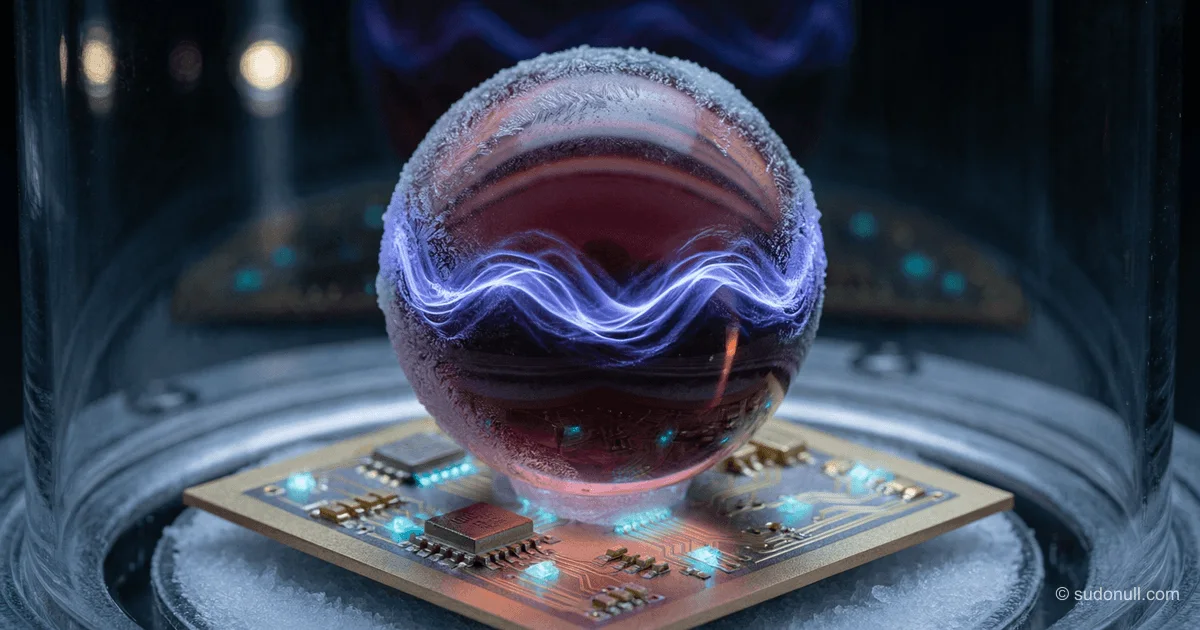
Breakthrough in Physics: Magnon Lifetime Increased 100-Fold, Paving the Way for Coin-Sized Quantum Chips
An international team of scientists extended magnon lifetime to 18 microseconds, proving that previous limitations were solely due to material purity. This achievement enables on-chip quantum memory and communication channels for scalable computers.
Breakthrough in Magnon Physics: How Magnetization Waves Live 100 Times Longer and What It Means for the Future of Quantum Computers
Introduction
An international team of physicists led by Andrey Chumak from the University of Vienna has achieved a breakthrough that could reshape quantum computing architecture. The researchers increased the lifetime of magnons—quasiparticles representing collective magnetization waves—from a few hundred nanoseconds to 18 microseconds. This achievement, published in the prestigious journal Science Advances, not only improves previous records but fundamentally changes the scientific paradigm: it turns out that the short magnon lifetime was limited not by fundamental physics laws but by the purity of the materials used. The discovery opens the door to creating quantum chips the size of a one-cent coin and could accelerate the advent of scalable quantum computers.
Event Details and Timeline
The study, whose results were published on May 1, 2026, culminated years of work. The experimental foundation was laid by Rostislav Serha as part of his doctoral dissertation, and the work was conducted in collaboration between the University of Vienna and the University of Colorado Colorado Springs, as well as scientific institutions in Germany, the USA, and Ukraine.
The key innovation was abandoning uniform long-wavelength magnons. Instead, the team excited short-wavelength dipole-exchange magnons, which are inherently insensitive to crystal surface defects—precisely the defects that limited lifetime in all previous experiments. The second critical factor was cooling the samples to 30 millikelvin, a temperature at which thermal processes that destroy magnons are virtually halted.
Experiments were conducted on three spheres of yttrium iron garnet (YIG) with a diameter of 300 micrometers, differing in purity: from standard industrial quality to an ultra-pure sample. The gradation of results was strikingly clear—the purer the material, the longer the magnon lifetime. The least pure sphere showed a lifetime of 4.5 microseconds, the medium-quality sphere 11 microseconds, and the ultra-pure sample a record 18 microseconds. Crucially, even the "worst" sample surpassed all previous records.
Measurements were performed at a frequency of 3.17 GHz using parametric three-magnon decay—a process where one magnon at the ferromagnetic resonance frequency splits into a pair of dipole-exchange magnons at half the frequency. The threshold power of this nonlinear process allowed calculation of the actual lifetime of the secondary magnons.
A fundamentally important result was the identification that at temperatures below 100 millikelvin, the lifetime stops increasing and reaches a plateau. This saturation is due not to fundamental limitations but to the presence of impurity paramagnetic centers of rare-earth elements in the crystal lattice. In other words, further progress hinges on materials science—improving crystal purification techniques—rather than discovering new physics.
Impact and Significance
The significance of this achievement extends far beyond a laboratory record. Magnons with an 18-microsecond lifetime transform from theoretically interesting but practically useless quasiparticles into reliable carriers of quantum information, comparable to superconducting qubits used in today's leading quantum processors.
Practical implications can be grouped into three areas:
First, magnons become candidates for a "quantum bus"—a communication channel capable of connecting hundreds of qubits on a single chip. Until now, such buses have been the missing link for scalable quantum computers. Magnon wavelengths can reach the nanometer range, theoretically allowing a full quantum processor to fit on a chip the size of a coin.
Second, magnons naturally interact with other quasiparticles—photons, phonons, superconducting qubits. This makes them ideal "universal translators" in hybrid quantum architectures, connecting systems that otherwise cannot exchange information directly.
Third, prospects open up for quantum metrology and ultra-sensitive sensors. Long-lived magnons increase signal accumulation time and improve signal-to-noise ratio in magnetometers, potentially leading to devices sensitive to minuscule changes in magnetic fields.
For the industry as a whole, this means the competition among quantum computing technology platforms becomes even more multidimensional. Magnonics emerges from the shadow of superconducting and ion technologies as an independent and promising path.
Reactions from Key Players
The quantum community received the results with notable interest. Publication in Science Advances—one of the most respected interdisciplinary journals—speaks to the high regard for the work.
The University of Vienna actively disseminated a press release, emphasizing that magnons could become the missing building block for scalable quantum computers. The release notes that the work was carried out by an international team involving young scientists—Caitlin McAllister completed an internship thanks to the Vienna Doctoral School of Physics, which offers opportunities for outstanding master's students from around the world.
Industry publications such as The Quantum Observer and Scienmag quickly picked up the news, highlighting the key conclusion that magnon lifetime limitations are not fundamental but materials-science-related.
Concurrently, the Laboratory of Experimental Quantum Magnonics at the University of Central Florida, led by Professor Jing Xu, is working on creating hybrid chips that combine magnetic materials with superconducting circuits. Her group is addressing the challenge of coexistence between magnetic fields and superconductivity by using type-II superconductors with pinning centers to immobilize vortices. The Vienna team's breakthrough gives additional momentum to this direction—long-lived magnons make hybrid architectures significantly more realistic.
Forecast and Conclusions
The Vienna group's results mark the transition of magnonics from an era of fundamental limitations to an era of engineering challenges. The clearly identified path—increasing the purity of YIG crystals and reducing the concentration of impurity centers—allows predicting further growth in magnon lifetime.
In the next 3–5 years, we can expect the demonstration of the first working magnonic quantum buses connecting several qubits. In the 5–10 year horizon, hybrid quantum processors may emerge, where magnons act as intermediaries between superconducting computing elements and optical data transmission channels.
The challenges to overcome are primarily technological. Short-wavelength magnons require the development of micro- and nanoscale transducers for efficient interaction with microwave circuits. Losses in existing prototypes of such transducers are about 3 dB, which is acceptable for practical applications but requires further improvement.
Crucially, the study removes a psychological barrier. If previously the short magnon lifetime was perceived as a fundamental limitation imposed by nature, it is now clear that it was a materials science problem, not a physical dead end. Lifting this barrier will likely attract additional research resources to quantum magnonics and accelerate progress.
Thus, the work of the Vienna physicists is not just a laboratory record but an event that could change the landscape of quantum technologies. Magnons are transforming from secondary quasiparticles into one of the key elements of future quantum computing architecture, and from now on the question is not "is it possible?" but "when?" and "how compactly?" The answers to these questions will shape the quantum industry in the coming decades.
— Editorial Team










No comments yet.