Wetour Robotics Prepares to Unveil New Orchestra OS for Robot Control via Wearable Sensors
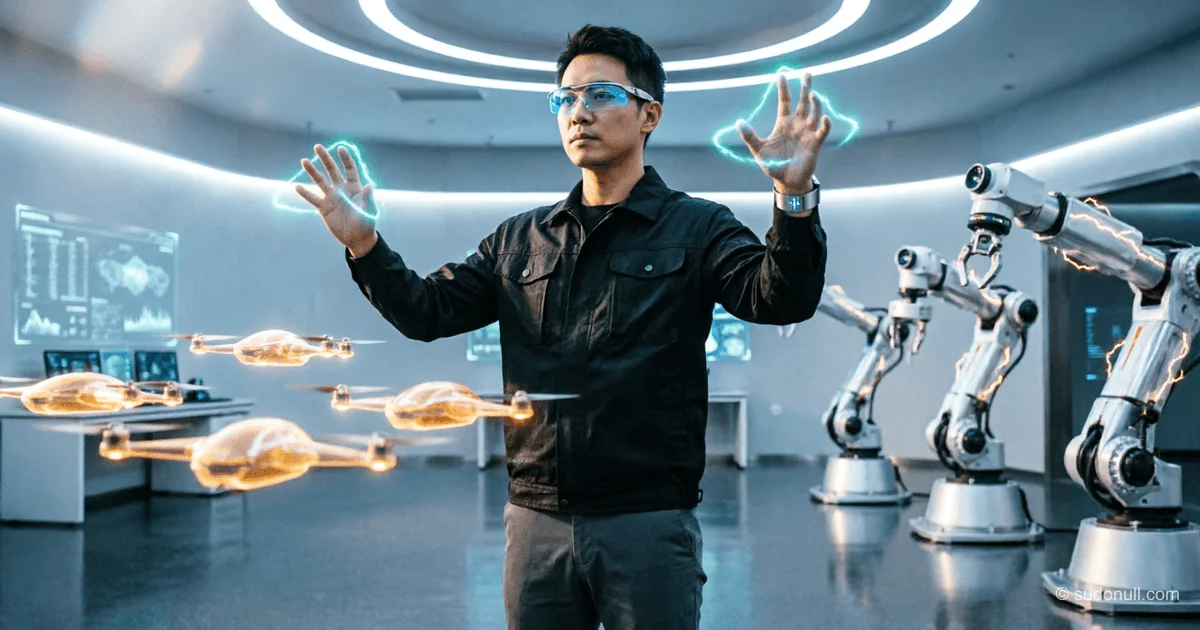
The company has announced a demonstration of Spatial Intent Fusion technology for May 28. The Orchestra platform will enable real-time control of drones, lights, and other devices by reading user gestures and gaze through bracelets and glasses.
An 'Orchestra' for Robots: How Wetour Robotics Turns Gestures and Gaze into a Universal Remote for the Physical World
Introduction
The modern world is overflowing with smart devices that refuse to talk to each other. Smartwatches cannot control an industrial manipulator, a fitness bracelet cannot command a drone, and a helmet-mounted camera cannot tell a wheelchair where its owner is looking. Every new device brings its own app, remote, or voice interface, leaving humans to act as the universal integrator of all this technology. On May 28, 2026, in Austin, Texas, Wetour Robotics intends to present a solution to this problem: the Orchestra operating system, which aims to become the 'Android for the era of physical AI.'
Event Details and Timeline
Wetour Robotics Limited (NASDAQ: WETO) is a technology company formerly known as Webus International, headquartered in Austin, Texas. Over the past months, the company has been gradually unveiling components of its future platform. On April 29, 2026, it published demonstrations of four key developments: VisionLink and Conductor modules that process data on edge devices without cloud dependency. On May 1, Wetour officially announced the debut event where Orchestra will be presented to the public for the first time.
The technical architecture of Orchestra is based on three sensor streams combined in real time. The first is VisionLink, a computer vision module that uses a chest-mounted camera to recognize hand gestures and send commands to connected devices. The second is Conductor, which works with surface electromyography signals: a bracelet reads the electrical activity of forearm muscles and translates hand movements into a real-time 3D hand model, even when the hand is not in the camera's field of view. The third component—spatial localization—is still under active development and aims to provide precise user positioning in a three-dimensional environment.
The key concept, which the company calls Spatial Intent Fusion, is the simultaneous, real-time understanding of three factors: where the user is, what they are looking at, and what their hand intends to do. In other words, the system reads not just one type of command but a holistic intention, assembling it from multiple sensor channels much like a person simultaneously perceives words, facial expressions, and gestures in a conversation.
The financial context adds weight to the event. In March 2026, the company closed a PIPE deal worth $5.16 million (60 million common shares), strengthening its presence in the US capital market.
Impact and Significance
Strategically, Orchestra addresses a problem the industry has long discussed but no one has solved universally: the fragmentation of the Internet of Things and robotic systems. Smart device manufacturers build closed ecosystems where everything works perfectly, but outside them, chaos of incompatibility reigns. Wetour proposes a model already proven in the software world: a horizontal platform that manufacturers of compatible devices can connect to. The company does not produce its own wearables or end devices—it creates a layer that makes them work together.
The range of potential applications listed by the company includes assistive mobility, industrial safety, spatial navigation, assistance for the visually impaired, warehouse logistics, sports training, smart home control, and consumer drones. This is not a niche technology but an infrastructure layer aiming for universality.
Particularly noteworthy is the architectural decision to forgo cloud processing. All computations occur on an edge hub, which is critical for industrial applications where sub-second latency and dependence on cloud connection quality are unacceptable. This also alleviates some privacy concerns—data never leaves the local loop.
Reactions from Key Players
CEO Nan Zheng framed the problem and his solution in a succinct statement: 'For a whole decade, every new wearable and every new connected device made the world smarter but the user more confused. Orchestra is our answer to that.' The emphasis on the 'confused user' is an accurate diagnosis of the current situation, and it is precisely this confusion that the company intends to monetize.
Investors appear to have reacted with cautious optimism. Investing.com data from April 2026 shows that WETO shares have shown strong momentum over the past month, with a market capitalization of about $42.79 million—however, against a backdrop of a 22.6% revenue decline to $4.97 million over the past 12 months and an overall stock decline of 87% over the year. This creates a dramatic gap between Orchestra's technological ambitions and the company's current financial position, making the upcoming presentation critical for its future.
Direct comments from major robotics market players—Boston Dynamics, Siemens, ABB—have not yet been forthcoming, which is typical before an official product launch. However, the very architecture of Orchestra, with its open Orchestra Connect Protocol, is designed to attract partners, and developer reactions after May 28 will be a key indicator of the platform's prospects.
Forecast and Conclusions
Orchestra enters uncharted territory—between operating systems for computers and firmware for individual devices lies a void currently filled by proprietary solutions and manual integration. Attempting to create a universal layer for physical AI is an ambition comparable to what Google did with Android for smartphones.
The key risk is the chicken-and-egg problem. A platform without devices is useless, and device manufacturers will not support a platform without an established user base. Wetour is trying to overcome this barrier through a 'developers first' strategy: tool demonstrations, an open protocol, and invitations to partners for the Austin event. If the company can attract a critical mass of developers and manufacturers, the ecosystem that made Android the dominant mobile OS could emerge.
The financial situation adds tension. With a market cap of around $43 million and declining revenue, Wetour is in a 'now or never' situation, and Orchestra represents a bet on transforming the company from a niche mobility player into an infrastructure platform.
If the May 28 demonstration proves convincing and early partners announce support for the Orchestra Connect Protocol, we can expect an acceleration of investment inflows and team expansion. If the reaction is lukewarm, the company risks being left with a technologically interesting but commercially unsuccessful product.
In any case, Orchestra marks an important point on the trajectory of Physical AI—a field moving from academic experiments to attempts at creating universal tools. Whether Wetour Robotics will be the one to write the operating system for the future or remain a footnote in tech history will become clear within three weeks of this article's publication.
— Editorial Team










No comments yet.