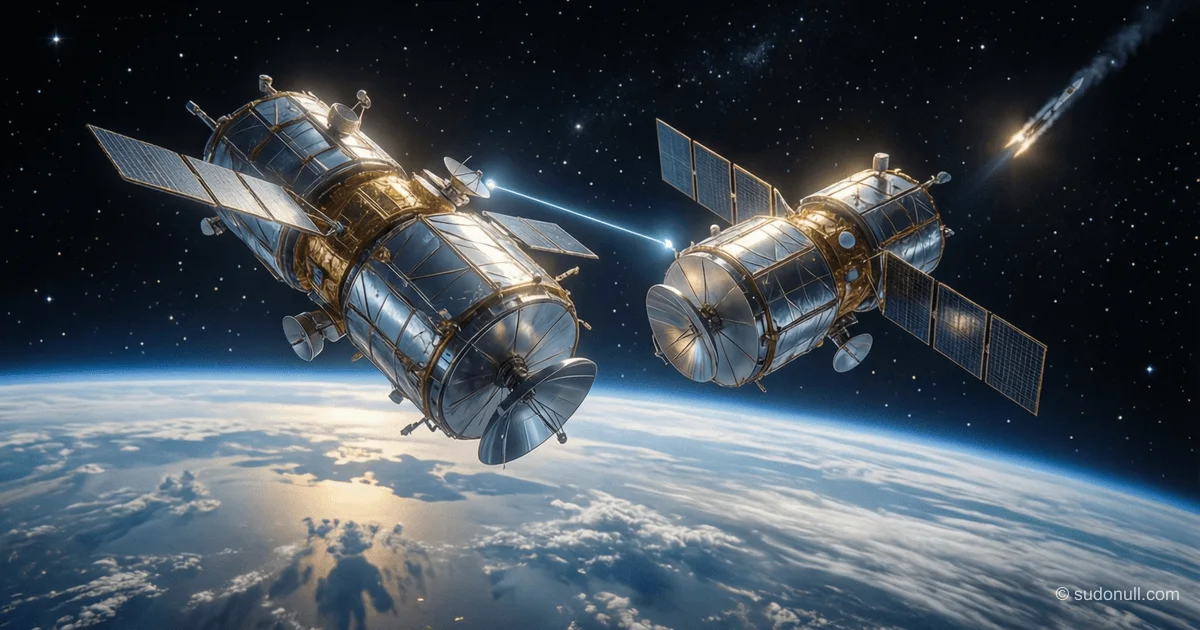
Foxconn Launches Next-Generation PEARL Satellites to Test Future Communications
The Taiwanese giant launched two low-Earth orbit satellites aboard a SpaceX Falcon 9 rocket. The spacecraft are designed for a five-year mission to test new communication technologies and space science.
PEARL satellites in orbit: How Foxconn is transforming from iPhone assembler to space communications player
Introduction
Taiwan's Foxconn, best known globally as the largest contract electronics manufacturer and the main assembler of iPhones, took another step away from its familiar image on May 3, 2026. Two second-generation satellites, PEARL-1A and PEARL-1B, were successfully launched into low Earth orbit aboard a SpaceX Falcon 9 rocket from Vandenberg Air Force Base in California. This event is not a one-off PR stunt but part of a deliberate strategy to enter the satellite communications market, valued at tens of billions of USD, and to transform Foxconn from a hardware manufacturer into an operator of space infrastructure.
Event Details and Timeline
The launch took place on the evening of May 3, 2026, as part of the CAS500-2 mission for co-manifested payloads. Both satellites—PEARL-1A and PEARL-1B—are built in an enlarged 6U XL CubeSat form factor and have successfully reached their target orbits. Their names reflect the mission's flight plan: the spacecraft follow each other (Before and After) to conduct coordinated experiments in inter-satellite communication.
This is the second generation of the PEARL satellite platform. The first generation, launched in November 2023 on the Transporter-9 mission, focused on testing satellite-to-ground communication via receiving stations in Taiwan, Europe, and Norway's Svalbard. The first mission phase was successfully completed in January 2026, and the control center in Taipei's Neihu district accumulated a significant amount of data over more than two years. Now, building on this experience, Foxconn is moving to a more complex task: satellite-to-satellite communication links.
The key technological differentiator of the second generation is the Ka-band payload for inter-satellite links (ISL). This allows the two PEARL satellites not only to exchange data with Earth but also to communicate directly with each other. Additionally, a compact ionospheric probe (CIP), developed by Taiwan's National Central University, is onboard to monitor space weather and its impact on communication quality.
The five-year mission has a dual purpose: to verify payload technologies in real conditions and to create a closed-loop design cycle where orbital data directly influences the design of future satellite generations. System integration before launch and operations afterward are managed by the Foxconn Research Institute, underscoring the company's serious commitment to R&D.
Impact and Significance
The strategic importance of the launch extends far beyond a technical experiment. Foxconn is systematically implementing the model that brought it success in electronics manufacturing—CDMS (Contract Design and Manufacturing Service), or "design and build turnkey"—but now applied to the space industry. The company is mastering the key competency of satellite manufacturing: assembly, integration, and testing (AIT). This is the skill set that turns individual components into a working space system, and Foxconn is methodically building it up, moving toward vertical integration with an increasing share of in-house components.
The market for these services is enormous. Low Earth orbit satellite constellations—from Starlink to Amazon Kuiper—require mass production of spacecraft in the thousands. This is where the manufacturing giant, with annual revenue of around $200 billion, sees its niche: transforming bespoke satellite manufacturing into assembly-line production with economies of scale. As senior analyst Wen Wei-chieh put it, the launch "symbolizes the maturity of Taiwan's satellite communication technologies" and expands the equipment market for low-orbit systems by leveraging accumulated manufacturing experience.
Service ambitions are equally telling. Foxconn has outlined the range of applications targeted by its satellite platform: mobile network complement, Direct to Cell technology, connectivity for remote areas, industrial IoT, and backup links for critical infrastructure. This list is not abstract dreaming but a set of real market niches where satellite communications are experiencing explosive growth. Direct to Cell, in particular, is a focus for players like SpaceX and AST SpaceMobile, and Foxconn's entry adds competition from a manufacturer capable of scaling equipment production faster than many.
The symbolic aspect is also noteworthy. A company whose name is associated with assembling others' products is launching its own satellites on Elon Musk's rocket—a figure embodying technological breakthrough and industry boundary disruption. This underscores that the line between "equipment manufacturer" and "infrastructure owner" in space is blurring as quickly as it did in the data center market, where server makers became cloud service operators.
Reactions from Key Players
Foxconn's official statements are businesslike but carry ambitious signals. The company emphasizes that the PEARL mission builds "practical orbital experience"—a key asset that cannot be acquired except by launching one's own satellites. It is this experience, not individual components, that Foxconn sees as the foundation of future competitiveness.
Jesse Chao, Senior Director of B5G Policy and Corporate Policy at Foxconn, articulated the strategic vision even before the first generation launch: in the era of Beyond 5G and New Space, launching low-Earth orbit satellites will become cost-effective and routine, and Foxconn intends to be ready to meet growing demand for key components, subsystems, and integration services. The second launch confirms that these words are backed by action.
Market analysts are cautiously optimistic. Foxconn is not trying to compete with Starlink as a consumer-facing service operator; instead, it aims to be an equipment supplier for such operators. This is a more realistic strategy, leveraging the company's main advantage: the ability to manufacture complex electronics at massive scale and low cost.
Also notable is the continued collaboration with Taiwan's National Central University, which supplied the ionospheric probe for the second mission and was a key partner for the first. Foxconn is deliberately building an industry-university ecosystem, reducing R&D costs while training talent for its growing space division.
Forecast and Conclusions
The launch of PEARL-1A and PEARL-1B is an event whose implications are still underestimated by the market. Foxconn is not seeking sensationalism; instead, it is executing a methodical plan where each step lays the foundation for the next. From testing satellite-to-ground links in 2023, it moved to inter-satellite links in 2026. The logical next step is experiments with Direct to Cell and the deployment of a larger constellation, possibly in partnership with telecom operators.
In the short term (1-3 years), we can expect the launch of a third-generation PEARL with an expanded payload suite and likely the first commercial contracts to supply satellite platforms to third-party operators. The medium term (3-7 years) could bring a full-fledged satellite production line with a high proportion of in-house components, competing with established players like Airbus Defence and Space or Thales Alenia Space.
The main challenge is not technological but strategic. Foxconn must convince satellite constellation operators that a Taiwanese contract manufacturer can be a reliable supplier of space equipment with the same quality as consumer electronics. The five-year orbital tests of PEARL-1A and PEARL-1B are precisely intended to provide the necessary proof.
The PEARL story is a vivid example of how a major tech business seeks growth beyond mature markets. When smartphone assembly no longer offers surprising growth rates, satellite communications—with demand projected to triple by 2050—becomes a logical diversification path. Foxconn is not building rockets; it leaves that to SpaceX. Foxconn is not creating consumer services; that is Starlink's territory. But when these operators need thousands of satellites at predictable prices and quality, the manufacturing giant intends to have its say. And the launch of two small CubeSats on May 3, 2026, is the first line in this as-yet-unwritten but already announced business plan.
— Editorial Team










No comments yet.