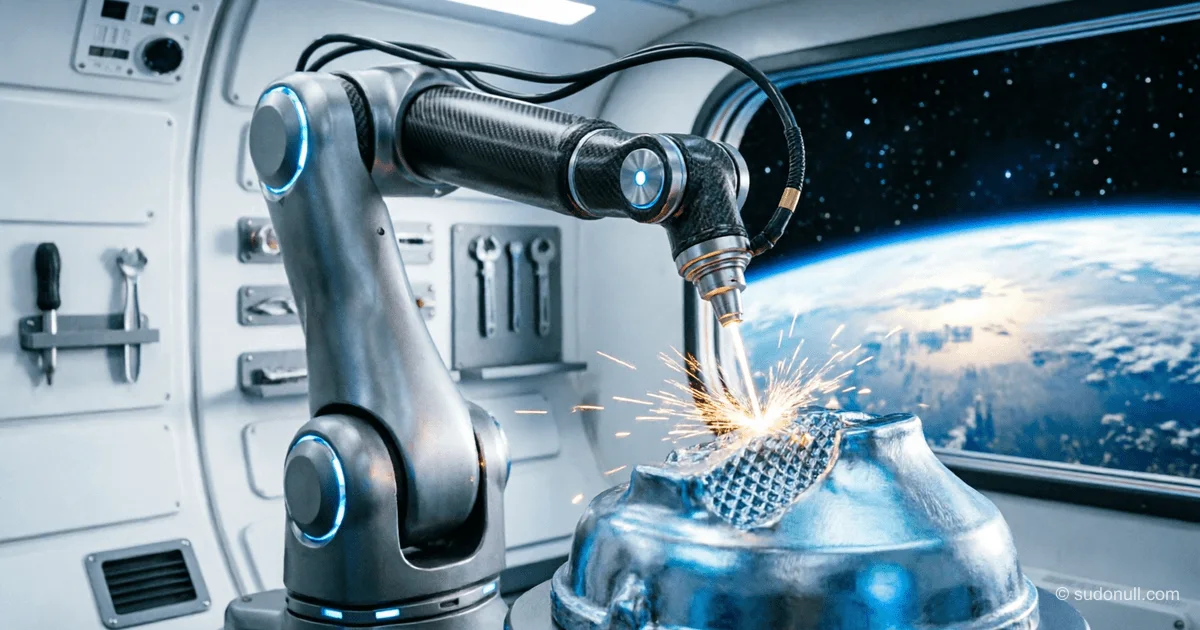
China Successfully Tests Metal 3D Printing in Open Space for the First Time in the World
The experiment aboard the cargo spacecraft Tianzhou confirmed the stability of laser wire-feed printing in microgravity. In the future, this will allow the production of spare parts and repair of structures directly in orbit, without waiting for delivery from Earth.
China has successfully tested metal 3D printing in open space for the first time in the world: how the "celestial workshop" is changing the game
Introduction
At the end of April 2026, China announced a technological breakthrough whose significance extends far beyond yet another space record. Onboard the cargo spacecraft Tianzhou, the technology of metal 3D printing under orbital microgravity conditions was successfully demonstrated for the first time in the world. The Institute of Mechanics of the Chinese Academy of Sciences (CAS), together with the Innovation Academy for Microsatellites of CAS, conducted an experiment proving that laser printing with metal wire feed can operate stably in weightlessness, opening the door to the production and repair of space structures directly in orbit. This event marks a transition from the paradigm of "bring everything with us" to a fundamentally new model — "produce as needed."
Event Details and Timeline
The experiment was conducted aboard the cargo spacecraft Tianzhou, which was launched on March 30, 2026, during its maiden flight. The official announcement of its successful completion was published on April 29 by leading Chinese scientific publications, including Science and Technology Daily and Xinhua.
The technical scheme of the experiment differed from earlier tests: while in January 2026, Chinese scientists managed to conduct metal 3D printing in suborbital flight aboard the Lihong-1 vehicle, lasting only a few minutes, Tianzhou became the first demonstration of the technology under full orbital flight conditions. The difference is fundamental: a suborbital trajectory provides microgravity only for a short period, whereas orbit allows for long autonomous cycles close to real production tasks.
The device installed onboard operated fully autonomously, executing commands from the ground control center. The technology used was the laser wire-feed process, where metal wire is fed into the area of a high-power laser, melted, and layer by layer forms the desired part.
During the experiment, the following key parameters were sequentially verified: stability and uniformity of metal deposition in weightlessness, reliability of multiple remote start and stop cycles, compatibility of the printing equipment with the spacecraft platform, full automation of operations, and correct transmission of telemetry data and images to Earth.
The research team emphasized that the technology faced a number of unprecedented physical challenges. In microgravity, the behavior of molten metal is radically different from on Earth: gravitational convection disappears, metal droplets behave unpredictably, liquid bridges lose stability, and the formation of the melt pool follows completely different laws. Added to this are engineering constraints: the equipment must be extremely lightweight, withstand launch vibrations, adapt to onboard power systems, and ensure safety in the confined volume of the spacecraft.
In parallel with the orbital demonstration, the team from the Institute of Mechanics continues work on the project of a "reconfigurable flexible platform for orbital manufacturing," which could become the basis for a full-fledged "space factory" in the future.
Impact and Significance
The main strategic meaning of the achievement was articulated by the head of the payload development team, Professor Jiang Heng from the Institute of Mechanics: "Mastering space metal 3D printing allows us to significantly enhance the autonomy of orbital servicing and expansion of spacecraft, reducing dependence on ground supply."
The economic logic is inexorable. Delivering one kilogram of cargo to low Earth orbit currently costs from $2,700 (Falcon 9) to $5,500 (Soyuz-2). Moreover, a significant portion of the mass of spare parts and tools stored on the space station is never used, yet every gram was paid for at space tariffs. The ability to print a needed part from compact metal wire, instead of transporting a finished product, reduces the mass of supplies and dependence on logistics chains.
For China, which is actively building its national orbital station Tiangong and planning manned missions to the Moon, the technology becomes a critical link in infrastructure autonomy. Unlike the International Space Station, where cargo ships from several countries ensure regular supply, the Chinese program relies heavily on its own resources. The ability to produce spare parts on-site is insurance against a situation where a breakdown results in months of waiting for the next cargo flight, and every day of downtime costs enormous sums.
On a global scale, the technology changes the architectural logic of space missions. The traditional approach of "design, build on Earth, launch" is giving way to the model of "launch raw materials and produce on-site." This is especially important for long-distance expeditions — a Mars mission, where the delivery window from Earth is measured in months and years, and any critical failure without the possibility of repair is tantamount to failure.
Reactions of Key Players
Official Chinese media covered the event with an emphasis on global primacy. Science and Technology Daily called the demonstration "an important milestone in the development of space manufacturing," and CGTN emphasized that the technology will allow "a shift from the principle of 'take everything you need with you' to the approach of 'produce as needed.'"
In a detailed commentary for China Science Daily, Jiang Heng outlined the vector of further development very specifically: "In the future, when going to the Moon or Mars, distances will be huge, and delivery costs colossal. If even an ordinary screw breaks, waiting for a spare part from Earth will take months. Space metal 3D printing is needed so that astronauts can produce what they lack right on the spot."
Interestingly, Western space agencies and companies — NASA, ESA, SpaceX — refrained from public comments. This is understandable: the technological race in additive space manufacturing is just beginning, and each side prefers to act without unnecessary publicity. NASA, in particular, has previously conducted experiments with plastic 3D printing on the ISS, but metal printing in space remains uncharted territory for all players except China.
Notably, in parallel with space experiments, ground-based additive manufacturing infrastructure is also developing. At the end of April 2026, GKN Aerospace, together with the U.S. Air Force Research Laboratory (AFRL), launched the TITAN-AM program with a budget of $8.4 million, aimed at industrializing laser metal wire-feed printing for large aerospace structures. The same LMD-w technology that the Chinese are testing in orbit is already used on Earth for producing titanium parts for Airbus A350 aircraft.
Forecast and Conclusions
The orbital demonstration on Tianzhou marks the transition of the technology from the stage of laboratory experiments to the engineering phase. In the short term (one to three years), we can expect expanded testing over longer periods and under more complex conditions, as the research team has already stated. The medium-term horizon (three to seven years) — the appearance of the first operational systems onboard the Chinese orbital station, capable of printing spare parts and tools on demand by the crew. The long-term perspective (seven years and beyond) — the deployment of full-fledged orbital "factories" based on flexible platforms, capable of producing large structures that cannot be launched from Earth in assembled form due to the size constraints of rocket fairings.
On the path to these goals, a number of fundamental problems remain to be solved. First, the control of molten metal in microgravity is still insufficiently studied: heat transfer processes, the behavior of liquid bridges, and the evolution of the melt pool require detailed physical modeling. Second, certification of parts printed in space for critical applications is a process that takes years on Earth and has no established procedure in space at all. Third, the energy consumption of laser printing systems requires either a significant increase in onboard power or the development of more efficient lasers.
However, the fundamental barrier has already been overcome. The technology, which just a few years ago was considered a theoretical possibility, has proven its functionality in real spaceflight conditions. China has staked its claim to leadership in a field that, in the coming decades, will determine whether space missions can become truly autonomous — or whether humanity will remain tied to Earth by a long and expensive logistics chain. The story of Tianzhou is the first line in a yet unwritten but already begun chapter on space industrialization.
— Editorial Team










No comments yet.