Penza Region Discusses Enhancing Drones with Artificial Intelligence
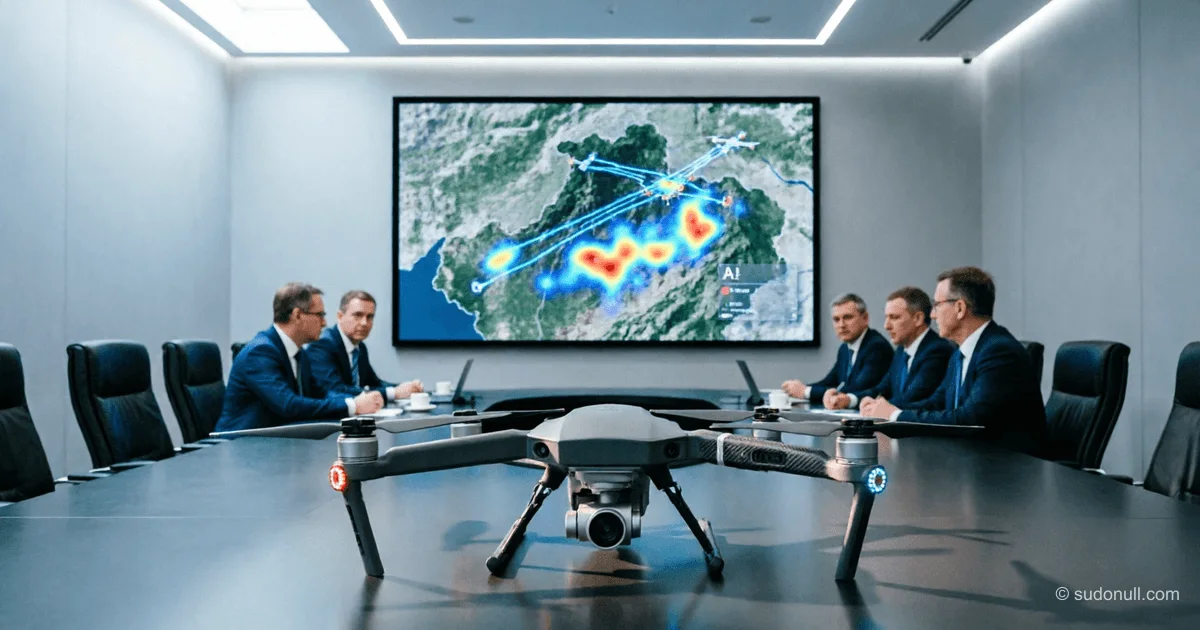
In Zarechny, a meeting was held on the regulatory framework for integrating unmanned aerial vehicles and artificial intelligence technologies into the region's economic activities. This is part of the trend toward deploying "smart" drones for various civilian tasks.
As an analyst tracking the development of unmanned systems in Russian regions, I view this meeting in Zarechny not as a routine bureaucratic gathering, but as a moment that solidifies Rosatom's role as the architect of the national civilian drone market. On the surface, the news reports a discussion about regulations. But knowing the context, we are witnessing a closed city with a nuclear legacy transform into a testing ground for technologies that will reshape entire industries.
The Core: What Is Really Happening
Formally, the meeting in Zarechny discussed drone applications in economic activities. But the real agenda is deeper: regional authorities are synchronizing three vectors—federal legislation, Rosatom's production capabilities, and the demands of specific enterprises like Impuls-Atom.
A key point often overlooked: the meeting was not held for abstract "digitalization" but to launch a practical mechanism where inspectors can remotely detect violations using drones. This was enabled by Federal Law No. 567-FZ of December 29, 2025, which legalized the use of unmanned aircraft systems in state control.
Valery Chuikov, founder of the Impuls-Atom plant, articulated the business demand bluntly: "It is important for us to understand the legal basis for producing civilian unmanned systems. Equally important is expanding their areas of application." Behind these words lies a concrete need: the plant is ready to produce drones but needs a guaranteed market. Regional authorities are creating that market by turning regulatory bodies into the first major customers.
Timeline and Context
The chronology clearly shows this is not a set of isolated initiatives but a systematic deployment:
January 16, 2026: The President holds a meeting on the development of autonomous systems, after which a list of instructions is approved for the accelerated adoption of drones in key economic sectors.
December 2025: Law No. 567-FZ comes into force, creating a legal foundation for using drones in control and oversight activities.
April 2026: Scientists at Penza State University announce the creation of an information-measurement system for drones capable of determining local meteorological conditions. Development lead Viktor Baranov explains: "Although we receive reliable weather forecasts for each region and city, this information does not guarantee that the forecast for a large area will hold true at the specific location where we are."
Late April 2026: The regional Ministry of Economic Development holds a seminar-meeting with officials and manufacturers.
Early May 2026: A new meeting focuses on AI and expanding application scenarios.
This sequence reflects Rosatom's typical methodology: first, a scientific foundation is laid (university development), then a production base is established (plant in Zarechny), and only then is the regulatory framework adjusted to open the market.
Winners and Losers
Winners:
Rosatom and its residents: Zarechny is a priority development area where the State Corporation's department for regional interaction oversees small and medium businesses. Manufacturers gain guaranteed demand from the state.
Control and oversight bodies: They can vastly expand their coverage without hiring additional staff. AI is expected to handle data processing from drones, detecting violations with minimal error.
Agriculture and Emergency Situations Ministry: Application scenarios are already developed—from monitoring land use to remote forest fire surveillance.
Losers:
Private drone operators without administrative resources: The civilian drone market is forming around state orders. Companies not affiliated with Rosatom or lacking access to regional authorities risk being left out of major contracts.
What the Media Leaves Out
Now for the promised insider perspective, completely missed by news reports. The real bet is not on drones per se, but on creating a Unified Monitoring and Identification System for autonomous vehicles integrated with ERA-GLONASS.
Why is this important? Because control over the sky in the civilian sector is becoming an infrastructure asset. Whoever owns the identification system can not only track flights but also collect data that becomes a commodity. The President's instructions directly call for creating geospatial services based on integrating multimedia sources using AI algorithms.
Zarechny is ideal as a testing ground: it is a closed administrative territory where monitoring technologies can be tested without leakage risks and with minimal restrictions from civil aviation laws. Solutions developed in the closed city are then scaled nationwide.
A second point that goes unmentioned: the synchronization with PSU's scientific base is no coincidence. The university's information-measurement system can measure methane concentration in mines and monitor pipeline integrity. These are exactly the scenarios that interest Rosatom as an operator of nuclear and mining facilities. A drone with a gas analyzer is an industrial safety tool that can be certified to nuclear industry standards.
Forecast: Next 30 Days and 90 Days
Next 30 days (until June 5, 2026):
The first contract between regional authorities and manufacturers from Zarechny for a batch of drones with AI modules for land control needs will be announced. I expect the amount to not exceed $1.5–2 million—a test volume that won't attract federal media attention but will signal the industry. Simultaneously, PSU will begin flight tests of the information-measurement system prototype on the university campus.
Next 90 days (until August 4, 2026):
The regional Ministry of Economic Development will approve a roadmap for deploying drones in at least three agencies—from environmental oversight to the Emergency Situations Ministry. The key signal to watch: if Impuls-Atom announces hiring of machine vision specialists, the project has moved from regulatory approvals to technical implementation. This would mean the Penza Region becomes a pilot region for the national monitoring system, and Rosatom gains a precedent that will then be lobbied at the federal level as a "successful import substitution practice."
— Editorial Team










No comments yet.