Japan's Toto ramps up ceramic component production for AI chips amid investment boom
Toto, a company known for manufacturing sanitary ware, has announced an expansion of its business producing ceramic parts for semiconductor equipment. This decision, amid high demand for AI chips, led to a record surge in its shares of about 18% on the Tokyo Stock Exchange.
As an analyst observing the transformation of global semiconductor supply chains, I view Toto's stock surge not as a curiosity about a "toilet manufacturer," but as an indicator of a fundamental shift in how the market evaluates the hidden links of AI infrastructure. What is presented as an "unexpected bonus" from the artificial intelligence boom is actually the logical culmination of a forty-year technological bet that Toto made quietly while everyone discussed the design of Washlet toilets.
[The Core]: What is really happening
This is not diversification or a lucky coincidence. Toto is executing a scenario where its "side" business becomes the main driver of market capitalization. The dry figures from the fiscal year 2026 report (ended March 2026) speak for themselves: the advanced ceramics division posted revenue of 67.4 billion yen (about $429 million) with an operating profit of 28.9 billion yen. This means the segment's margin exceeded 40% — an absolutely anomalous figure for "traditional" industrial manufacturing, comparable to software companies.
The key shift that most observers miss: for the first time in the company's history, the ceramics division's share of operating profit exceeded 53%, leaving the core sanitary ware business far behind (18 billion yen in Japan and 7 billion yen overseas). This is not a "side gig" for a toilet manufacturer — it is a full-fledged change in the company's profile in the eyes of investors.
Timeline and Context
The timeline of Toto's transformation clearly shows that this is not a spontaneous leap but a forty-year trajectory:
1980s: Toto enters the production of electrostatic chucks (ESC), leveraging its expertise in high-precision ceramics developed in the sanitary ware business. For decades, this remained a highly specialized niche — important but inconspicuous.
2020–2024: The margin of the ceramics segment grows from less than 9% to levels many times higher than those of the core business. Toto establishes itself as the world's second-largest ESC manufacturer.
February 2026: British activist fund Palliser Capital takes a stake in Toto and publicly demands that management increase transparency and investment appeal of the ceramics business, which investors believe is "undervalued by the market due to the association with toilets."
April 30, 2026: Publication of record results. Net profit for the fourth quarter was 11.7 billion yen compared to a loss a year earlier.
May 1, 2026: Toto shares surge 18% to 6,425 yen — a five-year high and the largest single-day gain in trading history.
Plan through 2028: The company announces investments of 30 billion yen (about $190 million) to expand three ceramic plants.
Who Wins and Who Loses
Winners:
- Toto and its shareholders: The company's market capitalization exceeded 1 trillion yen. The 48% rise in shares since the start of the year is a direct revaluation of the business from a "low-margin sanitary ware manufacturer" to a "high-tech supplier of AI infrastructure."
- Palliser Capital: The activist fund, which took a stake in February 2026, has already gained significant paper profit and will increase pressure on management to spin off the ceramics business to fully realize its hidden value.
- NAND memory consumers: The expansion of ESC production means that upstream constraints on NAND chip output will ease, potentially leading to lower prices for SSDs and data center memory within 12–18 months.
Losers:
- Toto's core sanitary ware business: It has been overshadowed. Supply issues with plastic and adhesive materials due to the Middle East crisis led to a temporary suspension of order acceptance in April and a write-down of 7 billion yen. The division looks increasingly like a burdensome drag.
- Toto's ESC competitors (NGK Insulators, Kyocera, Coorstek): With its 40 years of expertise and willingness to invest 30 billion yen in capacity expansion, Toto becomes an increasingly dangerous rival in a consolidating market where the top nine players already control 88%.
What the Media Isn't Saying
The vast majority of headlines revolve around the "gimmick" — a toilet manufacturer making money from AI. That's catchy, but it hides a much more serious insight about the structural vulnerability of the global AI boom.
The problem is not that Toto is a "funny" company, but that the global chip industry depends on a single Japanese plant that makes ceramic discs.
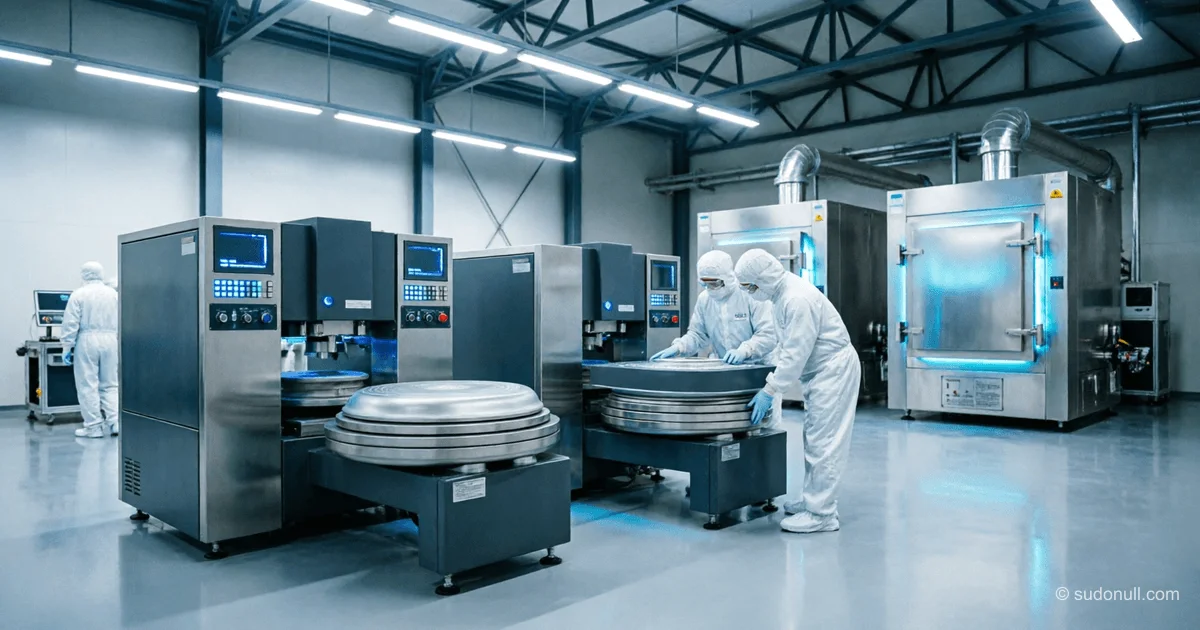
An electrostatic chuck (ESC) is a ceramic plate about the size of a pizza that holds a silicon wafer during NAND chip etching. The allowable surface unevenness is about 1/80 the thickness of a human hair. This is not a "consumable" but a critical component without which the NAND memory production line would stop. And Toto, as the world's second-largest ESC manufacturer, has an order book already filled through 2027.
Now imagine a scenario: the expansion of plants in Kyushu is delayed, while global demand for AI infrastructure continues to grow (the commissioning of data centers alone requires billions of dollars in investment quarterly). In that case, Toto becomes a bottleneck for the entire NAND chain. This is not just a Japanese corporate story — it is a systemic risk for global memory supply that the market underestimates. If previously the bottleneck was ASML's EUV lithography machines, now it could be a simple ceramic plate from a "toilet manufacturer."
Second point: Toto is not the only "strange" company in the AI chain. Ajinomoto (yes, the monosodium glutamate maker) produces insulating films for chips, Kao (shampoos) makes cleaners for silicon wafers. This means that AI infrastructure depends on expertise developed in industries far removed from IT, and this expertise has gone unnoticed by investors for decades. Now a landslide revaluation is underway.
Forecast: Next 30 Days and 90 Days
Next 30 days (until June 5, 2026):
Analysts at Nomura (who have already raised their target price for Toto to 5,430 yen) will revise forecasts further upward. Expect Goldman Sachs and Morgan Stanley to publish detailed reports analyzing the "second and third tier" beneficiaries of AI infrastructure, with Toto taking center stage as a "hidden champion" case. Palliser Capital will increase pressure on management to spin off the ceramics division.
Next 90 days (until August 4, 2026):
Toto will announce concrete plans to build a new plant outside Japan — likely in Taiwan or South Korea, closer to major ESC consumers. Investments will exceed the announced 30 billion yen. The key risk is the Middle East crisis affecting raw material supplies for the core sanitary ware business. If it worsens, management will have to make a painful choice between saving the "historic" business and fully focusing on ceramics. My forecast: by autumn 2026, Toto will publicly acknowledge that its future as a "toilet manufacturer" is limited and will begin the process of spinning off the sanitary ware division to maximize shareholder value from the ceramics AI business.
— Editorial Team









No comments yet.