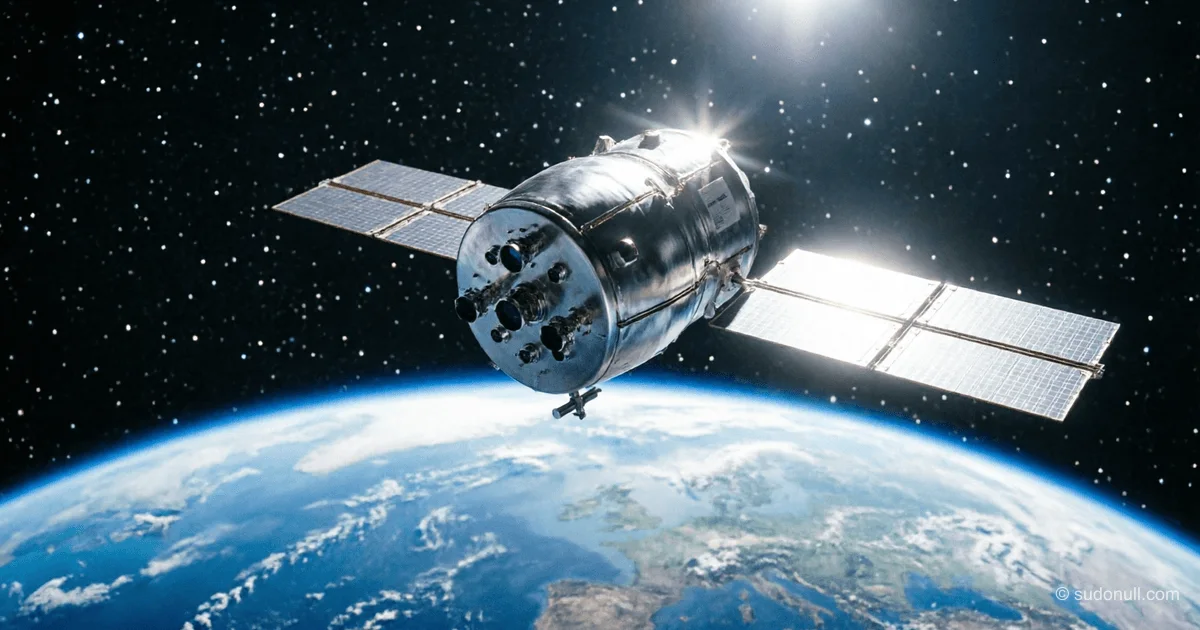
South Korea Successfully Launches Domestically Developed CAS500-2 Satellite
The Earth observation satellite CAS500-2 successfully reached low Earth orbit after a SpaceX Falcon 9 launch. The spacecraft boasts 0.5-meter resolution in black-and-white mode and will be used for disaster monitoring and agricultural observation. Key components of the satellite's platform and payload were developed using domestic technologies.
As someone who has watched the space race in Northeast Asia for nearly a decade, I see the launch of CAS500-2 not as just another checkbox for KARI, but as the completion of a tectonic shift in launch geopolitics and export controls. What is being presented under the guise of "disaster monitoring" is actually the final point in the dismantling of Russian influence on Seoul's space logistics and a quiet but confident entry of South Korea into the club of total technological sovereignty.
[The Gist]: What's Really Happening
Formally, we see the successful orbital insertion of a 534-kilogram spacecraft with 0.5-meter resolution. However, the essence of the event runs much deeper: this is the first time a South Korean high-resolution satellite of the KOMPSAT/CAS class, built with near-absolute localization (86% of the platform and 98.6% of the payload), is launched without relying on Russian launch infrastructure. This is not just a change of rocket. It is the final break of a dependency that stretched back to the launch of the first KOMPSAT.
Previously, the scheme was ironclad: the satellite was made in Korea, but key components (especially SAR sensors and buses for heavy platforms) often required European or American cooperation, and launches were carried out from Baikonur or on the Dnepr. With CAS500-2, this model has died for good. Seoul has shown that it can not only make the "brains" and "eyes" of the satellite itself, but also flexibly enter the American ride-share system (SpaceX) without losing momentum. Behind this is a clear order from KASA (Korea AeroSpace Administration): exit the toxic asset of Russian cosmonautics at any cost. And the cost turned out to be acceptable—a standard ticket on Falcon 9 within the pool.
Timeline and Context
To understand the scale of disaster for some and triumph for others, we need to rewind the tape a few years:
- First half of 2022: CAS500-2 was scheduled to go into orbit on a Soyuz rocket from Baikonur. The contract was signed, integration almost complete. The start of the SMO and subsequent Western sanctions put an end to international cooperation with the Russian Federation on seemingly non-military projects. The spacecraft became a hostage of the situation.
- 2023: South Korea searches for a new rocket. European options (Ariane, Vega-C) and American ones are considered. The choice of Falcon 9 was pragmatic: launch cost around $52–74 million per seat in a rideshare mission versus potentially more expensive and less schedule-flexible European launchers. But beyond price, the speed of insertion into the desired orbit played a role. No one wanted to wait years in line at Kourou.
- May 2026: CAS500-2 establishes contact with a Norwegian station in Svalbard. The fact that it worked immediately speaks to the maturity of the platform. Usually, after such nerve-wracking delays and changes in adapter architecture for the Falcon 9 fairing, a host of glitches occur. Here—clean work by KAI engineers.
Who Wins and Who Loses
Winners:
- KAI (Korea Aerospace Industries): They have emerged from the shadow of state-owned KARI and now have full rights to sell the CAS500 platform as a completely private product. Their next client could be any country that needs 0.5-meter resolution imagery but lacks access to American or European technological know-how in its pure form.
- SpaceX: They didn't just get a $50+ million contract. They got a precedent for poaching sensitive scientific cargo from a US ally country away from Roscosmos. Each such success destroys the myth that only Russian "workhorses" are needed for certain classes of launches.
Losers:
- Roscosmos and the Soyuz launch program: The financial loss is tangible (tens of millions of euros for several contracted launches that went to Musk), but the reputational hole is even bigger. The Southeast Asian market, which for decades was the domain of Russian rockets, is finally gone. Every CAS500 and KOMPSAT flying on Falcon 9 is a nail in the coffin of commercial launches from Plesetsk and Vostochny.
- European launch operators (Arianespace): They failed to secure this order, even despite the sanctions environment. This means that even with a competitor (Russia) artificially sidelined, Europe is slower and more expensive than SpaceX.
What the Media Isn't Saying
Now pay attention. Mainstream media, especially Western and Russian, shout about Roscosmos's failure or SpaceX's successes. But they miss the non-obvious insight about the dual-use nature of CAS500-2 in the context of air defense and killer satellites.
No one writes openly, but CAS500-2 with its multispectral imaging mode and ultra-high resolution in panchromatic is an ideal tool for verifying data from the military "425 Project" constellation. Remember "Project 425"—it's a purely military reconnaissance satellite program where some satellites see in optics, others via synthetic aperture radar (SAR). CAS500-2 is officially "civilian" and will monitor floods and crops. However, its trajectory (sun-synchronous orbit, altitude 498–528 km) with a revisit period of any point every 28 days allows it to be used as a reference calibrator for military targeting systems, as well as a backup for damage assessment after potential strikes on North Korea.
Legally, this "civilian/military" split allows bypassing some ITAR export restrictions when purchasing components and selling imagery on the commercial market with a clean slate. The world sees agriculture, while the military sees coordinates and fresh craters. This is not a bug but a feature of the modern space intelligence strategy of small technological powers.
Forecast: Next 30 Days and 90 Days
Next 30 days (until June 5, 2026):
The calibration phase of AEISS-C will begin. As soon as the first images of a "work area" (likely port zones of Busan or disputed territories in the Sea of Japan) leak into closed Telegram channels, analysts will start comparing CAS500-2's quality with American WorldView Legion satellites. I predict that KAI will officially announce the first export contract for the CAS500 platform with a Middle Eastern country in about 3–4 weeks. The contract value will be around $80–120 million for two satellites.
Next 90 days (until August 4, 2026):
The pairing of CAS500-1 and CAS500-2 in orbit will reduce the revisit time from 28 to 14 days, and in the case of priority tasking, to a few days. This will allow KASA to announce the launch of a commercial service "K-Sat Imaging" in opposition to European Airbus and American Maxar. The subscription price for the data stream will be 15-20% lower than the market rate ($22–25 per square kilometer of multispectral data instead of $30). This will upend the geospatial intelligence market in Asia, where many countries are looking for a cheaper alternative to American digital sovereignty but do not want to deal with Chinese satellites due to trust issues.
— Editorial Team









No comments yet.