TSMC Plans to Build €10 Billion Chip Plant in Germany
The world's largest contract chipmaker, Taiwan Semiconductor Manufacturing Co. (TSMC), has entered negotiations with partners to build a new plant in Saxony. The €10 billion joint venture aims to expand the company's production capacity in Europe.
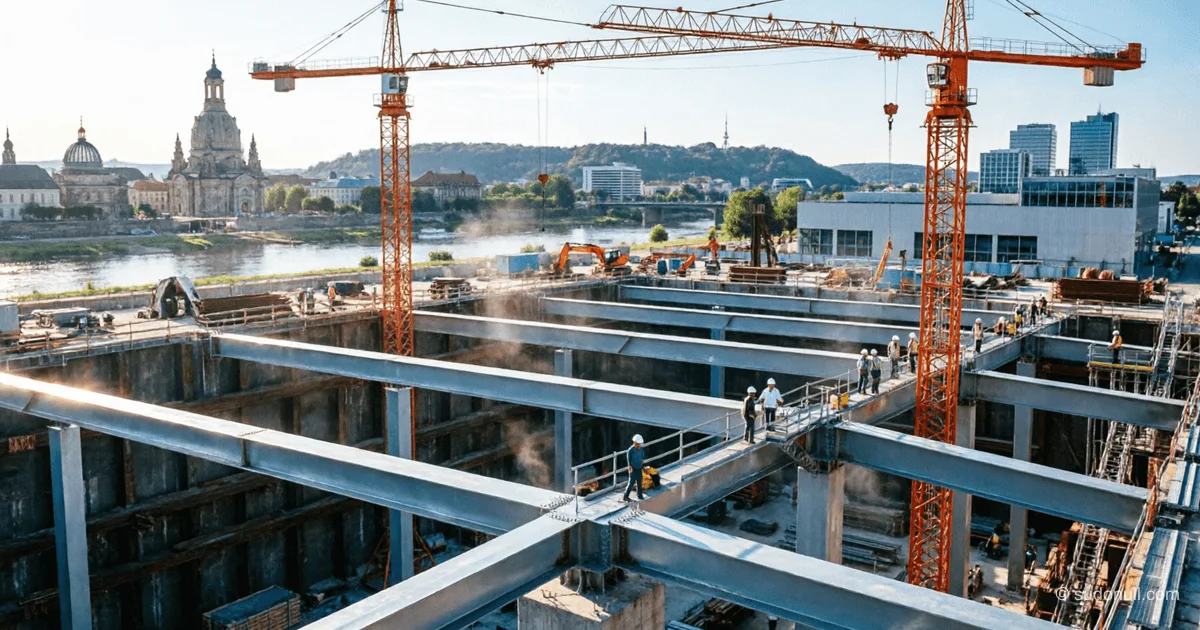
I look at this construction site in Dresden, where steel beams are already rising from the excavation pit for Europe's first TSMC plant, and I realize: we are witnessing the most expensive lesson in geopolitical maneuvering that the semiconductor industry has ever seen. What the press presents as "capacity expansion" or "a success of European bureaucracy" is actually a survival drama, where Taiwan is desperately converting its technological superiority into transactional sovereignty before Beijing cuts off its oxygen supply entirely.
[The Core]: What's Really Happening
This is not just a factory construction. TSMC is initiating the largest evacuation of know-how since World War II. At stake is not just €10 billion poured into Saxony's sandy soil. At stake is the physical survival of N-1 process technologies beyond the reach of the PLA.
Calling ESMC a commercial enterprise is only possible in a nightmare. It's a geopolitical option. By producing chips on 28/22 nm and 16/12 nm nodes at this plant, TSMC solves two non-trivial problems:
- "Fab 2.0" Insurance: If a hot phase begins in the Taiwan Strait, the most mass-produced (and critically important for the automotive industry) technologies will already be duplicated in Dresden. Note: they are not moving the ancient 45 nm node here, but the mature yet still scarce FinFET (16/12 nm) — the circulatory system of modern ADAS systems for BMW and Porsche.
- Control over Chips Act 2.0: Germany secured €5 billion in government subsidies for this. TSMC is essentially building a copy of its Taiwanese plant at European expense to dictate terms to the local market. This mirrors the situation with Intel's Arizona plants, but here the construction speed will be higher.
Timeline and Context
Timeline is crucial here because the pace set by TSMC in Dresden is absolutely anomalous for European construction:
- Mid-2024: Groundbreaking ceremony. Politicians take selfies in front of an empty lot.
- October 2025: Just a year later, the foundation slab is ready, vertical structures are being erected. Up to 30 cranes and 1,200 construction workers operate simultaneously on site. This is Taiwan's pace transplanted to Germany, causing cultural shock for Saxony's Premier Kretschmer: "There's a different energy, a different drive. We in Germany need to wake up."
- End of 2026 (plan): Sealing of the "box" (roof) and completion of clean rooms. Initial equipment installation runs in parallel.
- Spring 2026 (now): Start of negotiations for the second phase (the very news about "€10 billion expansion"). In reality, this is not a new decision but a planned fork. The success of the first phase is already budgeted.
Key takeaway: all timelines are accelerating. TSMC is pushing German contractors as if war were tomorrow. And in their worldview, it very well might be.
Who Wins and Who Loses
Winners:
- Saxony (but not all of Germany): Dresden is turning into a new HSINCHU. Dozens of TSMC employee families have already arrived, and a Mandarin program is opening at the International School of Dresden (tuition about €1,500 per month per student). TSMC is essentially building a small Taiwanese diaspora on the Elbe. The city will gain 15,000 new residents in the next 3 years, including supplier families.
- Material Suppliers (Topco, Air Liquide): Idle construction sites and chemical plants around Dresden are being revived. Air Liquide is building a new industrial gas plant, Taiwanese Topco is opening its first European subsidiary.
- NXP, Bosch, Infineon: They are minority shareholders (10% each) but get reserved production slots for the most popular automotive chips without market competition.
Losers:
- GlobalFoundries Dresden (AMD legacy): Their "native" Fab 1 in Dresden suddenly becomes an "old factory" with uneconomical operations compared to the subsidized ESMC.
- Dresden's Middle Class: Rental housing in Dresden is already rising. A specialist at the Fab receives not a German salary but an "expat" Taiwanese premium. Local engineers without Mandarin are left out of management.
What the Media Isn't Saying
Now for the promised non-obvious insight that would make any European regulator's hair turn gray. The media discusses the investment volume (€10 billion) and the number of jobs (2,000). But all my experience with Asian foundry projects screams one thing: this plant will never achieve true technological autonomy. It's an "iron assembly shop" without the encryption keys.
Why? Because TSMC is building a production clone in Dresden but is not transferring the "brains" here. The technology files (PDK) for 16/12 nm, let alone future mature nodes that could appear here, remain on servers in Hsinchu. Without access to the PDK, European engineers at ESMC will only be able to change consumables on lithography machines and perform routine "recipe loading" operations. Pressing the "Start" button on someone else's recipe does not mean owning the technology.
TSMC categorically prevents cross-pollination of personnel with American or Japanese fabs. Dresden staff will undergo internships but will not be allowed near the development core. This guarantees: even if the EU invests another €50 billion, without a Taiwanese engineering center, this plant is just a very expensive CNC machine that will stop a week after severing ties with headquarters.
Forecast: Next 30 Days and 90 Days
Next 30 Days (until June 5, 2026):
The holiday season hasn't started yet, so construction will continue to accelerate. Expect an official announcement from the German Ministry of Economics on an additional package for educational grants. But the main signal I'm watching for is an announcement from TSMC about recruiting not just operators but process integration engineers. If within a month ESMC opens applications for Senior Device Engineer positions, it means the degree of know-how localization is slightly higher than we thought. If not, everything is going according to the "operations shop" scenario.
Next 90 Days (until August 4, 2026):
EU members will stir. Saxony's success will push Poland and the Czech Republic (a stone's throw from Dresden) to maximize favorable conditions for ESMC suppliers. We will see aggressive tax wars between federal states and neighboring countries for the right to host warehouses and logistics centers for this plant.
But the key risk is energy. The Dresden plant means megawatts of continuous consumption. TSMC will sign green energy contracts. But EU bureaucracy regarding renewable energy certification is complex. I suspect that by August we will learn about temporary concessions from Germany for ESMC to use "dirty" energy during the commissioning phase, which will cause a scandal among the Greens but will be overridden by Berlin's political will due to the critical importance of chips for the automotive industry.
— Editorial Team







No comments yet.