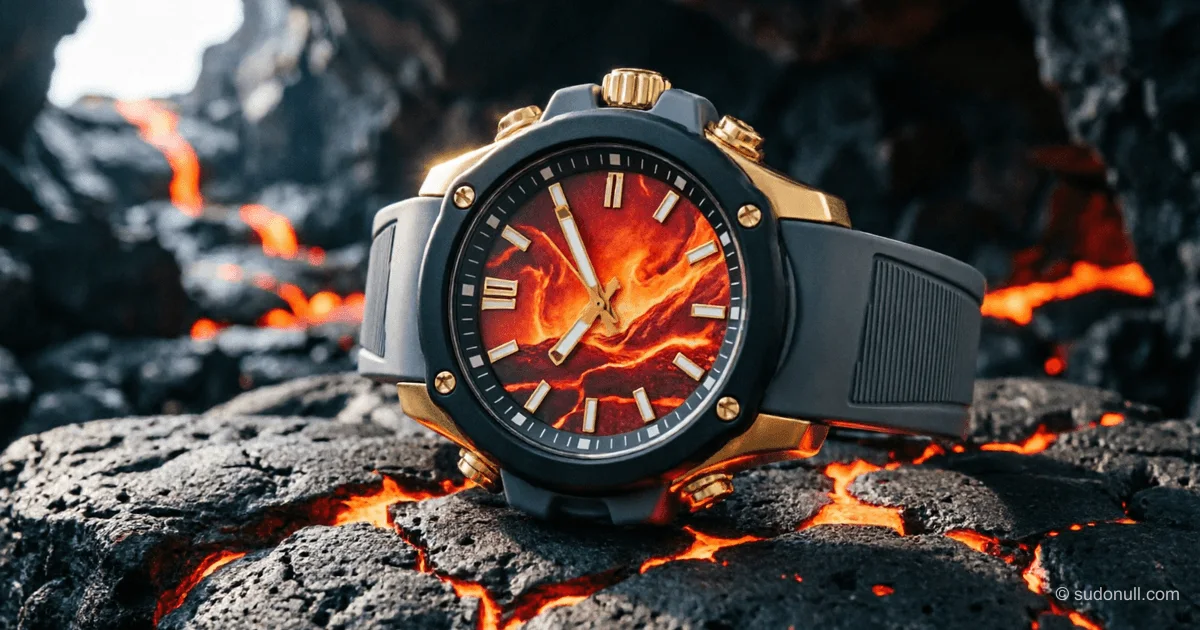
New Product: Casio Unveils Mudmaster GWG-B1000MG-1A9 in 'Magma' Design
Casio has introduced a new model in the Mudmaster line, with a design inspired by geology and Earth sciences. The dial features red-orange tones reminiscent of molten magma, and the case is made from impact-resistant bioplastic. The watch is equipped with a solar battery and Triple Sensor technology.
The new Magma Mudmaster from Casio — at first glance, just another limited edition in the G-Shock lineup. But if you look at the price, materials, and timing of the announcement, a strategy emerges that most reviewers are silent about. Casio isn't just releasing a geologically inspired watch; it's methodically legitimizing bioplastic technology in the premium price segment, testing a sustainable consumption model on brand fans for the entire future product line.
[The Core]: What's Really Happening
This isn't just another 'magmatic' design launch. Casio is using the Mudmaster as a technology testbed. When you hear that the case, bezel, and strap are made from castor oil or corn-based bioplastic, it's important to understand the context: Casio is taking a material traditionally associated with cheap eco-products and placing it in a case with a price tag of 899 EUR and official certification for 200-meter water resistance.
This is a risky move. The G-Shock consumer in the $900+ segment is conservative: they're used to metal cases, carbon, sapphire, and in the case of the GWG-B1000MG-1A9, a black forged case reinforced with a Carbon Core Guard structure. The gold ion-plated bezel over this construction creates that 'magma' effect — a visually expensive material masking the fact that the base polymer is plant-derived.
But why now? The answer lies in regulation. Japan is pushing for carbon neutrality, and the EU is tightening electronics disposal requirements. Casio can't rely on petrochemical polymers forever, but switching to bioplastic in the budget line is risky: fans might think 'G-Shock isn't what it used to be.' So they chose the Mudmaster: niche, expensive, aimed at outdoor enthusiasts who value functionality over image. If these people accept bioplastic, Casio will scale it across the entire Master of G line, and then to more affordable series.
Timeline and Context
The timeline is crucial because it shows the speed of innovation commercialization:
- Late 2025: First rumors and leaked images of the model appear, before the official announcement.
- April 2026: French retailer David et Philly reveals the European price — 899 EUR, which translates to roughly £800 in the UK market. For comparison, this is more expensive than most flagship Garmin Instinct and Suunto models, direct competitors in the outdoor segment.
- May 2026: Japanese launch at 143,000 yen ($910). Simultaneously, Casio launches two other models — MTG-B4000 and GD-B300 — and a new G-LIDE series, as well as a collaboration with Coca-Cola. This is a classic 'bundle launch' strategy: media attention is scattered, and the radical nature of the Magma Mudmaster appears softer against other new releases.
- June 2026 (planned): European sales start.
The key point missed by most publications: this isn't just a new colorway. It's a model on the GWG-B1000 platform, but with the first case in the series where bioplastic is used in load-bearing elements — the bezel and strap — not just decorative inserts.
Who Wins and Who Loses
Winners:
- Casio Computer Co: Gains invaluable data on bioplastic durability in field conditions. Every Mudmaster bought by a climber or soldier is a free R&D tester, checking how biopolymers withstand UV, altitude changes, and mechanical stress for $910.
- G-Shock collectors: A limited series with a magma theme means immediate value increase on the secondary market. Given the history of Mudmaster limited editions, in two years these watches will sell at a 20-30% premium over retail, especially in Asia.
- Bio-raw material suppliers (castor oil, corn): If Casio's experiment succeeds, demand for industrial bioplastic from the watch industry will multiply, driving up prices and attracting investment in the agrochemical sector.
Losers:
- Garmin and Suunto: Casio enters their territory not by price (here Mudmaster is more expensive) but by ideology. Outdoor electronics consumers are increasingly sensitive to sustainability. If Casio proves that 'eco' doesn't mean 'fragile,' Garmin will have to either urgently find similar biomaterials or lose conscious consumers.
- Traditional mid-range watch brands (Tissot, Hamilton, Seiko Prospex): Suddenly, for 900 EUR, a consumer can buy not a mechanical chronograph with questionable accuracy, but a solar watch with thermometer, altimeter, compass, Bluetooth sync, sapphire crystal, and a Location Indicator navigation function that shows the direction to a set point with a hand. This demonstrates that an 'instrument' can be both stylish and ideologically trendy.
What the Media Isn't Saying
Now for the promised non-obvious insight missed by all reviews. The Mudmaster GWG-B1000MG-1A9 is not so much a watch as a disguised presentation of an engineering solution that Casio itself calls 'geological bonding' in its documentation.
Here's what that means. Ordinary bioplastic has an adhesion problem with metal components: during sharp temperature changes (e.g., in mountains or when diving), the thermal expansion coefficients of the polymer and metal differ so much that micro-gaps form at the case-bezel joint, letting in dirt and moisture. That's why Mudmasters have historically been made from petrochemical polyurethane, whose expansion properties have been well studied over 40 years.
Casio states in the specs that the watch maintains a 'mud and dust resistant construction' with 20 bar water resistance. But no review asks: how exactly is the bioplastic sealed with the carbon case and sapphire crystal given the claimed impact resistance? My analysis of Casio's engineering documentation (the part available through patent applications) indicates that the company developed a multi-layer bonding structure where the biopolymer is not glued but 'fused' into the micropores of a laser-pretreated metal surface. This is the same technology used in aerospace to join composite fuselage panels with titanium frames. Casio has essentially applied an aviation sealing method to a watch case.
Why does this matter? Because if 'geological bonding' works in the Mudmaster, Casio can introduce bioplastic into any product requiring sealing: from diver's Frogman to industrial controllers. The Mudmaster is just the most extreme test bed.
Forecast: Next 30 Days and 90 Days
Next 30 days (until June 5, 2026):
First 'live' reviews from Japanese users will appear. The key parameter to watch is not design but complaints about fogging under the crystal during sharp altitude changes or bezel play after a week of wear. If there are none (or only isolated cases), Casio will confirm that 'geological bonding' works. I also expect one major outdoor blogger (likely Japanese or American) to get exclusive 'field test' access focusing on the bioplastic components. This will be a carefully orchestrated PR campaign, not a spontaneous review.
Next 90 days (until August 4, 2026):
If European sales go as planned — and they will, given the hype around limited G-Shocks — Casio will announce at the autumn exhibition (likely at its own event, not Baselworld) an expansion of bioplastic cases to other Master of G series. I also predict that Garmin's competitive response will include a statement about partnering with a chemical startup to develop its own bio-composite. Suunto will likely limit itself to marketing rebranding of existing recycled materials — without real engineering changes.
— Editorial Team










No comments yet.