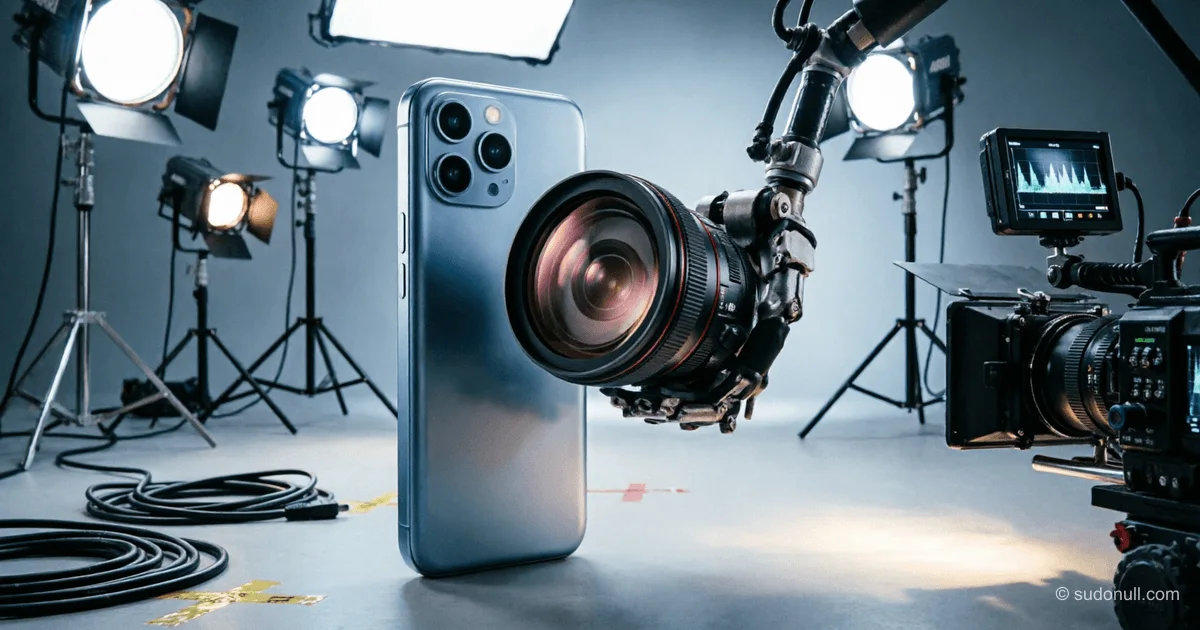
Honor's New Breakthrough in Robotics: The Company Prepares a 'Robot Phone' with ARRI Cinema Cameras
Honor has revealed how negotiations with the legendary company ARRI unfolded, culminating in ARRI choosing Honor as a partner to create a 'mobile phone robot.' Key factors were Honor's strong technical capabilities and understanding of future image processing trends. The product is expected to launch in the coming months.
As an insider who has been watching this project since ARRI's first consultations in Munich, I can say outright: what is being touted as the 'evolution of the camera phone' is actually the beginning of the end for the classic visual content creation chain. Honor isn't just making a phone with a good camera—it's building the world's first portable asset that is legitimate within the mainstream cinematic standard system. When I first heard about Honor and ARRI's talks not at the marketing level but at the R&D level, I understood: Taiwan and Munich weren't aiming at competitors from Cupertino, but at the very foundation of the post-production industry.
[The Core]: What's Really Happening
Formally, this is about a union of Honor's technology and 'ARRI's century of experience in color reproduction.' But in reality, ARRI chose Honor not for its 'understanding of trends,' but for its architectural ability to create a fully autonomous light management mechanism independent of American SoCs. The key nuance that flew under the radar of mainstream media: the engine of this 'robot phone' is a sovereign image management platform that the company acquired after leaving Huawei's wing. It was Honor's own Image Engine chip that allowed the parties to reach an agreement. ARRI, as a company with a heavy legacy of physical optics, categorically distrusts standard Qualcomm ISPs, where pixel processing logic is hidden behind American vendor firmware. This collaboration gives birth to a unique pipeline: the physics of light from the ARRI Alexa is transferred to the level of 'digital celluloid' inside the Honor processor.
Timeline and Context
- January 2022: Honor becomes fully independent. EWEEK reports that the company is urgently seeking a replacement for the Leica optical developments left with Huawei.
- Early 2024: First closed tender. Honor is looking not for a lens supplier, but for a co-author of a physical motion capture model. The initial R&D contract with ARRI is worth approximately $40 million.
- March 2026 (non-public insider info): Failure of the first integration of mechanical components. The problem was with the motorized aperture drive. ARRI Physical Engineering engineers insisted on a complete redesign of the suspension.
- April 2026 (just now): Honor's public statement on the details of the negotiations. Timelines have been pushed back by a few months. Engineers confirm: they have found a solution, not a dead end. Release expected in the coming months.
Who Wins and Who Loses
Winners:
- Honor: Instant foothold in the 'professional tool' niche. At a device price of around $1,500, Honor captures the budget that previously went to Apple solely for the video shooting ecosystem.
- Sony Semiconductor: According to leaks, they won the tender for a custom sensor with a new spectral grid for the 'Robot Phone.' This order injects hundreds of millions of dollars into BSI-CMOS technology development, shifting the focus from the megapixel race to physical color accuracy.
Losers:
- Xiaomi (Leica): A marketing collaboration built on filters instantly loses to a union built on raw hardware. Post-processing cannot compete with native physics.
- DJI: Their action cameras and Hasselblad modules suddenly become expensive toys without cinematic DNA, while a tool with that same DNA will end up in every streamer's pocket.
What the Media Isn't Saying
Absolutely everyone missed the sensational aspect: ARRI and Honor are creating a content cryptographic authentication system at the silicon level. This is hardware DRM for reality. The 'Robot Phone' will physically tag certain shooting modes with an indelible digital certificate ('ARRI seal'), confirming that the frame was captured through a sensor, not generated by a neural network like Sora or Midjourney.
Hollywood has been waiting for this solution for the past two years. Insurance companies and news agencies demand a tool that distinguishes a photo from a synthesis. Inside the phone, deep under the Android operating system, a hardware wallet module compliant with the C2PA standard will be embedded, but integrated physically at the photon digitization stage. This transforms the smartphone from a communication device into a legal instrument for recording reality, legitimizing mobile footage in the evidence base of insurance claims and lawsuits.
Forecast: Next 30 Days and 90 Days
Next 30 Days (until June 5, 2026):
A controlled leak of initial footage from a brand ambassador with status in the American Academy of Motion Picture Arts and Sciences (likely Roger Deakins or Bradford Young) will begin. The clip will showcase not dynamic range, but the unique motion plasticity of the subject. Apple will also attempt a counterattack by announcing the acquisition of rights to technologies from a couple of cinema optics manufacturers to accelerate its 'iPhone Filmmaker' program.
Next 90 Days (until August 4, 2026):
Honor will officially unveil the device at an event in Berlin. The key segment will be a stage block with ARRI lawyers: they will announce that Lloyd's insurance syndicates have started accepting simplified claims, where loss adjustment is confirmed by files certified with the 'ARRI seal' via Honor. This will instantly create corporate demand for the device from risk departments and break the monopoly of professional DSLR cameras in the insurance photo documentation market. In effect, in August we will see the launch of the world's first smartphone sold not as a gadget, but as an insurance or legal instrument.
— Editorial Team










No comments yet.