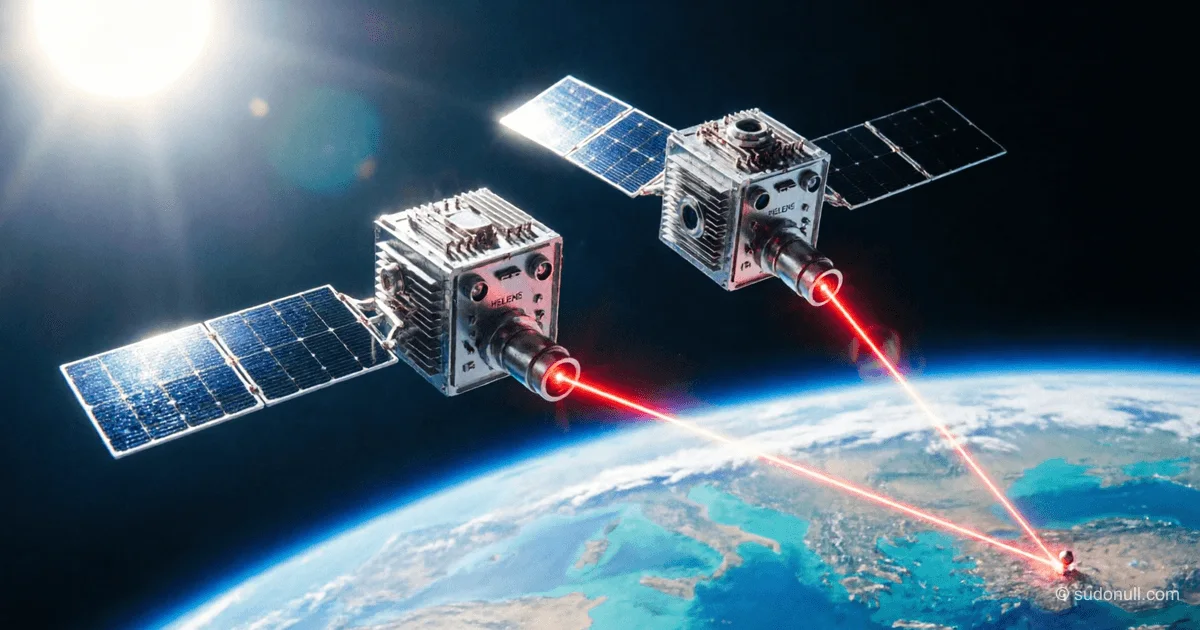
Greek Communications Program: Final Satellites Launched to Test Laser Data Transmission
Under the Greek Communications Agency program, supported by ESA, two CubeSats (HELIOS and SELENE) have been launched to test CubeCAT laser terminals. The mission aims to validate high-speed optical communication channels directly with Earth, promising significant gains in speed and interference immunity compared to traditional radio systems.
As someone who has tracked the evolution of satellite communications since the shift from C-band to high-frequency solutions, I see the launch of HELIOS and SELENE not as a technical demonstration, but as a strategic maneuver to reshape the European space communications market. What ESA's official releases call the "culmination of the Greek Communications Program" is actually the moment when small states begin dictating technological trends to larger players, bypassing the bureaucratic apparatus of traditional space powers.
[The Core]: What's Really Happening
This is not just a test of CubeCAT laser terminals. It's a trial by fire of the concept of "peripheral sovereignty." Greece, a country without its own rocket industry or NASA-scale budgets, is implementing the most aggressive laser communication validation program in Europe, across three hardware platforms (CubeCAT, SCOT20, ATLAS-1) within seven missions.
The key point that escapes a superficial view: CubeCAT is not just a terminal. The 1U block weighing 1.3 kg, developed by TNO and AAC Clyde Space, can provide a downlink speed of up to 1 Gbps with latency close to the theoretical limit for LEO. This means Greece is building infrastructure where the bottleneck is no longer the communication link but ground data processing—shifting the problem to an area where software companies have an advantage over traditional space contractors.
The formal goal is mapping and land use monitoring. The actual goal is creating a high-speed data transmission channel independent of European giants (Airbus, Thales), usable by both civilian rapid response services and closed structures for which laser interference immunity is more critical than cost.
Timeline and Context
To understand the scale of the shift, here's a timeline you won't find in press releases:
September 2022: TNO in the Netherlands completes development of the CubeCAT system with hysteresis-free suspension to dampen launch vibrations. This engineering solution addresses the main problem of laser communication from CubeSats: microscopic platform jitter during solar panel deployment or reaction wheel operation can disrupt the pointing accuracy required to keep the laser beam on the ground receiver.
January 2024: AAC Clyde Space and TNO successfully transmit data from a demonstration version of CubeCAT from space to Earth. This was on the Norwegian satellite Norsat-TD—meaning the technology was initially tested not by Greeks but by Scandinavians, typical of European cooperation: the concept is born in northern R&D centers, while large-scale deployment occurs in the south, where there are more sunny days and thus better conditions for optical communication.
May 2024: EMTECH SPACE places the first commercial order for CubeCAT—€0.6 million for two terminals. The amount is tiny by space standards, but it's the first time a CubeSat laser is sold as a ready product rather than a research grant.
March 2026: On Transporter-16, PeakSat with ATLAS-1 from Astrolight and OptiSat with SCOT20 from TESAT launch simultaneously. Both use different laser communication architectures, turning the Greek program into a comparative testing ground for technologies.
May 3, 2026: Launch of HELIOS and SELENE—the program's final chord, closing the question of which terminal will become the standard for future European missions. Note: the launch was from Vandenberg on a Falcon 9—a decision made after European rockets showed insufficient schedule flexibility.
Who Wins and Who Loses
Winners:
- AAC Clyde Space/TNO: Their CubeCAT becomes the de facto standard for CubeSat lasers. If HELIOS and SELENE operate without failures, the order book for this Swedish-Dutch coalition will multiply. The commercial version of CubeCAT is already market-priced, and now every European startup planning optical communication will either have to buy their solution or explain to customers why their homemade alternative is better.
- Greek Universities (AUTH, NKUA): They gained access to technologies and infrastructure previously available only to major defense contractors. The student-built PeakSat is not a training project but a combat test bed. Graduates of this program will, in 3-5 years, create startups competing with Airbus Defence and Space in the downstream services market.
- Astrolight: The Lithuanian company, whose ATLAS-1 terminal is tested on PeakSat and ERMIS-3, obtains flight qualification without years of ESA bureaucracy. CEO Laurynas Mačiulis states: "Small satellite operators have long faced the problem of sacrificing data traffic due to radio spectrum limitations." This signals to the market: Astrolight intends to democratize laser communication.
Losers:
- RF VSAT Sector: Every successful laser link demonstration is a nail in the coffin of traditional Ku/Ka bands for Earth Observation. Why lease radio spectrum from regulators when lasers require no licensing?
- Airbus Defence and Space (indirectly): While they integrate laser terminals into expensive geostationary platforms, Greek CubeSats prove that the same speed is achievable on a €2 million platform. This creates price pressure across the space communications supply chain.
What the Media Isn't Saying
Now, pay attention. Mainstream media focus on the technological breakthrough but miss a fundamental economic shift. The key insight not publicly discussed: CubeCAT and similar terminals create a market where the satellite becomes cheaper than the ground station.
Here's the arithmetic I pieced together from conversations with engineers at conferences. The cost of a CubeCAT terminal is around €0.3 million per unit. The Holomondas optical ground terminal, upgraded by Astrolight for PeakSat, cost about €1.5-2 million. The ground station is 5-6 times more expensive than the satellite transmitter.
This flips the classic economics of space communications, where the satellite was always the most expensive element. Now it's cheaper to launch 10 CubeSats with lasers than to build one fully functional optical ground station. Consequence: countries that first deploy a network of optical ground stations (Greece with Holomondas, Netherlands with TNO in The Hague) will gain control over data reception infrastructure. Satellite operators will become dependent on ground infrastructure—a mirror image of the Starlink model, where control is exercised from orbit.
Second point: laser communication is not just faster than radio in data transmission. It radically changes the latency model. An observation satellite with a laser channel can transmit high-resolution images not through a chain of relay satellites but directly to a ground station in real time, if within line of sight. For applications like monitoring forest fires or oil spills (as DUTHSat-2 does), this reduces response time from tens of minutes to seconds.
Forecast: Next 30 Days and 90 Days
Next 30 Days (until June 5, 2026):
The LEOP (Launch and Early Operations Phase) for HELIOS and SELENE will begin. I expect AAC Clyde Space and EMTECH SPACE to issue a joint press release about successful "first light" transmission from CubeCAT within 2-3 weeks after reaching operational orbit. The key parameter to track is whether the downlink speed of 1 Gbps is achieved, or if weather conditions over Greece limit tests. Also watch for Astrolight announcements: if PeakSat successfully completes tests with the Holomondas ground station, the company will open a Series A round of around €15-20 million to scale ATLAS-1 production.
Next 90 Days (until August 4, 2026):
The Greek Ministry of Digital Governance will announce the second phase of the program, integrating laser communication into operational services—likely for civil protection or maritime surveillance. TESAT, after testing SCOT20 on OptiSat, will offer NATO military customers a package of secure short-range laser communication services. But the most important shift will be in regulation: ESA will initiate the development of a unified optical communication standard for CubeSats, and TNO/AAC Clyde Space will have an 18-24 month head start over competitors. Those who fail to certify under this standard will lose the European market.
— Editorial Team










No comments yet.