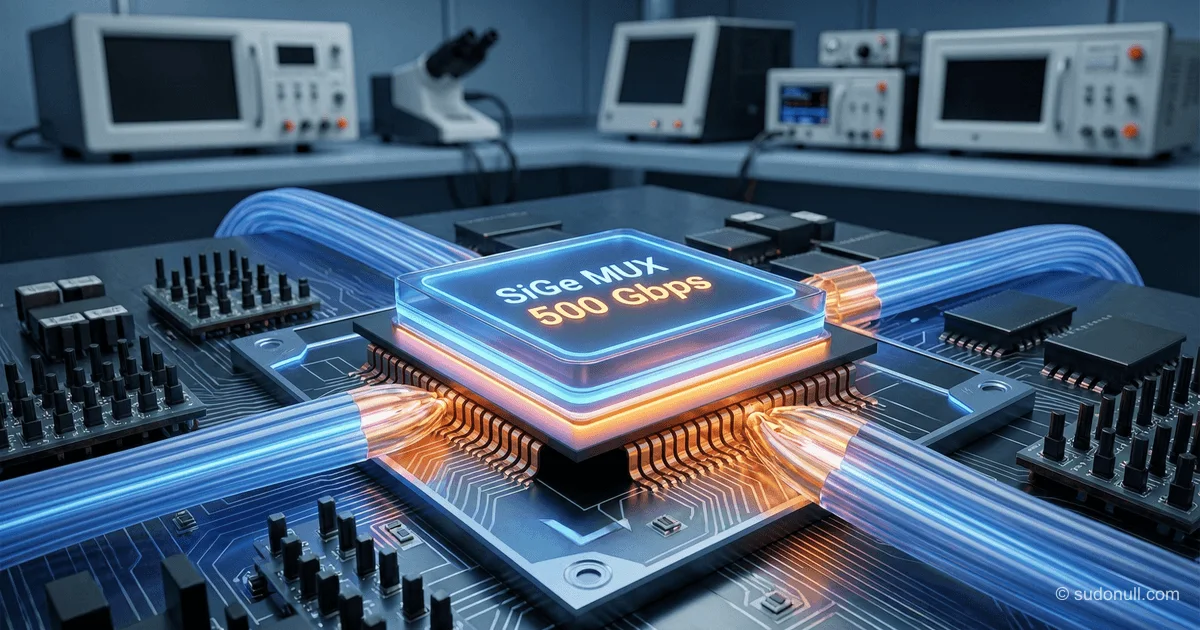
German Scientists Set Record with Chip Processing Data at 500 Gbit/s
Researchers at Paderborn University have developed a silicon-germanium chip that set a world record for bandwidth, processing over 500 gigabits of data per second over a single channel—a critical advancement for AI and 6G networks.
The story behind this chip from Paderborn runs much deeper than just a lab record. While everyone is focused on GPUs and 3nm processes, a quiet shift has occurred in Germany that could redraw the map of influence in semiconductors for communications. This is not just "another fast chip"; it's a strategic strike at the bottleneck of the entire 6G network industry.
The Core: What's Really Happening
The group led by Professor Christoph Schell from Paderborn University didn't just push a transistor to its limit. They created a working silicon-germanium (SiGe) multiplexer circuit that can convert four separate 128 Gbit/s data streams in real time into a single output channel with over 500 Gbit/s bandwidth. The key words here are "real time" and "SiGe."
What does this mean in engineering terms? We've long been able to transmit hundreds of gigabits over fiber optics. But the electrical interface between the fiber optic line and the digital processor (CPU, GPU, switch) is the bottleneck. The processor processes information hundreds of times slower than optics can transmit it. Schell's group created a chip that sits right in that bottleneck and expands it to a practical 500 Gbit/s at the physical layer, using a relatively mature and inexpensive SiGe BiCMOS process (likely with 130 or 90 nm technology nodes from IHP), rather than expensive sub-5 nm CMOS.
And here's the hidden sensation: they made an old technology work at speeds that everyone else is chasing with 2 nm processes. This is a long-term play against the physics of expensive transistors.
Timeline and Context
This result follows a decade of methodical work. Back in 2018, the same group demonstrated individual SiGe amplifiers and modulators operating at frequencies above 200 GHz. In 2022, they showed components for 200 Gbit/s transmission. But now, as of early May 2026, they have assembled everything into a single 4:1 MUX multiplexer capable of working with PAM-4 modulation (four-level pulse amplitude modulation), which is being standardized for 6G and data centers of the next decade.
Why now? Because the industry has reached a tipping point. 6G networks, being developed by Nokia, Ericsson, and Samsung, require peak radio access speeds of hundreds of Gbit/s per device. The backbone network must handle terabits. Current CMOS solutions with 5 nm processes (e.g., from Broadcom or Marvell) hit thermal noise and leakage current limits when trying to exceed frequencies of 110–120 GHz. SiGe, with its heterojunctions, naturally offers higher electron mobility and lower noise at these frequencies.
Winners and Losers
Winners:
- European equipment manufacturers (Nokia, Ericsson). They gain a strategic component for 6G base stations that does not depend on US or Taiwanese advanced logic fabs. IHP (Innovations for High Performance Microelectronics) in Frankfurt (Oder), where the chip was likely produced, is a European asset that can scale production without regard to US export controls.
- Second-tier data center operators. Those who cannot afford to replace their switch fleet every two years at $50,000 per unit. The SiGe chip promises an upgrade for optical interconnects without a full server platform overhaul.
- Cooling system architects. Lower heat dissipation compared to extreme overclocking of CMOS solutions at 500 Gbit/s means less aggressive liquid cooling, saving up to 15% CAPEX in new data center construction.
Losers:
- Giants like Broadcom and Marvell. Their strategy of selling not just a chip but a closed ecosystem of SerDes transceivers on custom TSMC processes is threatened by a cheaper, more accessible alternative on open specifications.
- Silicon photonics lobbyists. Some engineers aim to move all switching directly into light. The SiGe record tells them: "Hold on, electricity hasn't exhausted itself yet; we can squeeze another generation of devices out of it with lower investment."
What the Media Isn't Saying
The least obvious insight concerns military applications, which the authors naturally omit from their scientific paper. This chip is an ideal candidate for creating ultra-wideband digital receivers for electronic intelligence.
Modern SIGINT (signals intelligence) systems are overwhelmed by data at high frequencies. Analog-to-digital converters (ADCs) with sampling rates of hundreds of gigasamples per second require exactly such ultra-fast multiplexers to demultiplex the signal before digital processing. What Schell's group created on a commercial open-source process (IHP's SiGe BiCMOS is available to many universities and companies) is essentially a dual-use technology that enables a compact interception system for Ka-band satellite communications. We're talking about the ability to monitor a channel tens of gigahertz wide with resolution that previously required a whole rack of equipment costing several million EUR, now potentially fitting on a palm-sized board.
Forecast: Next 30 Days and 90 Days
30 days (by early June 2026):
The market will be quiet. Moreover, we will see attempts by major US vendors, through industry media, to launch a classic FUD (Fear, Uncertainty, Doubt) campaign: "SiGe doesn't scale," "yield is below 60%," "no ecosystem." Behind closed doors at IEEE MTT-S meetings and the upcoming RFIC conference in San Francisco, intense discussions will occur, with Broadcom and Qualcomm pressuring organizers not to allocate too much time to Schell's group presentation.
90 days (by August 2026):
I expect Schell's team to announce a partnership with a second-tier telecom equipment manufacturer (likely German Rohde & Schwarz or Finnish Nokia for the Hexa-X-II 6G project) to build a prototype commercial mobile 6G repeater. Speculative talk will begin about a buyout of the startup that will inevitably be formed to commercialize the technology, by a European defense holding (possibly Hensoldt or Thales), with the deal value rumored around $450–500 million—a pittance for strategic control over a component that could paralyze an adversary's entire radio interception system without it. This is not a story about "another record"; it's about how Europe suddenly remembered it has cards in chip diplomacy, hidden not in 2 nm, but in brilliant architectural work on old but smart processes.
— Editorial Team








No comments yet.