Berkeley Scientists Discover New Path to Energy-Efficient Chips
Researchers at UC Berkeley have found that an ultra-thin film of titanium dioxide less than 3 nm thick acquires ferroelectric properties, potentially enabling faster and more energy-efficient memory and logic chips for wearable electronics.
The news from Berkeley looks like yet another academic breakthrough in materials science, but in reality, it's a quiet shot that could reshape the semiconductor industry landscape in a few years. While giants like TSMC and Samsung fight over every angstrom, shrinking process nodes at the cost of tens of billions of dollars, Salahuddin's group found a way to make an "ordinary" material do what previously required extreme engineering solutions. This is not just a paper in Science—it's a potential wildcard for those who don't want to pay $30,000 per wafer on advanced process nodes.
The Essence: What's Really Happening
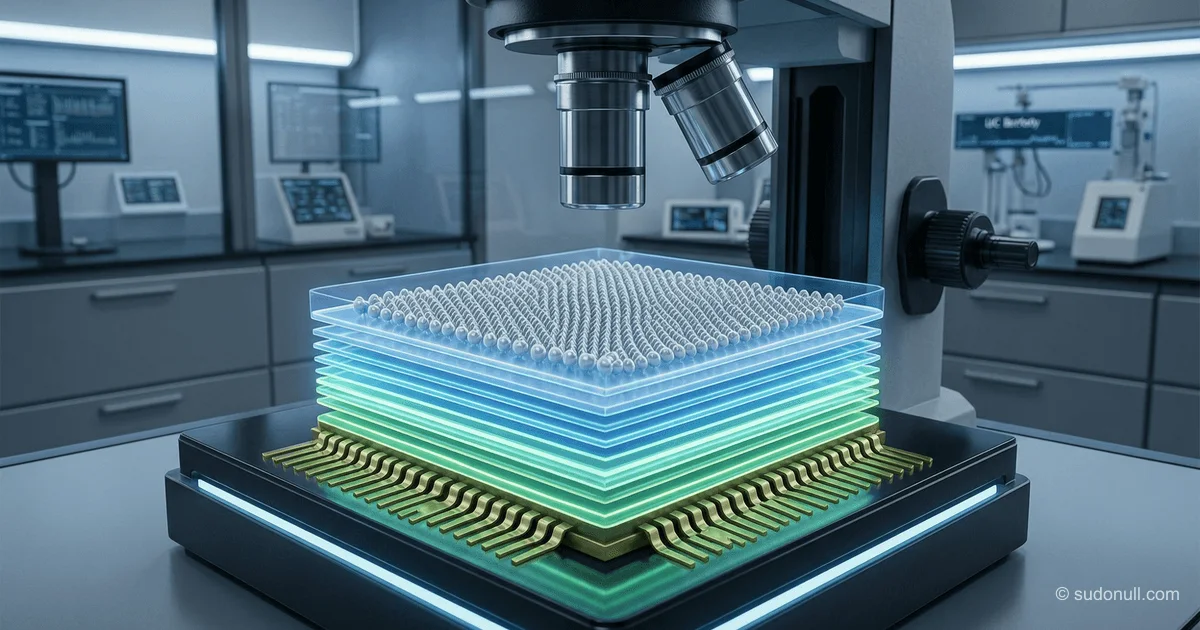
Professor Sayeef Salahuddin and his team at UC Berkeley discovered a fundamental property that changes the game. Titanium dioxide (TiO₂) has been used for decades in chips as a mundane dielectric—an insulator that simply stores charge and doesn't exhibit electrical polarization. Now it turns out: if you make a TiO₂ film thinner than 3 nanometers, it suddenly becomes a ferroelectric—a material capable of spontaneous polarization and switching that polarization under an electric field.
What does this mean technically? Ferroelectrics can replace several components in a chip at once. They can work as non-volatile memory (data doesn't erase when power is off), as logic elements, and as key components for neuromorphic computing. The problem has always been that traditional ferroelectrics (e.g., hafnium-zirconium oxide, HZO) require a complex "wake-up" process—many electrical cycles before they start working properly. Salahuddin's TiO₂ enters operational mode without any wake-up and withstands 10^6 cycles without degradation.
A key point few realize: these films are grown by atomic layer deposition (ALD) at temperatures below 400°C. This is the same technology already installed in chip fabrication plants. The industry doesn't need to rebuild factories or buy new equipment. TiO₂ is cheap, abundant, and integrates into existing processes without revolutionary changes.
First non-obvious insight: this technology doesn't target silicon competitors but equipment manufacturers. Ferroelectric memory on TiO₂ can work on substrates of amorphous carbon or amorphous SiO₂. This means it can be stacked in layers within three-dimensional integrated circuits. Imagine taking a standard logic chip and, like skyscraper floors, adding layers of non-volatile memory on top using TiO₂. This solves the "memory wall" problem—the bottleneck that has limited processor performance for decades.
Timeline and Context
The history of this discovery traces back to 2024. Then, Salahuddin's group was experimenting with size effects in binary oxides. In 2025, first hints emerged that ultra-thin TiO₂ films behaved unusually under an electric field. The decisive experiment took place in early 2026: researchers used synchrotron X-ray diffraction, XAS spectroscopy, and optical second harmonic generation to prove it wasn't a measurement artifact but a real phase transition.
Concurrently, the semiconductor industry is experiencing an existential crisis. TSMC invested $30 billion in a 2nm chip fab in Arizona. Samsung struggles with yield on its 3nm process. Everyone hits physical limits: leakage currents, electron tunneling, heat dissipation. Then comes a paper saying, "Listen, maybe let's not chase nanometers? Let's teach old materials new tricks."
The work was published on May 3, 2026, in Science. The lead author is Koishik Das, a graduate student from Berkeley's College of Chemistry and Department of Electrical Engineering. Co-authors include researchers from Lawrence Berkeley National Laboratory and SLAC National Accelerator Laboratory. This is a collaboration of serious caliber, not a lone work from a provincial lab.
Who Wins and Who Loses
Winners:
- Microcontroller and IoT chip manufacturers. NXP Semiconductors, STMicroelectronics, Texas Instruments. They don't need 2nm processes. They need to integrate memory and logic on a single chip cheaply. TiO₂ technology promises exactly that: add a memory layer on top of logic without radically changing the process. For an industry where margins on microcontrollers are percentages, not hundreds of percent like GPUs, this is a lifeline.
- Berkeley Lab and Salahuddin's group. The patent potential is enormous. If TiO₂ ferroelectrics can indeed be embedded in existing lines, licensing fees from every chip using this technology could amount to tens of millions of dollars annually. Plus grant funding: DARPA and NSF are already on the starting blocks with programs for "atomic-scale electronics."
- Consumers of wearable electronics. Apple Watch and Fitbit benefit directly. The main energy drain in wearables is memory and data transfer. Ferroelectric memory on TiO₂ requires no energy to store data and switches at less than 1 volt. This means weeks, not days, of battery life.
Losers:
- Intel. Yes, Intel. The company bet on HZO-based ferroelectric memory and FeRAM technology as part of its 3D XPoint package and future processor architectures. Now they have a competitor that doesn't require wake-up, works at lower voltage, and grows on existing equipment. Intel will either have to buy a license from Berkeley or catch up with its own research, losing time.
- HZO material manufacturers. Startups that bet on hafnium-zirconium ferroelectrics suddenly find themselves with yesterday's technology. HZO requires precise control of hafnium-to-zirconium ratio, complex annealing, and has stability issues. TiO₂ is simpler chemically and more manufacturable.
- Proponents of purely optical computing. There's a whole field arguing that electronics is exhausted and the future belongs to photonic chips. The Berkeley discovery gives electronics a second wind. If we can create non-volatile memory at atomic scales while staying within silicon technology, arguments for switching to photonics weaken.
What the Media Isn't Saying
This point concerns the military dimension of the discovery. TiO₂ ferroelectrics can withstand radiation better than traditional CMOS circuits. Ferroelectric memory is inherently radiation-hard because data is stored in the physical position of atoms, not in an electric charge that high-energy particles can disrupt. DARPA has funded the search for radiation-hard memory for satellites and military systems for years. TiO₂ grown by ALD at low temperatures is an ideal candidate for military contracts. No press release will mention this, but rest assured: contracts with the DoD are already being discussed.
The second point is flexible electronics. Since TiO₂ films work on amorphous substrates, they can be deposited on flexible polymers. This opens the door to foldable displays with integrated memory, medical patches with on-board data processing, and wearable electronics that can be rolled up. Media write about chips, but the real market here is medical sensors and wearables that Samsung and Apple will show in 3-5 years.
Forecast: Next 30 Days and 90 Days
30 days (by early June 2026):
In the academic community, a boom of verification experiments will begin. Dozens of labs will rush to reproduce Salahuddin's results. The first independent check will come from a group at MIT or Imec, confirming the data. This will create a wave of interest from venture capital. I expect a startup created to commercialize the technology (or already created but in stealth mode) will raise a seed round of $15-20 million from funds like Khosla Ventures or Lux Capital. Berkeley's website will feature a technology licensing page offering the patent on TiO₂ ferroelectrics.
90 days (by August 2026):
By the end of July, one of the major manufacturers—most likely STMicroelectronics or GlobalFoundries—will announce a pilot project to integrate TiO₂ ferroelectrics into a 28nm or 22nm FD-SOI process. This won't be mass production but test wafers to evaluate yield. Simultaneously, negotiations between Berkeley and major memory players will begin: Micron and SK Hynix will show interest, realizing this could shake up the DRAM and flash memory markets. The biggest event: Apple will launch a project to integrate ferroelectric memory into the S-series chip for future Apple Watches to increase battery life to 10 days. This won't be officially announced, but insider information will leak through analysts like Ming-Chi Kuo.
— Editorial Team









No comments yet.