August 12, 2014 at 11:19
The probability of mixing a unique deck of cards. Unexpected result
All of us have ever played cards. And anyone held in his hands, interfered with a card deck. So I, somehow sitting and mixing a standard deck of 52 cards, thought, but what is the likelihood that the result will be unique? That no one has ever received cards in the deck in the same order as I did after mixing?
It would seem that the first thing that comes to mind is the probability is small. After all, people constantly play cards. And if you take into account the fact that people constantly play poker on the Internet, then in general, probably, all the options have been tried for a long time ... Or not?
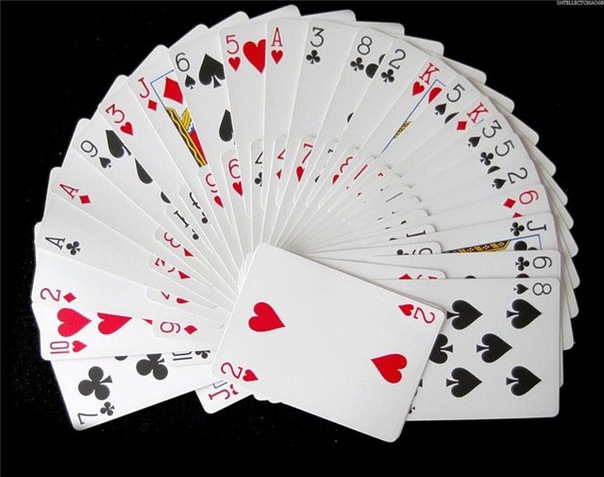
To begin with, I will say that by mixing I will mean the order of the cards obtained after an accidental shuffle of the deck.
Let's try to estimate the number of deck mixes made by all people in history from above. At the same time, suppose that each time a unique deck is obtained (well, what if?). Count with a large margin.
To begin with, we will deal with electronic games (we assume that the deck there also interferes, but is not generated during the game). Let there be 1,000,000 (one million) different game servers. A lot, probably? Well, we think with a margin. And let a dozen decks shuffle in them every second. Then the day is shuffled: 10 * 60 * 60 * 24 * 1,000,000 = 864 * 10 ^ 9 decks. And live? In any case, compared to electronic games, the number will be much less. Therefore (in order not to bother much, because we take a rough estimate from above), we simply double the resulting number. And round up: 1728 * 10 ^ 9 <2 * 10 ^ 12 mixes. So, we estimated from above the number of stirs per day in our time.
And in the whole history?
Of course, we know that computers appeared not so long ago that before the cards certainly certainly interfered manually. But are we taking an estimate from above? A rough estimate from above. So we will assume that at least as many decks as there are now always interfered with the day. As Wikipedia suggests , the history of the modern look of the card deck certainly dates back less than a thousand years. We will proceed from this. Over a thousand years have passed: 365000 days. Then, for the entire history, certainly less than 365,000 * 2 * 10 ^ 12 = 73 * 10 ^ 16 mixes were produced . For convenience, we will use a slightly larger number 10 ^ 18.
Recall that the assessment was taken very, very high. Therefore, exactly in the entire history more than 10 ^ 18 mixes of the deck were not committed (if only some supercomputer did not interfere with the deck for whole days, but more on that at the end of the article).
So what is the probability of getting a new map layout option when mixing?
To begin with, let's see what the number of card layout options in general is. This is 52! = 52 * 51 * 50 * ... * 2 * 1. According to the Stirling formula, this is approximately equal to:
 = 8 * 10 ^ 67 .
Thus, the likelihood that someone has already received a freshly mixed deck sometime less than 10 ^ 18 / (8 * 10 ^ 67) = 1.2 * 10 ^ (- 50) . Yes, the probability that the deck is NOT unique is extremely small. Thus, we can give an answer to the question posed at the beginning of the topic: The
probability of getting a unique deck with stirring is obviously greater than 99.999 ... 999%(50 decimal places follow decimal point). Suddenly? Yes, quite unexpectedly even for a person familiar with probability theory.
Moreover, given that the calculation was very rough, the real probability is even greater .
Now let's calculate how much time it takes to sort through all these options on the computer. Most modern supercomputers, according to Wikipedia , perform about 10 ^ 16 operations per second. Per day - 60 * 60 * 24 * 10 ^ 16 = 864 * 10 ^ 18. In a year - about 3 * 10 ^ 23. So how many years does it take to sort through all 8 * 10 ^ 67 deck mixing options? Something like a billion billion billion billion billion years . Pondering, it’s even scary. Moreover, even if all the other computing resources of the planet are sent to help this supercomputer, this will not help much. It will still take billions and billions of years. But this is just a deck of 52 cards. What can we say about the number of games in Go?
It would seem that the first thing that comes to mind is the probability is small. After all, people constantly play cards. And if you take into account the fact that people constantly play poker on the Internet, then in general, probably, all the options have been tried for a long time ... Or not?
Top score
To begin with, I will say that by mixing I will mean the order of the cards obtained after an accidental shuffle of the deck.
Let's try to estimate the number of deck mixes made by all people in history from above. At the same time, suppose that each time a unique deck is obtained (well, what if?). Count with a large margin.
To begin with, we will deal with electronic games (we assume that the deck there also interferes, but is not generated during the game). Let there be 1,000,000 (one million) different game servers. A lot, probably? Well, we think with a margin. And let a dozen decks shuffle in them every second. Then the day is shuffled: 10 * 60 * 60 * 24 * 1,000,000 = 864 * 10 ^ 9 decks. And live? In any case, compared to electronic games, the number will be much less. Therefore (in order not to bother much, because we take a rough estimate from above), we simply double the resulting number. And round up: 1728 * 10 ^ 9 <2 * 10 ^ 12 mixes. So, we estimated from above the number of stirs per day in our time.
And in the whole history?
Of course, we know that computers appeared not so long ago that before the cards certainly certainly interfered manually. But are we taking an estimate from above? A rough estimate from above. So we will assume that at least as many decks as there are now always interfered with the day. As Wikipedia suggests , the history of the modern look of the card deck certainly dates back less than a thousand years. We will proceed from this. Over a thousand years have passed: 365000 days. Then, for the entire history, certainly less than 365,000 * 2 * 10 ^ 12 = 73 * 10 ^ 16 mixes were produced . For convenience, we will use a slightly larger number 10 ^ 18.
Recall that the assessment was taken very, very high. Therefore, exactly in the entire history more than 10 ^ 18 mixes of the deck were not committed (if only some supercomputer did not interfere with the deck for whole days, but more on that at the end of the article).
Probability calculation
So what is the probability of getting a new map layout option when mixing?
To begin with, let's see what the number of card layout options in general is. This is 52! = 52 * 51 * 50 * ... * 2 * 1. According to the Stirling formula, this is approximately equal to:
= 8 * 10 ^ 67 . Thus, the likelihood that someone has already received a freshly mixed deck sometime less than 10 ^ 18 / (8 * 10 ^ 67) = 1.2 * 10 ^ (- 50) . Yes, the probability that the deck is NOT unique is extremely small. Thus, we can give an answer to the question posed at the beginning of the topic: The
probability of getting a unique deck with stirring is obviously greater than 99.999 ... 999%(50 decimal places follow decimal point). Suddenly? Yes, quite unexpectedly even for a person familiar with probability theory.
Moreover, given that the calculation was very rough, the real probability is even greater .
Bonus
Now let's calculate how much time it takes to sort through all these options on the computer. Most modern supercomputers, according to Wikipedia , perform about 10 ^ 16 operations per second. Per day - 60 * 60 * 24 * 10 ^ 16 = 864 * 10 ^ 18. In a year - about 3 * 10 ^ 23. So how many years does it take to sort through all 8 * 10 ^ 67 deck mixing options? Something like a billion billion billion billion billion years . Pondering, it’s even scary. Moreover, even if all the other computing resources of the planet are sent to help this supercomputer, this will not help much. It will still take billions and billions of years. But this is just a deck of 52 cards. What can we say about the number of games in Go?