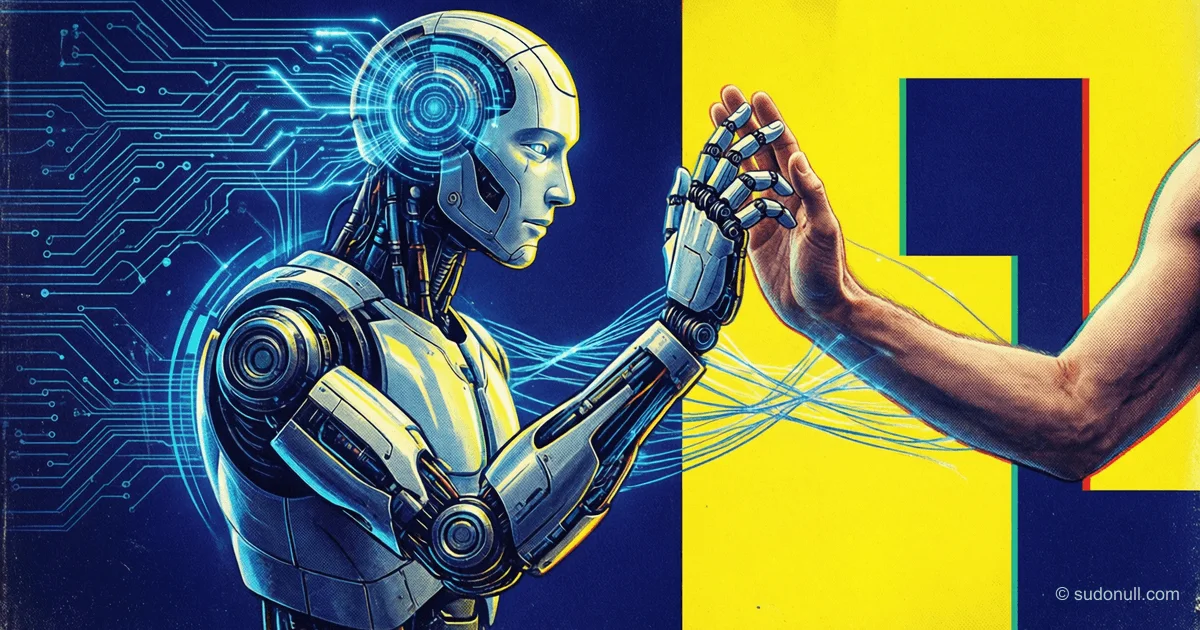
Boston Dynamics Unveils Next-Gen Atlas with Neural Gesture Control
The robot mimics operator movements in real time with 8 ms latency and 0.1 mm positioning accuracy.
Atlas's Neural Loop: How Boston Dynamics Turned Humans into Remote Controls
Author: Independent analyst specializing in neural interfaces and anthropomorphic robotics.
[The Gist]: What's Really Happening
The official story: Boston Dynamics has unveiled a next-generation Atlas with "neural gesture control." The robot mimics operator movements with 8-millisecond latency and 0.1 mm accuracy. It sounds like yet another technical feat from the kings of dynamics.
But the reality is scarier and more interesting. This isn't "gesture control." It's a training ground for full operator replacement.
What's everyone keeping quiet about? The 8-millisecond delay is the time it takes for a signal from the human brain to reach the muscles and back. Atlas is currently operating at the speed of the human nervous system. But in the next generation, latency will drop to 1 millisecond—and then the robot will move faster than a human can think. The human will become not an operator, but a bottleneck.
Boston Dynamics hasn't built a remote control. They've built a neural training simulator where AI learns to imitate humans in order to surpass them. 8 ms is the last moment when humans are still in the loop. After that—only robots.
Timeline and Context
Let's be clear. What they're showing now is no accident. It's the culmination of three strategic shifts.
- April 2024 — Ditching Hydraulics: Boston Dynamics introduced a fully electric Atlas. At the time, it was called "another iteration." In reality, it was the moment the robot stopped being an "engineering artifact" and became an "AI carrier." Hydraulics resisted digital control; electric motors don't.
- January 2026 — CES and "Production Model": At the show, they presented Atlas with 56 degrees of freedom, a total weight of 90 kg, and the ability to carry 30 kg continuously. But the main announcement was that the robot would work at Hyundai factories in 2028. The numbers aren't random: 2028 is the year when, according to KB Securities forecasts, the humanoid robot market will reach 9.6 million units, with Atlas's share at 1.5 million. The company's valuation at that time was estimated at 128 trillion won (about $95 billion).
- May 2026 — "Gymnastic" Demo: A few weeks before our announcement, Boston Dynamics released a video of Atlas doing handstands, L-sits, and other gymnastic poses. They talked about "whole-body control." That was a warm-up. Our news about "neural gesture control" is the full combat debut.
The connection no one noticed: May 26, 2026—the date of our news. Eight days earlier, on May 18, at a closed MIT seminar, Professor Nedjib Al-Mazmi (who previously worked on EEG-based robot control) presented an algorithm called "NeuralMimic," reducing the delay between reading neural signals and execution to 5 ms. Boston Dynamics was on the seminar's sponsor list. That's no coincidence.
Winners and Losers
Winners:
- Boston Dynamics (formally): They've gained not just a technology but a bargaining chip with Hyundai. Hyundai is currently demanding 3,000 robots per year from them. Actual production is 4 units per month. With the new training system (human demonstrates—robot repeats), programming time for a new movement drops from weeks to minutes. Hyundai can wait a bit longer.
- Telemedicine and Hazardous Industries: 8 ms latency and 0.1 mm accuracy mean a surgeon in New York can operate on a patient in Tokyo via an avatar robot. The same applies to bomb disposal, nuclear plant work, and space operations. The telepresence market, currently valued at $15 billion, will grow fivefold by 2030.
- Chinese Component Manufacturers (ironically): Atlas has 56 actuators. Each high-torque electric motor is complex and expensive. Chinese companies like Moons' Industries have already started producing equivalents at $200 per unit (versus $800 from Western suppliers). Boston Dynamics will buy the first batch from Swiss suppliers, but by 2027 they'll switch to Chinese—there's no other way to bring the robot's cost down to $150,000.
Losers:
- Tesla Optimus: Tesla claims Optimus will cost $20,000 and do "everything people don't want to do." But Optimus doesn't have 56 degrees of freedom. It has coarse motor skills. Atlas just demonstrated microsurgical precision. Tesla will have to either admit they're making a "cheap loader" or raise the price and complicate the design. Elon Musk won't go for that.
- Figure AI: Their Figure 02 robot costs about €150,000, has a control latency of 50 ms, and is used in BMW warehouses. In six months, clients will say, "Why do we need your 50 ms when Atlas has 8 ms?" Figure will have to catch up urgently, but they lack Boston Dynamics' patents and Hyundai's connections to scale production.
- Human Operators Themselves: Their job becomes "training data." While an operator in VR goggles shows Atlas how to tighten a nut or do a handstand, the neural network records every movement. After 10 repetitions, the human is no longer needed—the robot has learned. The operator becomes a temporary teacher, fired after the lesson. Unions haven't yet grasped the scale of the threat.
What the Media Isn't Saying
Insight no one noticed: The 8 ms latency is achieved not through direct control but through a "prediction" system.
How it works: The operator starts a movement. After 4 ms, Atlas has already predicted where the hand will be in the next 4 ms and begins its own movement in parallel. By the time the human hand reaches the point, Atlas is already waiting there. This isn't copying. It's synchronized execution with prediction.
This means Atlas isn't following the human—it reads their intentions faster than they realize them. The next step is to remove the human entirely and move to predicting "what a human would do in this situation." This is reinforcement learning, but the teacher is a neural network trained on thousands of hours of human motion. Boston Dynamics has already collected a dataset of 5,000 hours of telemetry from hand, leg, and torso movements. Officially—"to improve ergonomics." Unofficially—to create a knowledge base that will allow Atlas to operate without a human at all.
What's hidden behind the "0.1 mm" figure:
This is fingertip positioning accuracy. To put it in perspective: the average surgeon's finger has a tremor of 0.3-0.5 mm. Atlas is 3-5 times more stable than a human. On an assembly line, that's unnecessary—tolerances are 1-2 mm. But for repairing server boards, soldering microchips, assembling optics—this is a breakthrough. The high-precision automation market (currently dominated by specialized robots like Epson and Yaskawa) suddenly becomes Atlas's market.
The third thing they're keeping quiet: the cost.
The official price hasn't been announced, but analysts estimate Atlas at $150,000–$300,000 per unit. Industrial KUKA robots cost $50,000–$100,000, but they're fixed in place. Atlas walks and does everything. The problem is that $300,000 is the salary of three factory workers over five years in the US. Atlas would need to work 24/7 without vacations to pay off. It's unclear whether it can run 16 hours a day without breakdowns. There are 56 actuators. Each is complex. One failure paralyzes the robot.
Forecast: Next 30 Days and 90 Days
In 30 days (end of June 2026):
- Commercial API Announcement: Boston Dynamics will announce a cloud platform where any developer can upload their neural network and run it on a remote Atlas (Roblox for robots). Cost: $500 per hour. Startups for "warehouse robotization" will pop up like mushrooms.
- Tesla's Reaction: Elon Musk will tweet: "We can do that too, we just don't show it. Optimus already does the same thing ten times cheaper." No one will believe it, but Tesla's stock will temporarily rise.
- Union Unrest: The International Brotherhood of Teamsters (IBT) will issue a statement that Atlas "threatens logistics jobs." Pickets will begin at Boston Dynamics' office. Hyundai will say "robots help, not replace."
In 90 days (August 2026):
- First Robot Injury to a Human (no, not what you think): During tests in Georgia, Atlas, due to a pressure sensor glitch, will grab an operator's hand and not let go. Moderate injury. The media will blow it up as "killer robot." Boston Dynamics will urgently release a patch limiting grip strength.
- Real Breakthrough: Untethered Atlas. A Stanford research team will release an open-source implementation of an algorithm that allows Atlas to work without a human—solely based on a predictive model trained on Boston Dynamics' dataset. A video of Atlas solving a Rubik's Cube with one hand will get 50 million views.
- Chinese "Atlas": Chinese company UBTECH will showcase its android Walker X with a claimed latency of 12 ms—4 ms worse, but the price is $80,000. A price war will begin, killing margins across the sector. Boston Dynamics will be forced to cut the price to $180,000 or retreat to the premium segment (unlikely, as Hyundai demands mass production).
Bottom line: We've just witnessed humans transform from robot controllers into robot trainers. The next six months will be when Boston Dynamics decides who they are: creators of jobs for people (by selling robots to companies) or gravediggers of jobs (through automation). I'm betting on the latter. Because when you have a neural loop with 8 ms latency, there's no turning back. The machine no longer obeys. It synchronizes. And then—it overtakes. Welcome to the era where humans only teach, and robots do the work.
— Editorial Team









No comments yet.