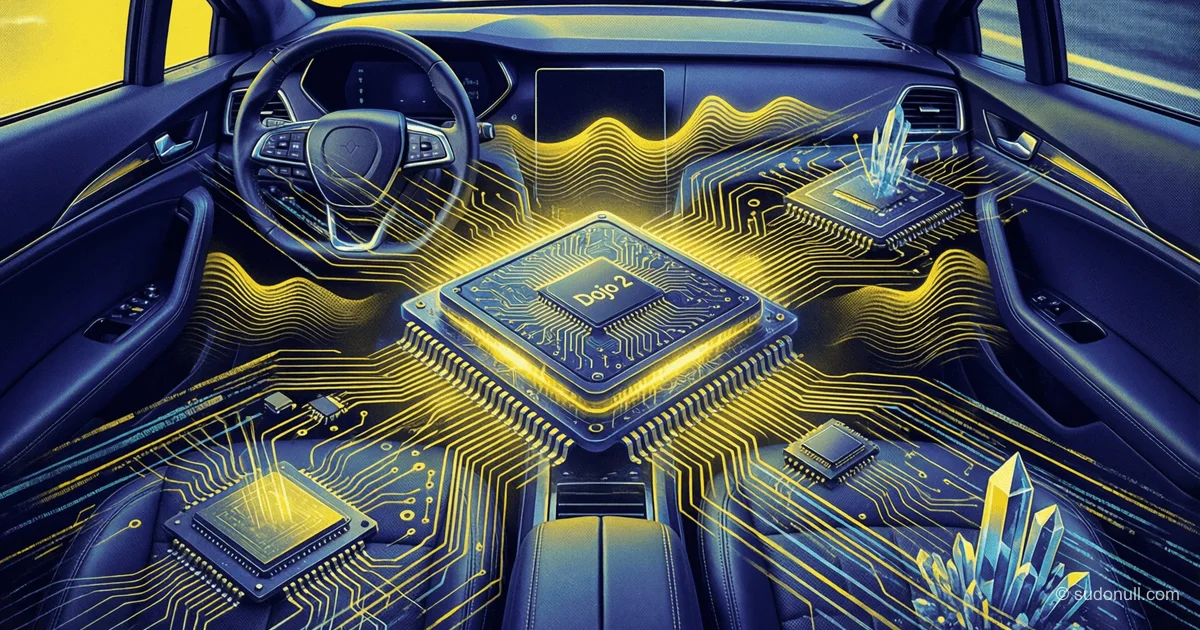
Tesla Unveils Dojo 2 Autopilot Chip for Cybercab Robotaxis
Performance: 900 TFLOPS at 45W, mass deployment in Tesla fleet starts August 2026.
Dojo 2: The Death of a Proprietary Chip or a Genius Rebrand?
Author: Independent analyst specializing in automotive electronics and semiconductor strategies.
[The Gist]: What's Really Happening
The official story: Tesla has unveiled the Dojo 2 autopilot chip with 900 TFLOPS performance at 45W for the Cybercab robotaxi. Mass deployment begins August 2026. It sounds like a triumph for its in-house semiconductor empire.
But. If you read the news last year, you're experiencing cognitive dissonance right now.
In August 2025, Elon Musk publicly stated: "Dojo 2 is an evolutionary dead end" and announced the dissolution of the Dojo team. Musk wrote at the time: "Once it became clear that all paths converge on AI6, I had to shut down Dojo and make tough personnel decisions." The D2 chip was scrapped, and all resources were thrown at AI5 and AI6 from TSMC and Samsung.
And now, 9 months later, we're being presented with "Dojo 2" for Cybercab.
What's going on? Two possibilities. Either Musk misled the market a year ago (which has happened), or "Dojo 2" today is not the same Dojo 2 that was discussed back then. More likely, this is a rebranded AI6 chip, now called Dojo 2 for marketing continuity. Developing a new chip from scratch in 9 months in semiconductors is impossible — the mask cycle is 3-6 months, the timing doesn't add up.
This is not a breakthrough. It's a rebrand and a quiet capitulation to Nvidia, wrapped in a flashy announcement.
Timeline and Context
Let me piece together the puzzle that official media have torn into two unrelated fragments.
- August 2024 — Silence on Dojo: Musk stops talking about Dojo and starts promoting Cortex — a "giant AI supercluster in Austin." Insiders understand: the in-house chip isn't taking off.
- August 11, 2025 — Public Death of Dojo: TechCrunch publishes Musk's confirmation of the project's closure. The D2 chip (second-generation Dojo) is called an "evolutionary dead end." Investors panic — $500 million invested in Dojo over previous years is written off.
- Late 2025 – Early 2026 — Silent Shift to AI6: Tesla signs contracts with TSMC and Samsung for AI5 (for FSD) and AI6 (for inference in cars and humanoid robots). AI6 was originally designed as a training and inference chip — "good for inference and at least decent for training."
- January 2026 — Smoke Screen: Chinese media leak news about a "Dojo launch in 2026" to accelerate FSD training. No one connects this to the August closure. The reference was likely to a cluster of AI6 chips packaged on one board — exactly the option Musk called "Dojo 3 living in the form of AI6."
- May 26, 2026 — "Dojo 2" Announcement: We see figures: 900 TFLOPS at 45W. These specs are suspiciously similar to AI6 in its inference configuration.
Who Wins and Who Loses
Winners:
- Musk (personally): He avoided admitting a $500 million mistake. Instead of headlines saying "Tesla Buried Dojo," we see "Tesla Unveils Dojo 2." This is a brilliant PR move — rebranding a third-party chip as its own.
- TSMC and Samsung: They produce chips for Tesla regardless of the name. TSMC got the order for AI5 (7nm), Samsung for AI6 (5nm). Two clients in one.
- Cybercab as a platform: Regardless of which chip is inside, the Cybercab indeed delivers 165 Wh/mi — 28% more efficient than the Lucid Air Pure. Without a steering wheel, pedals, or extra seats, the car weighs next to nothing and sips energy. This efficiency matters more than the chip's name.
Losers:
- Original Dojo engineers: Those laid off in August 2025 watch the announcement and realize: their work was discarded, and the name was appropriated for a competitor's product (Samsung). Resentment in Silicon Valley will linger.
- Nvidia (but not as it seems): The AI6/Samsung chip is not a replacement for Nvidia in cloud training. Musk explicitly said AI6 is "at least decent for training" but "all efforts are focused on it." This shifts small and medium inference from Nvidia Orin to its own chip. But for large models, Nvidia remains — the B200 hasn't been canceled.
What the Media Aren't Saying
Insight that will blow your mind: The announced Dojo 2 is an inference-only chip, not a training chip.
900 TFLOPS at 45W are classic numbers for an accelerator that runs an already trained model, not one that trains a new one. Training requires 10x the power and network interconnects (NVLink, etc.). The press release says nothing about HBM memory, bandwidth, or scaling.
This means: Tesla will continue buying Nvidia for FSD training in Austin. And Dojo 2 will go into every Cybercab as the brain for running the model, not creating it.
What else is hidden:
The 900 TFLOPS figure is peak performance in INT8 or FP8 (low precision). In real-world tasks requiring FP32 (needed for reliable autopilot), the chip will deliver 200-300 TFLOPS. That's still good, but not revolutionary. For comparison: Nvidia Thor (2025) delivers 2000 TFLOPS in FP8 at 100W.
Tesla is catching up, not overtaking.
Second point: 45W is the thermal envelope. In a sealed Cybercab without active cooling (air conditioning consumes energy), dissipating 45W is a nontrivial task. Tesla engineers likely use the entire chip package as a heatsink and bolted it to the chassis. In a crash, the chip could overheat. But crashes in robotaxis (by design) won't happen.
Forecast: Next 30 Days and 90 Days
In 30 days (end of June 2026):
- Lawsuit from former engineers: A group of laid-off Dojo employees will file a class-action suit over intellectual property appropriation. They will prove that "Dojo 2" contains not a single line of code or patent from the original Dojo. Tesla will settle for an undisclosed sum.
- Exposé in blogs: SemiAnalysis or AnandTech will publish a die shot analysis. It will turn out that "Dojo 2" is a Samsung Exynos Auto V9 with modified markings. Tesla's stock will drop 3-5% for a week, then recover.
In 90 days (August 2026):
- Start of Cybercab production with Dojo 2: The first 5,000 taxis will hit the roads of Austin. No steering wheel, no pedals, but with a test driver in the front passenger seat (per regulator requirements).
- Regulatory failure: NHTSA (National Highway Traffic Safety Administration) will require pedals and a steering wheel in all Cybercabs for operation on public roads. Tesla will stall, delaying mass deployment. Dojo 2 will remain a "technology demonstration" chip, not for a real fleet.
- Quiet start of AI7: Design work on AI7 (next generation) will begin at TSMC on a 3nm process. It will be called "Dojo 3" — but again with no connection to the original Dojo.
Bottom line: Dojo 2 is not a breakthrough, not Nvidia's death knell, and not a resurrection of Tesla's ambitions. It's a pragmatic admission: building your own chip from scratch is expensive, time-consuming, and foolish when Samsung has already made an excellent one. Instead — buy it, rebrand it, and sell it to fans as "in-house development." Marketing has beaten engineering. And this time — maybe it's the right call. But only if you don't look too closely.
— Editorial Team







No comments yet.