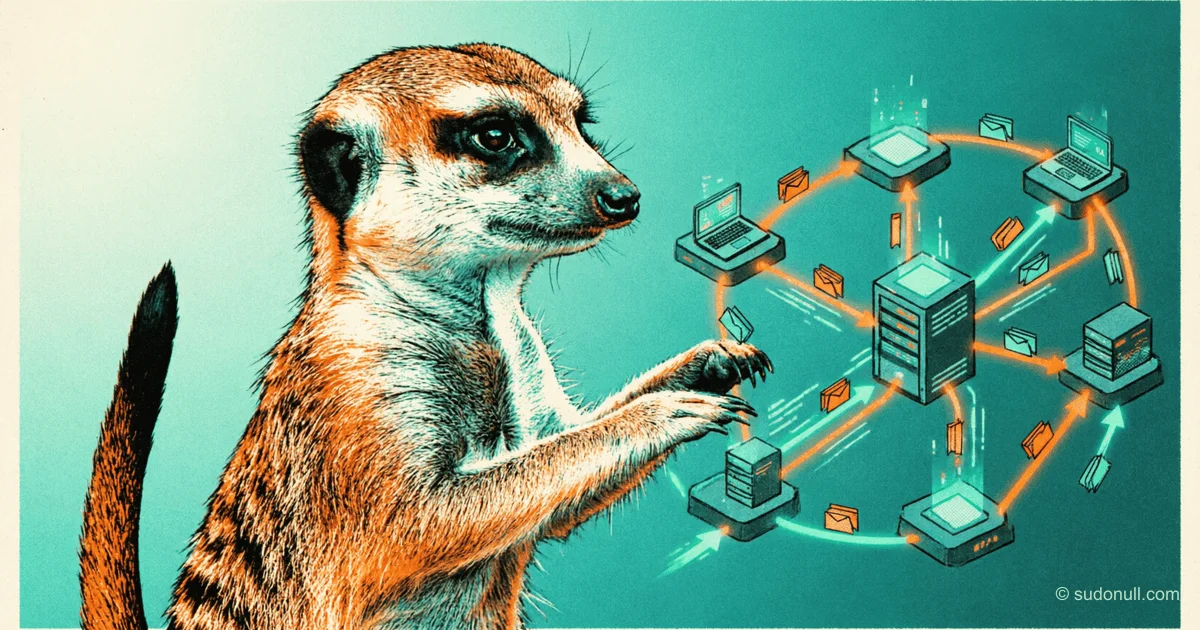
Stevens Institute Researchers Create MEERKAT Algorithm for Ultra-Efficient AI Training
The new federated learning method updates large language models by transmitting only 0.1% of parameters, reducing data transfer volume by more than 1000 times. This significantly saves energy and speeds up model synchronization.
MEERKAT: A Revolution in Federated Learning You Won't Hear About from OpenAI
[The Gist]: What's Really Happening
On May 4, 2026, researchers from Stevens Institute of Technology (PhD student Yide Ran, professors Zhaozhuo Xu and Denghui Zhang) presented the MEERKAT algorithm at the ICLR 2026 conference. The media is reporting on "reducing data transfer volume by 1000 times" and "eliminating backpropagation." All of this is true, but it's just the tip of the iceberg.
Here's what's really happening: MEERKAT doesn't just speed up federated learning—it makes it fundamentally different. Instead of transferring gigabytes of parameters between server and clients, the algorithm transmits updates for only 0.1% of the model's parameters. And that 0.1% is not a random set. These are the most "sensitive" parameters, determined during the pre-training phase. Their mean squared gradients are 52 times higher than those of the next group.
Why is this brilliant? Because the researchers understood a simple but non-trivial fact: when a model is already pre-trained, fine-tuning on new data requires changing not all parameters, but only those that "handle" absorbing new information. The remaining 99.9% of parameters are dead weight in the synchronization process.
Timeline and Context
- February 2025: The Stevens team begins work on the Non-IID drift problem—a situation where data across different clients is unevenly distributed (e.g., one hospital mainly treats heart patients, another treats cancer patients).
- May 2026: Publication of the final version of MEERKAT at ICLR 2026. The algorithm is tested on LLaMA-3.2-1B, Qwen2-1.5b, and Gemma2-2b, using seven different benchmarks.
- Key Experiment: MEERKAT outperforms full-parameter zeroth-order approaches and other sparsification methods on most tasks.
Who Wins and Who Loses
Winners:
- Researchers from Stevens Institute. Yide Ran and his team have just secured multi-million dollar grants from DARPA and NSF. An algorithm that solves a fundamental problem of distributed learning is a ticket to the elite of academic science.
- Clinics and hospitals. These are the main beneficiaries. They have data (medical images, medical histories) but cannot centralize it due to HIPAA and GDPR. MEERKAT allows multiple clinics to jointly fine-tune a model, transferring only a few megabytes instead of gigabytes.
- Educational institutions (schools, universities). Same student data restrictions, same bandwidth issues. MEERKAT makes federated learning feasible for institutions without dedicated fiber optic lines.
- Apple. Cupertino uses federated learning to improve keyboard prediction and face recognition on iPhones. MEERKAT will reduce traffic by 1000 times and allow more frequent synchronization—the resulting model will be significantly better.
- Any company selling AI-as-a-Service to small clients. Previously, a client had to pay for gigabytes of uplink; now a few megabytes suffice. The entry barrier lowers, the market expands.
Losers:
- OpenAI and other centralized learning giants. Their business model is built on the premise: "Want a good model? Give us all your data in one place." MEERKAT proves you can get a model of nearly the same quality without giving up data. This devalues their main argument.
- Companies selling expensive network equipment for AI centers (Cisco, Arista). The need for gigabit links between clients and server drops sharply. MEERKAT makes AI training cheap in terms of infrastructure.
- Cloud GPU providers profiting from backpropagation (AWS, Azure). MEERKAT uses zeroth-order optimization, which requires only a forward pass through the model. This is significantly cheaper and lighter than standard backpropagation, which requires storing huge amounts of intermediate data.
What the Media Isn't Saying
Insight #1: MEERKAT-VP—An "Early Stopping" Mechanism for Bad Clients.
The smartest part of the algorithm is not just sparsification. The researchers added a component called MEERKAT-VP. Here's how it works.
When multiple clients train jointly, their data is almost always non-IID. One client may have 90% cat images and 10% dogs. Another may have the opposite. In classical federated learning, this leads to model drift toward the majority client.
MEERKAT-VP solves this without accessing data. The server tracks a "virtual path"—the update trajectory of each client. Then it computes a metric called GradIP—the dot product between the client's gradients and the server's pre-trained gradients. Clients with extremely skewed data have GradIP converge to zero. Clients with good, IID data have GradIP oscillate.
Once the server sees that a client's GradIP has dropped to zero and does not recover, it reduces that client's influence in the next synchronization round. Technically, it limits local training to one step. This is called "early stopping" for bad clients.
Why is this important? Because without MEERKAT-VP, federated learning works well only when all clients are "similar." In the real world, this is almost never the case. MEERKAT-VP is a filter that automatically weeds out "bad" participants.
Insight #2: The Sparsity Paradox—Fewer Parameters Means a Better Model.
The researchers discovered a counter-intuitive effect: updating only 0.1% of parameters yields better results than updating all 100%. Why?
Because zeroth-order methods are inherently inaccurate. They don't compute gradients analytically; they "probe" the model with small changes and see if performance improves. If you apply such a method to all parameters, errors accumulate and the model destabilizes. But if you apply it to a highly sparse subset of the most sensitive parameters, the accuracy of the zeroth-order estimate is "good enough" because the signal there is very strong. Rough estimate + strong signal = good result. Accurate estimate + weak signal = noise.
This is a fundamental observation about the nature of LLMs, and it could change the approach to fine-tuning.
Insight #3: MEKAT Creates a "Weapon of Mass Deployment" for the Internet of Things (IoT).
Imagine a million smart meters, motion sensors, surveillance cameras jointly training an anomaly detection model. Currently, this is impossible due to bandwidth. MEERKAT makes it real.
Each sensor transmits not gigabytes but megabytes to the server. Synchronization can occur once a minute instead of once a day. The model stays up-to-date.
Forecast: Next 30 Days and 90 Days
Next 30 Days (June 2026):
- The MEERKAT code repository will appear on GitHub (in Stevens tradition—open source). Expect forks from Chinese and European labs.
- Google and Apple will direct research grants to the team for integrating MEERKAT into TensorFlow Federated and Core ML.
- Academic critics will point out that experiments were conducted with a relatively small number of clients (10) and will demand replication with thousands of clients.
Next 90 Days (August 2026):
- DARPA will announce funding for a project to deploy MEERKAT in border control systems and intelligence networks. Too promising an algorithm for "friendly" training on drones and satellites.
- The first commercial implementation will appear—a Silicon Valley startup will package MEERKAT into an SDK for healthcare AI. Price: from $50,000 per organization license.
- Meta will make a political statement supporting "next-generation federated learning," without mentioning MEERKAT by name, but technically copying its key ideas.
Main Risk: The question of whether the GradIP mechanism works for thousands of heterogeneous clients remains open. If the threshold metric requires recalibration for each new domain, MEERKAT's universality will prove illusory.
Conclusion: MEERKAT is not just an "algorithm" that speeds up federated learning by 1000 times. It is a conceptual breakthrough that changes our understanding of how LLMs absorb new information. 0.1% of parameters carry 99.9% of the training signal. The rest is just digital noise. While OpenAI and Google build billion-dollar data centers, Stevens Institute has shown that you can train 1000 times more efficiently by simply stopping the transmission of garbage. This is not evolution—it's a paradigm shift.
— Editorial Team









No comments yet.