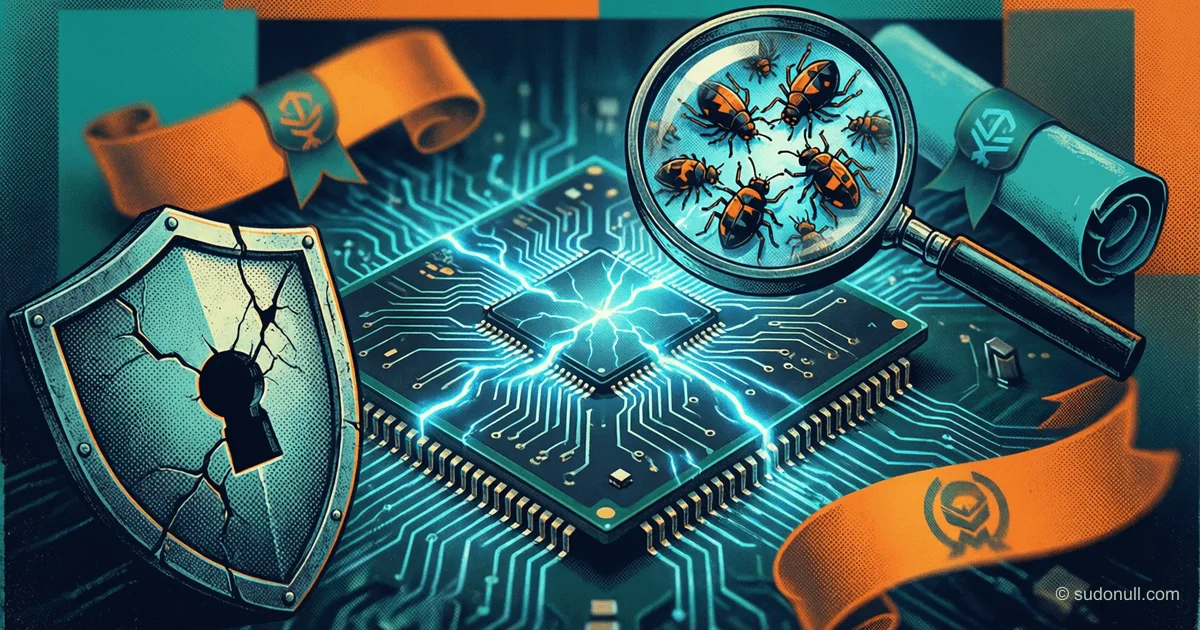
Intel Invites Researchers to Hardware Security Competition
The company announced the call for submissions for the Hardware Security Academic Award, and is also deploying AI to automate vulnerability discovery in specifications.
Intel's $11 Million Insurance: Why the Hardware Security Competition Isn't About Science
[The Gist]: What's Really Happening
On May 22, 2026, Intel officially announced the call for submissions for the 2026 Intel Hardware Security Academic Award (IHSAA-26). The deadline is June 15, 2026. Winners will receive an "exclusive invitation to meet with an Intel top manager," appear on the "Chips and Salsa" podcast, and present their research to Intel's security and product development teams.
On paper, it's a generous gesture supporting academic science. In reality, it's outsourcing the hardest R&D phase for pennies.
Look at the details: the award offers no cash prize. Winners get "recognition" and access to Intel's closed events. In the corporate world, that's called "free labor for a storefront."
But the essence runs deeper. Look at the competition categories: "AI for Security," "Security for AI," "Resilient Silicon," "Trusted Manufacturing and Supply Chain Security." These aren't abstract topics. They are precisely the areas where Intel is struggling. And precisely where they are losing to competitors.
Timeline and Context
This story didn't start in May. It's been brewing for years, but sharply escalated in the last six months:
2024-2025: Intel steadily loses ground in security. AMD implements full memory encryption and Microsoft Pluton. Qualcomm with Snapdragon Guardian bets on hardware isolation for AI workloads "smartphone-style." Intel has the old reliable vPro, which no longer impresses.
March 2026: Intel releases the Platform Security Report, boasting "150+ protections against real-world attacks." The market reacts coolly — because competitors are already talking not about 150, but about "trusted execution environments" for AI.
May 2026 (weeks before the competition): Two critical vulnerabilities. May 11 — CVE-2026-20754 in NPU drivers: DoS attack possible from an unprivileged user. May 12-13 — Intel discloses 13 vulnerabilities, including CVE-2026-20794 with a CRITICAL rating in Intel Graphics (buffer overflow, privilege escalation).
May 22, 2026 (now): Competition announcement. The timing is no coincidence. Intel is trying to show "we're working on the problem" while the world digests news of yet another security hole.
Notice the overlap: 10 days before the competition announcement — 13 vulnerabilities published. 11 days before that — another critical one in NPU. The competition becomes less a scientific initiative and more a PR shield.
Who Wins and Who Loses
Intel wins (short-term): They get fresh ideas from hundreds of academic groups worldwide without paying a dollar. Classic open innovation, but in a particularly cynical form.
Graduate students and young researchers win: For them, winning an Intel competition is a resume line that opens doors in the industry. Access to Intel's development teams is especially valuable — it's an informal career elevator.
Princeton wins: Intel has partnered with Princeton for 6 consecutive years on the REU (Research Experience for Undergraduates) program. Top universities receive grants, access to proprietary technologies, and industry-level publications.
US taxpayers lose: Many submissions to the competition are funded by NSF or DARPA grants. Intel gets results at public expense. Their Platform Security Report states outright: "Intel #1 in the industry for assurance practices." But who paid for those "practices"? We did.
Competitors (AMD, Qualcomm, NVIDIA) lose: Intel legitimizes its research focus through the academic community. When a paper on "Resilient Silicon" wins, the entire industry must follow that direction. Intel sets the standard.
What the Media Isn't Saying
The most important insight is hidden in the name of one competition category and in the details of related events.
The category is called "Resilient Silicon." Architectural, microarchitectural, and circuit innovations to protect against physical attacks, side-channel leakage, and faults.
The insight missing from the news: Intel publicly admits that their chips are insecure at the physical level. And they don't know how to fix it without help from academia.
Why does this matter? In 2025, researchers from UC San Diego and Intel Labs won an award for HFI (Hardware-Assisted Fault Isolation). This technology blocks speculative attacks like Spectre. Intel knew about Spectre for years. But the solution came from academics, not the internal team.
Now Intel is going back to academia. Again with a problem they can't solve internally. Regarding "Resilient Silicon," they're essentially saying: "We can't guarantee your data is safe when an attacker has physical access to the chip. Help us."
The second hidden point concerns artificial intelligence. In March 2026, Intel announced TDT-DTECT — an AI model that analyzes x86 code execution in real time. This technology runs locally on the NPU and doesn't send data to the cloud. Sounds like a breakthrough. But note the partners: CrowdStrike, ESET, SentinelOne, Symantec, Trend Micro. All are traditional EDR/AV vendors. Intel isn't building its own security ecosystem. They're integrating into someone else's. This is a "component supplier" path, not a "platform owner" path. In the long run, that's a losing strategy.
Forecast: Next 30 Days and 90 Days
Next 30 days (by end of June 2026):
- Expect a massive influx of submissions 24 hours before the deadline (June 15) — standard academic practice. Intel will receive 300 to 500 submissions.
- At least 2-3 more CVEs on Intel products will be published. The pattern "vulnerability first, competition later" is becoming a system. The next critical vulnerability will likely be in Intel AMT or vPro.
- Intel stock (INTC) will remain in the $25-30 range. The competition news is too niche to move stock prices. The market is waiting for real financial results, not academic awards.
Next 90 days (by end of August 2026):
- Intel will announce the competition winners in August. Their names will be published, and their papers made publicly available. Among the winners, I expect at least one paper on quantum-resistant cryptography — that's the next frontier Intel is already laying out in the Platform Security Report.
- In fall 2026, the Intel Academic Security Workshop will take place in Hillsboro, Oregon. There, winners will meet with top management. It's at this workshop that informal agreements on technology commercialization may be made.
- Most importantly: by the end of August, the first commercial version of a solution based on Intel TDT-DTECT should be released — ESET expects it in the second half of 2026. If the technology works as claimed, it could be a turning point. If not, Intel will lose trust not only in the consumer market but also in the enterprise segment.
What I'll be tracking: CrowdStrike's reaction. They are Intel's key partner in AI security. If within the next 60 days CrowdStrike issues a press release about deep integration of Falcon with Intel TDT, the technology is real. If silence, Intel overestimated its capabilities.
For now, Intel continues playing the same old game: showing the world they are "security leaders" by hiring academics for $0 and convincing everyone that 13 critical vulnerabilities in a month is normal. It's not normal. It's a crisis. And they're trying to patch it with a piece of paper bearing the competition logo. But that paper won't hold when every chip is a potential hole.
— Editorial Team









No comments yet.