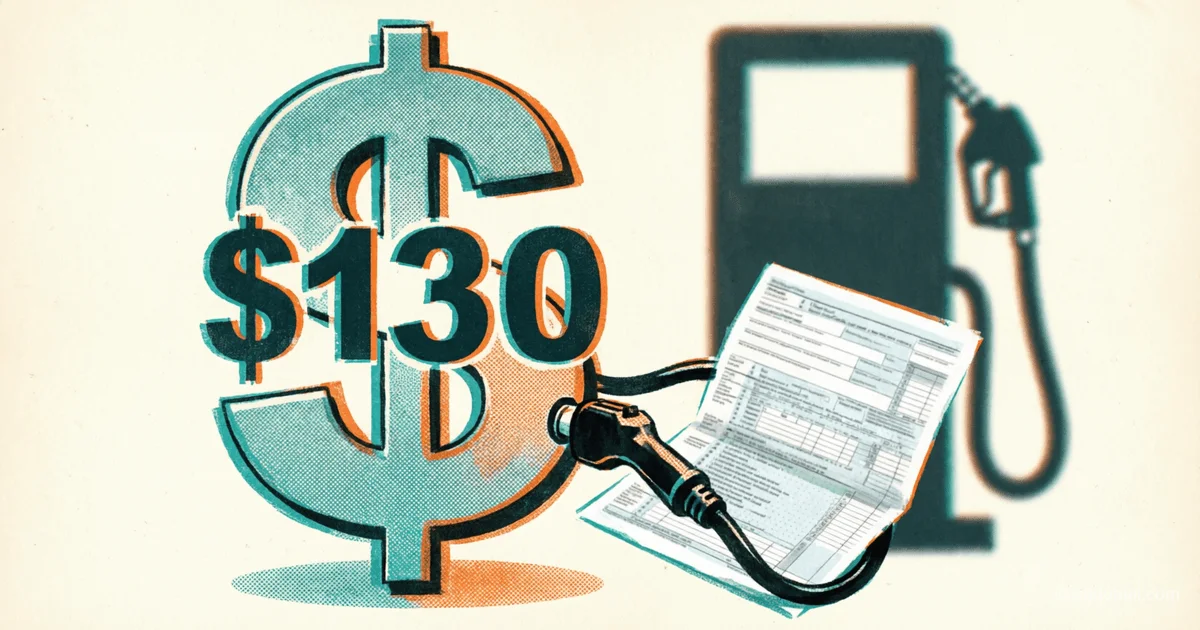
US Congress Proposes $130 Annual Fee for Electric Vehicle Owners
The bipartisan BUILD America 250 Act would impose a $130 annual fee starting in 2029 to compensate for lost fuel tax revenue. The fee would increase every two years to $150, while plug-in hybrid owners would pay $35.
$130 Tax for EVs: How the US Is Punishing the Future It Built
Author: Analytical Note, Internal Review
On May 22, 2026, at 3:00 AM Washington time, the US House Committee on Transportation and Infrastructure passed H.R. 8870, known as the BUILD America 250 Act. The vote: 62-2. Three members did not vote. The marathon session lasted 15 hours.
Media reported: "Congress proposes $130 tax for EV owners." That's like saying the Titanic had a minor leak.
What actually happened is inevitable: the US government officially admitted that its own policy killed the EV market. And now, instead of fixing the system, it decided to finish off the wounded. The $130 fee is not a "fair share." It is political suicide packaged as a transportation bill.
[The Gist]: What's Really Happening
The BUILD America 250 Act authorizes $580 billion for transportation infrastructure over five years (2027-2031). Of that, $474 billion comes from the Highway Trust Fund (HTF). The problem is that the HTF has been on the brink of bankruptcy for years. The traditional revenue source—the federal fuel tax (18.4 cents per gallon of gasoline, 24.4 cents per gallon of diesel)—has not been raised since 1993 and has lost over 50% of its purchasing power.
The growing number of EVs exacerbates the problem. Every new EV is a driver who uses the roads but pays no fuel tax. Congress's solution: require states to impose an annual registration fee of $130 on each EV and $35 on plug-in hybrids. Starting in 2029, the fee will increase by $5 every two years, capping at $150 for EVs and $50 for hybrids.
States that refuse to collect this fee will lose 125% of their federal highway funding. This is not a recommendation. It is an ultimatum.
Non-obvious insight: The real tax for EV drivers will not be $130, but significantly higher, and Congress knows it. According to Consumer Reports, the average American driver pays $70-90 per year in fuel taxes. $130 is already 30-85% more than what a gasoline car owner pays. But 15 states already have additional annual EV fees, ranging from $50 in some states to over $200 in others. Add $130 on top, and you get a tax burden 2-3 times higher than that of a gasoline neighbor. The bill silently allows this because it does not require the repeal of local fees.
[Timeline and Context]
To understand why this bill appeared now, you need to trace the chain of disasters.
- September 30, 2025: The federal $7,500 tax credit for new EVs expires. Congress does not extend it.
- October 2025 - January 2026: The EV market collapses. In January 2026, EV registrations drop 41% compared to January 2025. Market share falls from 8.3% to 5.1%. In absolute numbers, only 59,802 new EVs out of a total market of 1.12 million.
- January 2026: Ford suspends production of the F-150 Lightning. Tesla announces the end of Model S and Model X production. Automakers are forced to offer discounts of up to $15,000 on EVs to compensate for the lost tax credit.
- May 2026: The BUILD America 250 Act with the $130 EV fee is introduced.
- May 21-22, 2026: The Transportation Committee approves the bill.
Chronological deception: Note the sequence. First, Congress kills EV demand by eliminating the $7,500 credit. The market crashes. Then Congress "discovers" that the HTF is losing revenue from EV drivers and imposes a fee. But they created this problem! If they had kept the credit and simultaneously raised the fuel tax (which hasn't changed in 33 years), the EV market would have continued to grow, and fund revenues would have increased. Instead, they chose the path of "kill and blame the victim."
[Who Wins and Who Loses]
Wins (cynically): Lawmakers from oil states.
62 "yes" votes represent a bipartisan consensus. Democrats and Republicans together punish EVs. Because their constituents in Texas, Oklahoma, Louisiana, and North Dakota receive dividends from oil companies. EVs threaten those dividends. The $130 fee is a slap in the face to everyone who bought an EV.
Wins: Tesla.
Yes, you heard right. Tesla is the only US EV manufacturer that generates profit without credits. Ford and GM lose $19.5 billion and $7.1 billion respectively on EVs. The $130 fee will hit them harder because they are already selling at a loss. Tesla will survive. Ford may not survive the next quarter without another lifeline.
Loses (catastrophically): Ford and GM.
They already have huge losses in their EV divisions. Add to that the drop in demand due to the missing $7,500 credit. Add the $130 fee. Add Trump's tariffs on imported components, which raised production costs by $6,400 per vehicle. Detroit's Big Three are entering a tailspin from which they will not emerge without a government bailout.
Loses (strategically): Every American, including those who don't drive EVs.
The paradox is that the $130 fee will not solve the HTF problem. Over the first five years, the fee will bring in less than $10 billion. The total HTF deficit over the same period is over $100 billion. The difference means either new taxes or infrastructure cuts. Roads will continue to deteriorate. And EV drivers will be blamed.
[What the Media Isn't Saying]
First. The EV tax is a gift to the oil lobby disguised as fiscal responsibility.
The American Petroleum Institute (API) has lobbied for years to keep the fuel tax low, because a high gas tax would accelerate the transition to EVs. Instead of raising the fuel tax to an adequate level (e.g., 30-40 cents per gallon), Congress imposes a fee on EVs. The result: gasoline cars continue to pay a low tax, EVs pay more. This incentivizes buying gasoline. It incentivizes buying oil. It incentivizes oil company profits.
Second. The bill contains a provision no one is discussing—about dyed fuel.
The same committee that approved the BUILD America 250 Act, in the same month, issued Announcement 2026-1 on taxes for dyed diesel fuel. For the uninitiated: dyed fuel is diesel for agricultural machinery and heating, which is not subject to road tax. The new rule allows only the original payer to claim a tax refund. Sounds boring? No. It means Congress is tightening control over the fuel market—and doing so simultaneously with introducing the EV tax. Coincidence? No. This is a comprehensive "reform" aimed at maximizing revenue from fossil fuels.
Third. The federal fuel tax is temporarily suspended due to gas prices.
On May 12, 2026, ten days before the BUILD America 250 Act vote, President Trump announced a temporary suspension of the federal fuel tax due to price spikes after the conflict with Iran and the blockade of the Strait of Hormuz. Understand the irony: the tax that EV drivers don't pay is temporarily suspended for everyone else. Yet EV drivers are told: "Pay $130." At a time when gasoline drivers pay nothing. This is sheer madness.
[Forecast: Next 30 Days and 90 Days]
30 days:
By June 22, 2026, the bill must pass the full House. Forecast: it will pass by a narrow margin. Democrats will vote against, but the Republican majority will be enough. Then to the Senate. Here it's harder: 60 votes are needed to overcome a potential filibuster. Republicans have 53 seats. They need at least 7 Democrats. The question: will Democrats from auto states (Michigan, Ohio) vote FOR an EV tax? If not, the bill will stall in the Senate.
90 days (by August 2026):
Watch Q2 2026 EV sales. If they continue to fall (and they will—there was no recovery after January-February), Ford and GM will start cutting electrification investments. Some models may disappear from catalogs. Lexus and Lucid, which showed growth in January (+166% and +97% respectively on a low base), may become the only growing brands in the EV segment. This would mean the US EV market is transforming from mass-market to premium—affordable only to the wealthy.
Bet: Watch the rebel states. California and New York, with the highest EV registration rates, may challenge the requirement to collect the $130 fee. If they refuse, the federal government will withhold 125% of highway funding. This will trigger a constitutional crisis between states and the federal center. Courts will be busy with this dispute until the end of the decade.
Verdict: The BUILD America 250 Act is an admission of defeat. The US said: "We cannot build the road network of the future, so we will punish those trying to drive into that future." The $130 fee will not save the HTF. It will not slow climate change (because it won't accelerate the EV transition, but slow it). It will not make roads safer. It will only create another divide: "us" (gasoline drivers) versus "them" (EV drivers). And in this war, everyone loses. Except the oil companies. They, as always, come out on top.
— Editorial Team










No comments yet.