China Launches 'Smile' Mission to Image Earth's Magnetic Field in X-rays
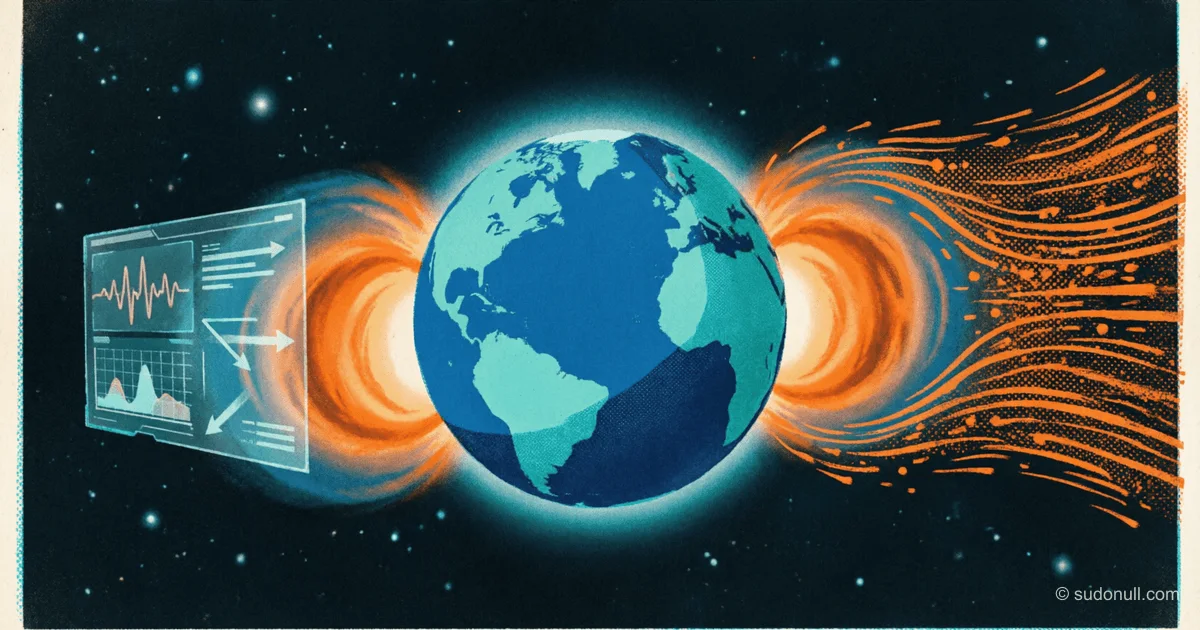
The joint Sino-European SMILE observatory (Solar wind Magnetosphere Ionosphere Link Explorer) launched on May 19, 2026. The spacecraft will, for the first time in history, observe Earth's magnetosphere in soft X-rays, improving space weather forecasting.
Mission 'Smile': Scientific Diplomacy in Orbit and the Quiet Struggle for Space Weather
Author: Analytical Note, Internal Review
While everyone is discussing Starship and quantum computers, on May 19, 2026, at 11:52 Beijing time, a Vega-C rocket lifted off from the Kourou spaceport in French Guiana. On board was the SMILE spacecraft — Solar wind Magnetosphere Ionosphere Link Explorer, or 'Smile'. The 2,200 kg Sino-European observatory began a 42-day journey to its operational orbit.
Media reported: 'China and Europe launch satellite to study space weather.' It sounds like just another niche scientific mission that nobody cares about. This is a dangerous misconception.
SMILE is not just a satellite. It is the first spacecraft in history to see Earth's magnetic field in X-rays. It is equipped with a unique soft X-ray telescope that will, for the first time, allow us to observe the entire magnetosphere, rather than 'poking it with a stick' using passing satellites. And behind this lies much more than just science.
[The Core]: What's Really Happening
Earth is constantly bombarded by the solar wind — a stream of charged particles traveling at speeds up to 800 km/s. Particularly powerful coronal mass ejections (CMEs) can trigger geomagnetic storms that disrupt satellites, knock out power grids, and threaten astronauts. In 1859, the Carrington Event disabled telegraph lines worldwide. Today, a similar event would cause trillions of dollars in damage.
The problem is that we still don't fully understand how the solar wind interacts with the magnetosphere. We have individual satellites — WIND, ACE, THEMIS — that measure parameters at specific points. But that's like studying a hurricane by standing in one spot with an anemometer. You see the wind speed right there, but you don't see the whole picture.
SMILE solves this problem using an effect discovered by the ROSAT and XMM-Newton missions: when highly charged ions from the solar wind collide with neutral atoms in Earth's exosphere, charge exchange occurs, accompanied by emission in the soft X-ray range. SMILE's X-ray camera (SXI) will detect this radiation and turn the invisible boundary of the magnetosphere into a clear image.
Non-obvious insight: SMILE is, in essence, the first 'X-ray radar' for observing space weather. The data it collects will allow forecasting geomagnetic storms with unprecedented accuracy. And accurate space weather forecasting means billions of dollars in saved infrastructure.
[Timeline and Context]
The SMILE mission is an 11-year-long story.
- November 2015: The European Space Agency approves the SMILE mission as a joint project with the Chinese Academy of Sciences. Out of 13 proposed concepts, this one is selected.
- June 2023: Successful critical design review in Shanghai.
- September 2024: The payload module from Airbus in Spain arrives at the European Space Research and Technology Centre (ESTEC).
- December 2024: The Chinese platform arrives at ESTEC on a special flight from Shanghai.
- January 21, 2025: The two halves of the satellite are mated.
- April-May 2026: Final tests in the Maxwell chamber and on the vibration stand.
- May 19, 2026: Successful launch from Kourou.
Chronological deception: Officially, the mission is called 'joint,' but look at the distribution of roles. China is responsible for the satellite platform, three of the four scientific instruments, and ground support. Europe is responsible for the payload module, the X-ray camera, and the launch vehicle. On paper — parity. In reality — China is gradually pushing Europe out of the 'senior partner' position in space projects. The Vega-C is European, but the launch cost is split equally. And the satellite was built with Chinese money.
[Who Wins and Who Loses]
Winner (strategically): China.
Beijing has just gained access to cutting-edge European X-ray optics technology and ESA infrastructure for years to come. Chinese engineers worked side by side with Europeans at ESTEC. This is not just 'cooperation' — it's technology transfer bypassing US sanctions. China cannot buy space technology from the US, but it can get it through Europe. SMILE is the perfect channel.
Winner: Europe (ESA).
Europe gains access to Chinese rocket infrastructure (in the future) and data from a unique instrument. But most importantly, ESA maintains scientific relevance in an era when NASA and CNSA are racing to the Moon and Mars. SMILE gives Europe a niche where it remains a leader: magnetospheric physics.
Winner: The scientific community.
For the first time, data will be open to the entire world. Scientists from over 55 countries will be able to use SMILE results. This will accelerate the development of space weather models.
Loser: NASA.
The US space agency has a similar mission, LEXI (Lunar Environment Heliospheric X-ray Imager), which was delivered to the Moon in January 2025. LEXI observes the magnetosphere from the lunar surface. But its field of view and sensitivity are inferior to SMILE. SMILE has a field of view of 9.6 degrees, LEXI has 44 degrees, but SMILE is in an orbit with an apogee of 121,000 km, giving it a unique perspective. NASA is losing this scientific race to China and Europe.
Loser (catastrophically): Telecommunications and energy corporations.
Every hour of GPS satellite downtime due to a geomagnetic storm costs $500,000 in losses for aviation and logistics. Accurate SMILE forecasts will allow satellite operators and power grids to prepare for storms 24-48 hours in advance. But for insurance and reinsurance companies, this means a shrinking 'space risk' market. If a strike can be predicted, it cannot be claimed as force majeure.
[What the Media Isn't Saying]
First. 'Open data' — not entirely true.
Officially, SMILE scientific data will be open to the world. But there's a catch: primary processing and calibration of data occurs at Chinese centers. China receives data 6-12 hours earlier than the rest of the world. In the context of rapidly developing space storms, those hours mean the ability to be the first to warn its satellites and military assets. China gains a time advantage in protecting its orbital constellation.
Second. Military applications.
The mission is declared purely civilian. But the ability to observe the magnetosphere in real time has direct military significance. Any intercontinental ballistic missile entering the atmosphere creates a plasma cloud that interacts with the magnetic field. SMILE (or its successors) could be used to detect launches. It's no coincidence that the Chinese part of the project is overseen by the Academy of Sciences, which is closely linked to defense structures.
Third. Silence in Russian media.
Note: the SMILE launch went almost unnoticed in the Russian information space. This is no accident. Russia has its own magnetosphere study program (Resonance satellites, Ionosphere project), which is far behind schedule. The Sino-European success is a blow to the prestige of Russian space science, which has been funded on a residual basis for decades. Silence is a defensive reaction.
[Forecast: Next 30 Days and 90 Days]
30 days:
By June 20-25, 2026, SMILE will complete a series of 11 maneuvers to reach its target orbit with a perigee of 5,000 km and an apogee of 121,000 km. During this period, look for news about first test activations of scientific instruments. Particularly critical is the activation of the SXI X-ray camera — the most complex element of the mission. If reports emerge in June about problems with detector cooling (they operate at temperatures around -70°C), it could delay the start of the science phase by months.
90 days (by August 2026):
In late July to early August, a 2-month period of instrument calibration and testing will begin. But already in August, we may see the first 'raw' X-ray images of the magnetosphere. If these images are released (and competition between ESA and CAS for 'first light' will be fierce), it will be a scientific sensation. The first images will show the shape of the bow shock in front of the magnetosphere and the position of the magnetopause.
Bet: Watch for NASA's reaction. They have the Geospace Dynamics Constellation (GDC) program, scheduled for launch in 2028-2029. SMILE's success could force NASA to reconsider GDC's configuration — perhaps adding an X-ray telescope modeled on SMILE. If in August NASA announces a new contract for the development of a 'small X-ray telescope for GDC,' it will be a direct response to the Sino-European breakthrough.
Verdict: SMILE is more than science. It is a geopolitical tool and a technological bridge between two space powers, bypassing a third. China gained access to European technology, Europe gained access to Chinese money and rockets. The US was left out. And most importantly, in three years, we will have the first working prototype of a 'space weather radar.' A world that can be predicted is a world that can be managed. SMILE is the first step toward managing space weather. And China took that step with Europe, not with America. Remember this day.
— Editorial Team










No comments yet.