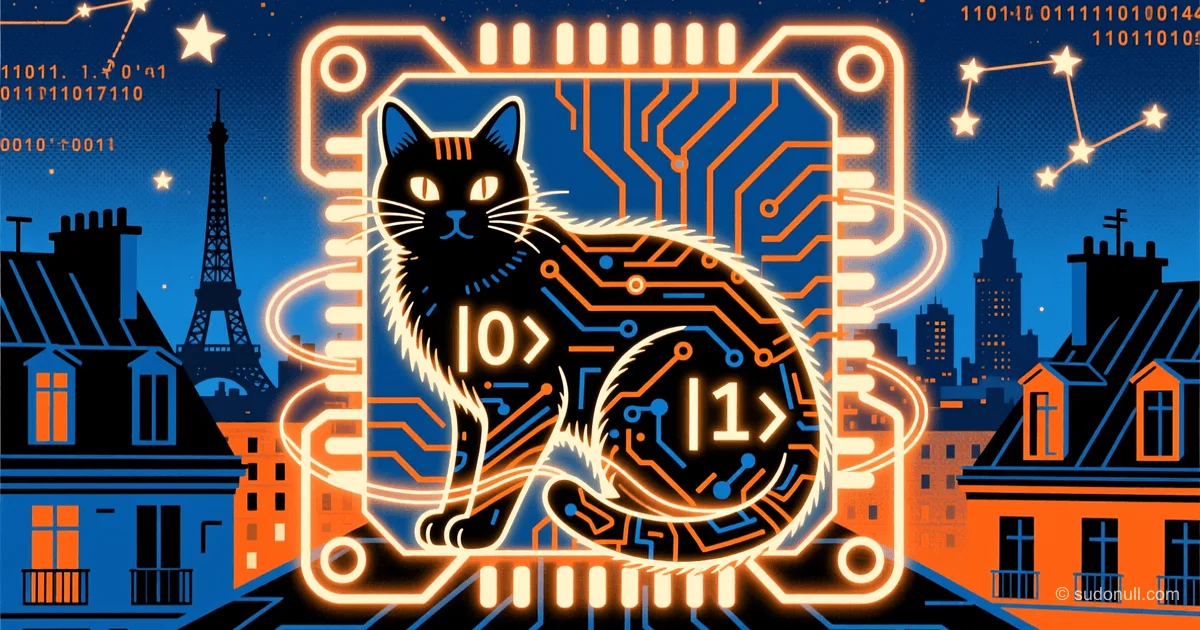
French startup with cat qubits gets investment from NVIDIA
NVIDIA's venture arm NVentures has invested in Alice & Bob, a company developing "cat qubits." The technology promises to radically reduce error rates in quantum computing.
Headline: Cats vs. Ions: Why NVIDIA paid for "cat qubits," and what it means for Google and Quantinuum
On May 22, 2026, NVIDIA's venture arm NVentures announced an investment in the French startup Alice & Bob, which is developing "cat qubits." The amount was not disclosed, but it supplements the B-round of €1 billion (about $1.05 billion), bringing it to €1 billion.
Mainstream media writes: "NVIDIA invests in quantum computing." But that explains nothing.
Folks, NVIDIA is not "interested" in quantum. NVIDIA is building the cage in which all quantum computers will live. And the "cats" from Paris are the perfect beast for that cage.
[The Gist]: What's really happening
Forget about "quantum supremacy." It's about "quantum-classical servitude."
Most think a quantum computer will replace classical ones. NVIDIA thinks otherwise: a quantum processing unit (QPU) is just an accelerator, like a GPU, but even more finicky. It will never work alone. It always needs a powerful classical supercomputer nearby to suppress noise, correct errors, and interpret results.
Alice & Bob makes qubits that are by definition more stable. Unlike conventional superconducting qubits (like Google's or IBM's), "cat qubits" use the "two-photon dissipation" effect. Simply put: they are harder to flip from 0 to 1 randomly. They suppress bit-flip errors exponentially.
However, this comes at a cost: they become more sensitive to phase-flip errors. It's like a car that no longer stalls at traffic lights (bit-flip error) but handles worse on turns (phase error).
And here's where NVIDIA comes in.
Correcting phase errors can only be done with classical algorithms. This requires enormous real-time computing power. It's an ideal task for GPUs. Alice & Bob already works with NVIDIA CUDA-Q, and they managed to speed up error correction decoding by 9x compared to conventional processors.
The essence of the deal: NVIDIA is not paying for qubit technology. NVIDIA is paying to prove: "Your quantum computer won't take off without my supercomputer." Alice & Bob is the perfect reference for this thesis.
Timeline and Context
NVIDIA is methodically buying into all alternative architectures to avoid betting on the wrong horse.
- 2024: Collaboration begins. Alice & Bob integrates its simulators (Dynamiqs) with the NVIDIA ecosystem.
- September 2025: NVentures invests in Quantinuum (ion traps, tracking round at $6 billion).
- Early 2026: Investments in QuEra (neutral atoms) and PsiQuantum (photonics).
- May 2026 (present): Injection into Alice & Bob (cat qubits).
- May 21-22, 2026: Simultaneously, the US government announces $2 billion in funding for nine quantum companies (IBM, GlobalFoundries, etc.).
Note the dates. The quantum computing market has just left the "lab experiment" stage and entered the arms race stage. And NVIDIA doesn't want to be left unarmed.
Who Wins and Who Loses
Winners:
- NVIDIA (unquestionably): They now have a "bet" on every horse. Whether Quantinuum with ions or Alice & Bob with "cats" wins, the data center to manage those qubits will be built on NVLink and CUDA-Q. This is the "shovels during a gold rush" strategy taken to the extreme.
- France and Europe: Alice & Bob is part of the French national plan PROQCIMA (target 2032). Investment from an American giant validates "Made in Europe" technology. It shows that the Old World can compete with the US and China in the most complex, knowledge-intensive fields.
- AWS and Azure customers: If cat qubit technology reduces the number of physical qubits needed for a logical qubit from 1000 (as with IBM) to ~50 (as Alice & Bob promises), quantum computing will become tens of times cheaper and available via the cloud much sooner than 10 years from now.
Losers:
- Google Quantum AI: Google has its own path: superconducting Transmon qubits (Willow processor). NVIDIA is now funding architectures that are direct competitors to Google. If "cats" or "neutral atoms" win, Google's multi-billion dollar investment in Willow could become a dead-end branch of evolution.
- IBM (paradoxically, but true): IBM received $1 billion from the US government for its quantum research. But NVIDIA is not investing in IBM. NVIDIA prefers startups it can "tame." IBM is used to being king of the hill, but here it's being pushed aside as "just another player."
What the Media Isn't Saying
Insight number one (most important): "Cat qubits" combine hardware and software.
Conventional qubits break from external noise. "Cat" qubits also break from noise, but due to their design, they are somewhat "immune" to readout errors.
But most importantly, there are the "Elevator Codes" that Alice & Bob announced in January 2026. This is an error correction method that reduces logical error rates by 10,000x using just one additional "elevator" qubit that moves between code layers.
Usually, error correction requires hundreds of "bad" qubits to protect one "good" one. Elevator Codes allow it with dozens. This is the holy grail of quantum computing: hardware-efficient correction.
And NVIDIA helped them simulate it. Without GPU acceleration, this calculation would have taken weeks. NVIDIA did it in hours. This is the detail no one notices: NVIDIA is the only company that has both AI chips and software for simulating physics more complex than a nuclear explosion.
Forecast: Next 30 Days and 90 Days
30 days (by June 22, 2026):
- Quantinuum will file for an IPO. This will be the largest offering in quantum industry history (valuation exceeding $200 billion). NVentures will reap huge rewards, further fueling interest in the fund.
- Google will do a "quiet" rebranding. They will start talking not about "quantum supremacy" but about "quantum utility in hybrid environments." This is a direct response to NVIDIA's rhetoric that a QPU will never be alone.
90 days (by August 22, 2026):
- China will respond. Expect an announcement from Beijing or Shanghai about a "breakthrough in error correction." Chinese scientists will present their version of "cat qubits" (or an analog of Elevator Codes), claiming they have surpassed the French in stability. This will be not just a scientific paper but a political statement.
- Launch of a "hybrid" service. NVIDIA and Alice & Bob will announce the availability of a cat qubit simulator in the cloud. Any researcher will be able to "touch" the technology without having a physical quantum computer. This will lower the barrier to entry and accelerate application development (chemistry, materials science) for the Alice & Bob architecture.
- First commercial contract. Alice & Bob will sign a contract with a major European automaker (likely Volkswagen or Mercedes) to simulate new batteries. This will prove that their "cats" can earn money, not just catch photons.
Summary: NVIDIA does not believe in the victory of any single technology. It believes in the victory of the software stack that connects the chip to the cooling fan. By investing in Alice & Bob's "cats," NVIDIA is hiring the most dangerous predators to chase IBM's and Google's "mice." And wherever the mouse runs, NVIDIA's cat (CUDA-Q) will be waiting at the exit.
— Editorial Team







No comments yet.