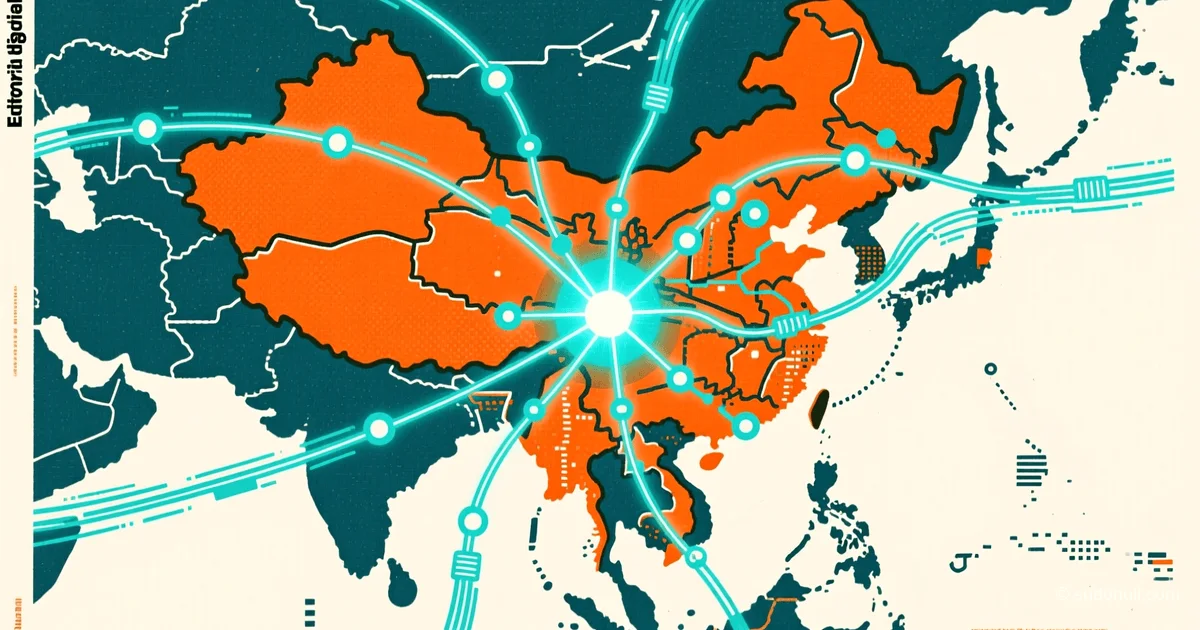
China Launches Pilot Project for Cross-Border Data Exchange with ASEAN Countries
China's National Data Administration announced on May 21 the launch of a pilot zone in Nanning. The project aims to reduce data transmission delays and create unified standards for mutual data recognition with Southeast Asian nations.
Headline: 18 Milliseconds to Hanoi: Why the Transatlantic DPF Is Dead and Nanning Is the New Brussels
On May 21, 2026, China's National Data Administration announced the launch of a pilot zone in Nanning for cross-border data exchange with ASEAN countries. The numbers that caught attention: data transmission latency between Nanning and Hanoi will drop from 107 to 18 milliseconds. Media outlets write about infrastructure, cables, and "cost reduction."
Colleagues, you're looking at the fence, but you should be looking at the forest. 18 milliseconds is not about speed. It's about geopolitics. It's the moment when China officially launched an alternative to the Western model of data regulation, and it did so not in words but in hardware.
[The Essence]: What's Really Happening
Western media have been writing about "internet fragmentation" and "standards competition" for three years. But until May 21, 2026, these were abstractions. The Transatlantic Data Privacy Framework was the reality [$9.8 trillion in economic relations, $358 billion in digital exports from the US to the EU in 2024 alone].
What happened in Nanning? China didn't just lay cables (though 12 cross-border terrestrial cables linking Vietnam, Laos, and Myanmar is serious). China created a "turnkey solution": infrastructure + mutual recognition of rules + brokerage platform + legal support. This is a vertically integrated solution to a problem that the West has been solving for decades through courts and committees.
And, most importantly, this is happening just as the EU and US are beginning their second review of the DPF, scheduled for 2027. While Western bureaucrats debate how to handle two complaints from European citizens (yes, over the entire lifespan of the mechanism—two complaints), China is building a system that will serve 680 million people across ten countries.
Timeline and Context
What happened on May 21 was not sudden. It is the culmination of a 120-day strategic blitzkrieg.
January 2026 — The 6th ASEAN Digital Ministers Meeting took place in Hanoi. An agreement was reached to establish the China-ASEAN Digital Academy and the AI Innovation Center. Key point: both sides will synchronize China's 15th Five-Year Plan for the digital sector with the ASEAN Digital Masterplan 2030. This is not just cooperation—it's clock calibration.
March 2026 — Version 3.0 of the China-ASEAN Free Trade Agreement comes into effect. For the first time in the history of a trade agreement, a separate section is dedicated to data and the digital economy.
April 2026 — The China-ASEAN Business and Trade Information Platform undergoes final testing. It was developed by China News Network and targets agencies, industry associations, the Chinese diaspora, and cross-border businesses.
May 2026 (19-21) — First, the trade information platform launches (May 19), then, on May 21, the data pilot. These are not two events. They are the first and second stages of one operation. First—information for business. Then—rules and infrastructure.
May 2026 (May 21) — Nanning becomes the second city in China (after Shanghai) and the first "regional" pilot for cross-border data.
Who Wins and Who Loses
Winners:
- Guangxi Zhuang Autonomous Region — A region that was an "inland province" for decades suddenly becomes the gateway to Southeast Asia. The model of "development in Beijing-Shanghai-Guangzhou + integration in Guangxi + application in ASEAN" transforms Guangxi from a transit zone into an integrator. This is a quantum leap in status.
- Chinese Tech Giants (Alibaba, Tencent, Huawei) — They now have a predictable, legal "pipeline" for data into a region of 680 million consumers. Previously, every cross-border data transfer required individual approval. Now—unified rules. Tencent is already testing cross-border livestreaming through Guangxi, and Alibaba is preparing a cross-border e-commerce platform specifically for ASEAN.
- ASEAN as a Whole — They gain access to China's technology and market on their own terms. But more importantly, they gain an alternative to the Western model, where rules are dictated from Brussels and Washington. Now they have a choice.
Losers:
- European Union (catastrophically) — While the EU discusses with the US how to handle complaints through the Data Protection Review Court (which has processed… two), China is building a system for 680 million people. By 2027, when the second DPF review occurs, China will already have two years of operational infrastructure. Asian companies will simply drift into China's orbit because there "it just works."
- Singapore (paradoxically) — Singapore was the traditional data processing hub for Southeast Asia. Nanning (with its 18 ms to Hanoi) intercepts part of that flow. Especially the part linked to Vietnam, Laos, Myanmar—fast-growing markets. Singapore won't lose entirely, but its monopoly on the "gateway to ASEAN" is over.
- Facebook/Meta (quietly but surely) — Meta had plans to build data centers in Thailand and Vietnam to serve ASEAN. The Guangxi model means this data can be processed in China instead of locally. Meta will never agree to this for political reasons (the Chinese government would gain access to the data). But their competitors (TikTok, Alibaba) will. Meta will be pushed out of the region not technologically, but infrastructurally.
What the Media Isn't Saying
Insight One: Nanning is the "analogue of Brussels" for a digital GDPR, Chinese-style.
The EU spent years creating the GDPR and DPF as "soft power"—if you want to work with Europe, you comply with European rules. China is now doing the same in ASEAN, but faster and with fewer compromises.
Key difference: Europe demands that the US create courts and review mechanisms. China simply builds cables, data centers, and says: "Here are the rules. They resemble ours. Sign." The difference in philosophy: the West regulates through lawyers, China through engineers. And engineers win because they build, not debate.
Insight Two (the least obvious): Technology is a pretext. The real goal is currency.
Whoever controls data flows controls money flows. Behind the 18 milliseconds to Hanoi is not just reduced latency. It's the opportunity for Chinese banks and payment systems (Alipay, WeChat Pay) to become dominant in the region.
When data goes through Chinese infrastructure, transactions also go through Chinese platforms. Visa and Mastercard have no access to this "pipeline." They remain outside. China UnionPay and the digital yuan (e-CNY) gain a speed and cost advantage. That's the essence: data is the vanguard of money.
Insight Three: The second pilot after Shanghai is no coincidence.
Note: the first city to receive a pilot for international data cooperation was Shanghai—a "comprehensive" pilot. The second was Nanning—with a clear "ASEAN orientation."
This reveals a strategy: China will not create uniform rules for all. There will be regional pilots for each major partner. Nanning for ASEAN. Urumqi—likely for Central Asia. Heihe—for Russia. By 2030, China will have not one standard, but a network of "compatible" standards, each slightly different, but all leading to Beijing.
Forecast: Next 30 Days and 90 Days
30 days (by June 22, 2026):
- The first commercial deals through the China-ASEAN Business and Trade Information Platform will be announced. These will be cross-border e-commerce contracts between Chinese companies from Guangxi and Vietnamese/Thai partners. Total value—around $500 million. Information will appear in Chinese state media as "first success."
- Thailand and Malaysia will officially announce their joining of the mutual data recognition system. This will be presented as "strengthening relations," but in reality—an admission that they have no alternative. The Philippines and Indonesia will hold back for now—they will bargain for better terms.
- Emergency consultations will begin in Brussels. Topic: "What to do about the Nanning pilot." The result will be predictable: they will issue a loud statement about "the need to protect European standards" and… do nothing, because they lack the tools to compete with physical infrastructure.
90 days (by August 22, 2026):
- The Nanning pilot will expand. To the three initial components (infrastructure, mutual recognition, scenarios), two new ones will be added: "digital currency" (e-CNY for cross-border settlements) and "cybersecurity" (joint exercises and intelligence sharing on cyberattacks). This will transform the pilot from an economic one into a full-fledged political and military one.
- The US will respond. They will announce the launch of the "Indo-Pacific Digital Corridor" involving Japan, South Korea, Taiwan, and… Singapore. Singapore will find itself in a difficult position: join the American corridor or accept the Chinese one? Most likely, they will participate in both, but this will cause friction. Shares of Singaporean companies dependent on data processing will be volatile.
- The first "data leak" from the Nanning system will occur. Not a cyberattack, but a human-related incident. Western media will blow it up as "proof of the insecurity of the Chinese model." China will respond with a swift investigation and public punishment of those responsible. Markets will react with a short-term drop in confidence, but no long-term damage—because there is no alternative anyway.
Summary: On May 21, 2026, China didn't just launch a data pilot. It launched a "digital CSTO" for Southeast Asia. 18 milliseconds to Hanoi is not a technical specification. It's a political declaration: "We are here, we built it, and we don't need your permission."
Europe and the US can debate the DPF and GDPR until 2027. By then, Nanning will already be serving half a billion people, have working contracts, and, most importantly, a precedent. And in the world of data, precedent matters more than any agreement.
— Editorial Team










No comments yet.