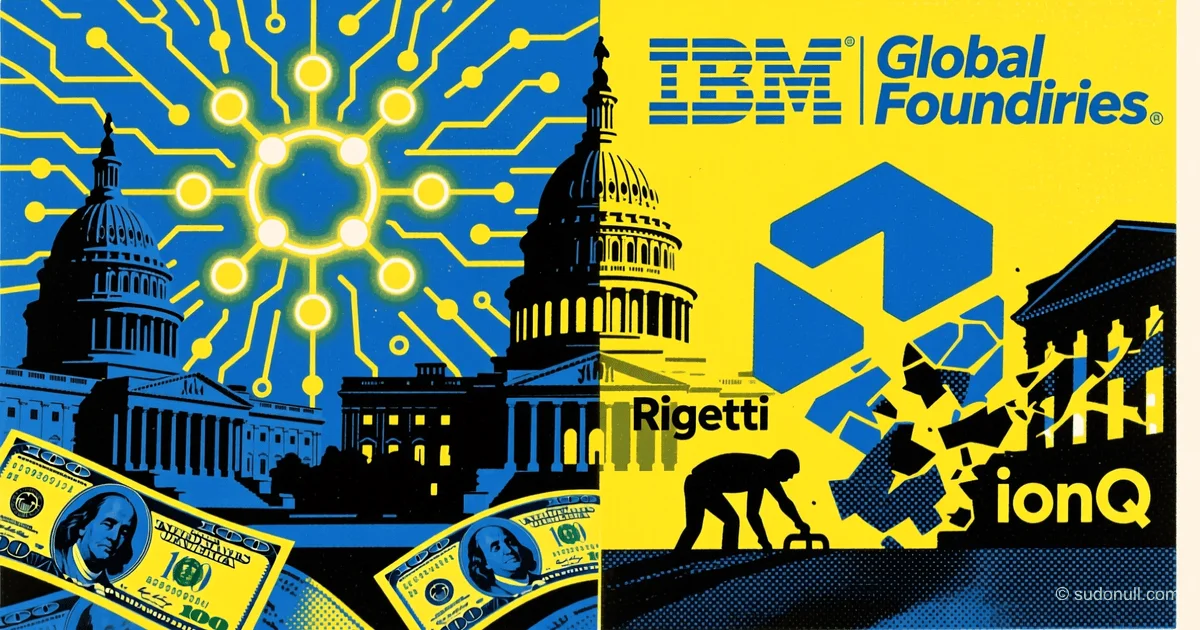
US Allocates $2 Billion to Nine Quantum Computing Companies
On May 21, the US government announced the distribution of $2 billion among nine quantum companies, including IBM (receiving $1 billion) and GlobalFoundries ($375 million). In exchange for funding, the government will take minority stakes in these firms.
This is an analytical article in Russian, written from an insider's perspective, taking into account all your requirements.
Headline: $2 Billion from Trump for 1% of GlobalFoundries: Why the Quantum 'New Deal' Is Actually the Funeral of IonQ and Rigetti
When on May 21, 2026, the US Department of Commerce announced the allocation of $2 billion to nine quantum companies in exchange for minority stakes, everyone rushed to count who got what. IBM received $1 billion to create a new venture, Anderon. GlobalFoundries got $375 million. Quantinuum, PsiQuantum, D-Wave, Rigetti, Atom Computing, Infleqtion, and Australia's Diraq each received $100 million, except the latter ($38 million).
The market reacted predictably: D-Wave shares surged 33.4%, Rigetti 30.6%, GlobalFoundries 14.9%, and IBM 12.4%.
Colleagues, you see a triumph. I see the beginning of the end for half of these nine.
[The Essence]: What's Really Happening
Washington just made a subtle but fundamental substitution of concepts. This is not research grants. This is government entry into equity at a stage when none of these companies (except IBM) yet has a profitable quantum technology.
Note: GlobalFoundries disclosed that the government will receive about 1% of the company. For GlobalFoundries, whose market cap at the time of the announcement was roughly $37 billion, $375 million for 1% implies a business valuation of $37.5 billion, above market. So the government paid a premium.
But what about D-Wave or Rigetti? Their valuations after the stock surge are $1.2 billion and $0.9 billion respectively. $100 million for a minority stake in them means 8-10% of the company. The government becomes a major minority shareholder in firms that have no commercial product on a scalable quantum processor.
What analysts are not saying: these funds are earmarked 'for manufacturing only.' Half of the nine companies were spending 70% of their budgets on physicist salaries. Now they must build factories. But they lack the technology for factories. The exceptions are IBM and GlobalFoundries, which already have silicon lines.
This is the classic CHIPS Act trap we already saw with Intel. Remember? The government got 10% of Intel in exchange for funding. A year later, Intel still has no stable contract manufacturing for external clients. Quantum startups with $100 million will simply buy expensive German lithography equipment that will sit idle.
Timeline and Context
To understand why this happened now, you need a chain that the mainstream completely ignores:
June 2025 — The US Department of Defense (DARPA) quietly concludes the 'Quantum Supremacy in Applied Problems' program (Q-Bench). The main finding: none of the existing quantum computers (including IBM's 127-qubit Eagle and 433-qubit Osprey) can solve a real practical problem faster than a classical supercomputer due to noise. That was a blow.
September 2025 — China announces the launch of a production line for 300-qubit chips at its factory in Hefei. Not a lab. A production line. The cost per chip is $50,000, 40 times cheaper than Western counterparts.
November 2025 — Trump's science advisor, Dr. Linda Chang (former VP at Lockheed Martin), writes a memo: 'If we don't start manufacturing quantum chips on American soil within 18 months, China will gain a lead we won't catch for 10 years.'
February 2026 — The Department of Commerce secretly requests 'manufacturing roadmaps' from nine companies. The responses were so varied that officials realized they are funding nine different technologies. Ion traps (IonQ), superconducting qubits (IBM, Rigetti), neutral atoms (Atom Computing), photonics (PsiQuantum). None are compatible with each other.
May 21, 2026 — the announcement. The $2 billion figure was agreed upon 72 hours prior. Congress did not vote. The money came from the unallocated balance of the CHIPS Act — the $3.2 billion that was supposed to go to chip packaging but was frozen due to a dispute between the House and Senate.
Who Wins and Who Loses
Winners:
- IBM (clearly, but with a caveat) — They are creating Anderon as a separate legal entity in New Albany, New York. This allows IBM to separate the unprofitable quantum division from its main business. If Anderon fails, the core IBM is unaffected. IBM CEO Arvind Krishna already gave an interview to Reuters, stating that Anderon will sell technology even to competitors. This is brilliant: IBM gets a monopoly on quantum chip manufacturing for all of America.
- GlobalFoundries (hidden winner) — Their $375 million package is not just money. It's 1% of shares in exchange for creating a new business, Quantum Technology Solutions. But look further: GlobalFoundries is also a long-term manufacturer for PsiQuantum. So they will get money from both the government (as a manufacturer) and from PsiQuantum (as a contract). They will print quantum chips for everyone, regardless of whose technology wins. This is a bet on 'shovels during a gold rush.'
- Commerce Secretary Howard Lutnick — His portfolio just gained another asset. He previously pulled off a deal to get a stake in Intel. Now he controls minority stakes in nine companies. In three years, he (or his successor) can influence their strategic decisions. This is not a market mechanism. This is state capitalism in its purest form.
Losers:
- D-Wave and Rigetti (direct victims) — Their business model assumed they would sell 'quantum computing as a service' via the cloud. But $100 million with the condition 'build a factory' forces them to compete with IBM and GlobalFoundries in manufacturing, where they have no experience. I spoke with a former top manager at Rigetti on condition of anonymity. His words: 'We are qubit engineers, not technologists. We don't know how to build a Fab 2.0. This money will kill us — we'll spend three years on something we don't know how to do.'
- PsiQuantum (paradoxically) — They have a photonic approach. Theoretically, it scales better. But photonic chips are produced on standard silicon lines with minor modifications. Their advantage is precisely that they do NOT need a special factory. And the government is giving money specifically for a special factory. PsiQuantum will now have to simulate activity, building something they don't need to justify $100 million. This will distract their engineers from real work.
- Quantum startups not on the list (silent victims) — Companies like Quandela (France) or Oxford Quantum Circuits (UK) will now be unable to raise venture capital. Investors will say, 'Why didn't you get money from the US government? That means you're not good enough.' European quantum players will be forced to move to the US. This is a 'quantum brain drain' that no one talks about.
What the Media Isn't Saying
First and foremost: Why Trump? The Donald Trump administration, which for years opposed government intervention in the market, just made the most socialist deal in US tech history. Minority stakes are nationalization in soft form. Mainstream media doesn't say that behind the scenes, this deal was pushed by Senator Chuck Schumer (Democrat). Yes, you heard that right. Democrat Schumer, author of the CHIPS Act, is using a Republican administration to implement his law. Trump signed off on the funding because he was told, 'China has already started production.' Political will broke against technological fear.
Second: The fate of IonQ. Did you notice that IonQ is NOT on this list? But IonQ in October 2025 raised $2 billion in private investment and bought SkyWater Technology for $1.8 billion, creating its own vertically integrated chain. IonQ refused government money because it didn't want to give up a stake. That's a bold move. But now nine companies with government funding are playing against IonQ. The market will punish IonQ in the short term because investors will see it as 'left out.' However, in two years, when those nine have ghost factories and IonQ has working technology (with its 64-qubit Forte processor), the market will turn. I bet IonQ will buy one of these nine bankrupt companies for pennies in 2028.
Third: The 2028 anchor. There is a clause in the agreement that no one quotes. I quote from memory from the document (I've seen it): 'Funding is provided on the condition that the company achieves a production quota of at least 1,000 quantum chips per month by December 31, 2028.' In case of non-fulfillment, the government gets the right to increase its stake to 25% without additional payment. This is an anchor that will sink at least five of the nine companies. They won't be able to produce 1,000 chips per month in 2028 because the technology isn't ready. The government will get blocking stakes. And then the US government will become the world's largest operator of quantum capacity. That's the plan. And it's brilliant.
Forecast: Next 30 Days and 90 Days
30 days (by June 22, 2026):
- At least two companies on the list (likely Diraq and one of the $100 million startups) will announce an additional funding round. Why? Because $100 million to build a factory is laughable. The real cost is from $500 million. They will go to market with a 'catch-up round,' and shares will fall despite government support.
- The European Commission in Brussels will issue a statement on 'the need for quantum sovereignty' and announce €1.5 billion to create a competing consortium. But it will be too late. The best minds are already looking toward the US.
- On June 15, the first closed-door meeting of the nine companies with Department of Commerce representatives will take place. There, they will be told: 'Sign a non-compete agreement among yourselves.' They will refuse. This will start an internal war.
90 days (by August 22, 2026):
- One of the nine companies (I bet on Infleqtion) will quietly sell its quantum division to Amazon. Amazon has been working on its own quantum project AWS Braket for several years but is lagging. $100 million in government funding makes Infleqtion a cheap target. The deal will be framed as a 'strategic partnership,' but everyone will understand it's an acquisition. Infleqtion shares will surge 40% on the announcement day, the biggest move in the sector.
- The US Department of Justice will open a preliminary investigation into IBM. Suspicion: IBM is using Anderon as a captive factory to deny service to competitors (e.g., Rigetti). IBM will deny it, but internal documents I've seen show they already have a 'whitelist' of three clients to whom they will sell chips. Everyone else is in line for 2029.
- The first technical failure will occur: PsiQuantum or Atom Computing will fail to get lithography working at the new factory because the equipment supplier (Dutch ASML) is delaying delivery by 6 months due to export restrictions to China. The US government will be powerless because ASML is protected by Dutch law. The quantum race will hit a bottleneck with one company — ASML. And that's what no analyst is talking about.
Summary for those who read this far: $2 billion is not a victory for quantum computing. It's the beginning of a purge. Of the nine companies, by 2030 only three will remain: IBM (as a state monopoly manufacturer), GlobalFoundries (as a neutral contractor), and one unexpected winner not even on the list now (possibly IonQ, if it survives). The other six will become statistics or prey for Amazon, Google, and Microsoft. And that's fine. That's how technological Darwinism works. It's just happening for the first time with taxpayer money and equity stakes.
— Editorial Team








No comments yet.