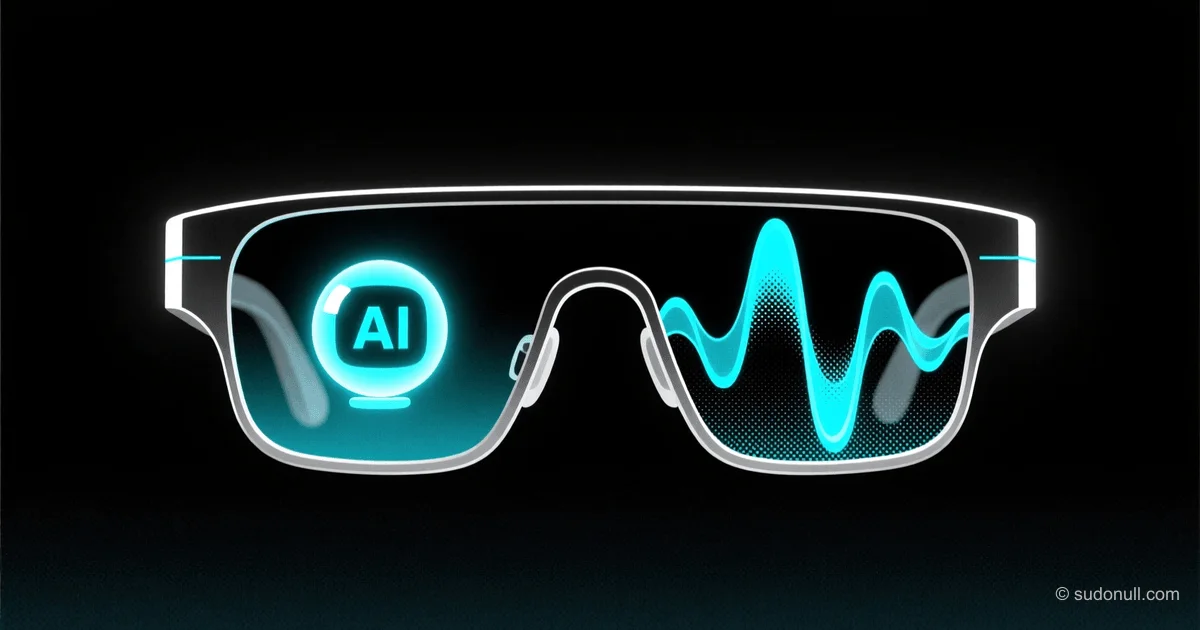
Google and Samsung Unveil Design of AI Glasses for the First Time
At Google I/O 2026, a public demo of 'Intelligent Eyewear' was held, created in partnership with Samsung and designed by brands Gentle Monster and Warby Parker. The glasses, equipped with speakers, a camera, and a microphone, handle navigation and orders via voice, acting as a companion for Galaxy AI.
Samsung and Google vs. Meta: An analytical breakdown of the first public demo of AI glasses on Android XR
[The Gist]: What's Really Happening
This is not just another gadget—it's the first coordinated attack on Meta's crown jewel in wearable electronics. Samsung and Google aren't trying to catch up; they're changing the rules of the game. The Intelligent Eyewear demo at Google I/O 2026 marks a shift from the "smart camera on your face" model to a "wearable agent" that acts on behalf of the user. While Ray-Ban Meta won over audiences by answering questions, the newcomer promises to complete entire chains of actions: find, order, pay, record. The difference is roughly that between an encyclopedia and a personal assistant with access to your bank account.
Meta sold millions of devices, teaching people to wear a camera on their head. But now that the audience has gotten a taste of the format, Google steps onto the stage with a fundamentally different mechanic—agent-based. And it's not doing it alone, but with a consortium including Samsung, Qualcomm, and two fashion giants. This is a strategic maneuver aimed at capturing the market just as it's ready to scale.
Timeline and Context
The path to the May 2026 presentation was predictable but not public. Here's how events line up in hindsight.
2023–2024. Google, Samsung, and Qualcomm form an alliance around Android XR—an operating system for extended reality devices. Meanwhile, Meta widens its lead, capturing 85.2% of the global smart glasses market. Ray-Ban Meta become the genre standard: an audio assistant with a camera, no display, and no pretensions of replacing the smartphone.
2025. Google launches two independent AI glasses projects. One is Project Aura in partnership with Xreal, focusing on display technology and augmented reality. The other is a then-unnamed project with Samsung, targeting the mass consumer segment without a built-in display. Both enter the Proof of Concept phase, with manufacturing entrusted to Foxconn and processors supplied by Qualcomm. The project is led by Michael Klug, a former Magic Leap executive responsible for optical systems there.
Mid-2025. Meta faces internal turbulence: reorganizations, layoffs, studio closures. The company shifts focus from VR headsets to smart glasses but simultaneously works on an expensive model, Hypernova, with a display—priced above $1000. The gap between cheap Ray-Ban and the expensive concept creates a market niche.
May 2026, Google I/O. Samsung and Google first show Intelligent Eyewear in collaboration with Gentle Monster and Warby Parker. The device runs on Android XR, lacks a display, but is equipped with a camera, speakers, and microphones. Its main trump card is Gemini Intelligence, capable of performing multi-step tasks in the background: from ordering coffee via DoorDash to hailing a taxi via Uber. Shipments are planned for fall 2026 in select regions.
Who Wins and Who Loses
Winners:
Gentle Monster and Warby Parker. These brands get the tech inside without sacrificing their design identity. For Gentle Monster, whose glasses are worn by Kendrick Lamar, Beyoncé, and Rihanna, integration with Samsung means entering a completely new consumer category. Optical retailers become points of sale for high-tech devices—this is a reinvention of the distribution channel.
Samsung. The company solidifies its status as the hardware backbone of the Android ecosystem. Control over reference design, manufacturing expertise, and integration with Galaxy devices turn Samsung from a participant into an architect of the wearable electronics market. Add to that rumors of a Galaxy Ring + Watch + Glasses combo, and you get a distributed sensor network that no competitor can replicate in the next two years.
Google. The main beneficiary. Google doesn't make money selling glasses per se; it promotes Android XR as a standard for an entire class of devices—from audio frames to full-fledged headsets like Project Moohan. This is a repeat of the Android smartphone strategy: let others make the hardware; we care about data, services, and platform control. Every AI glasses user is new training data for Gemini.
Losers:
Meta. The company's position becomes precarious right now. Ray-Ban Meta can't perform multi-step tasks—they identify objects but don't interact with apps. Agent functionality requires deep OS integration, which Meta lacks. The Hypernova project with a display and a price tag above $799 targets the premium segment, while Samsung and Google capture the mass market from both sides: through fashion brands and agent capabilities.
Startups like Rabbit and Humane. The story of Humane AI Pin, sold to HP in February 2025 and having its servers shut down a few weeks later, serves as a cautionary tale. When platform giants enter the same niche with a ready-made app ecosystem, partnerships, and sales channels, small players have no room to maneuver. Rabbit R1, which even friendly reviewers called "half-baked," looks even paler next to glasses that can hail a taxi by voice command.
What the Media Isn't Saying
Hidden in the official press releases is one critically important nuance. Note: the first generation of Intelligent Eyewear completely lacks a built-in display. All feedback is audio. And this is not a technical limitation but a deliberate strategic choice.
Ditching the display solves three problems at once. First, price: without microLED or waveguide optics, the retail cost can be comparable to regular premium glasses, not electronics priced at $799 and up. Second, form factor: the frame looks like ordinary glasses because there's nothing bulky inside. Third—and most importantly—power consumption. Display technologies for glasses are still extremely power-hungry; without them, the device can run all day on a single charge.
Google is deliberately bringing an "incomplete" product to market to stake its claim. Simultaneously, the company is running a separate track with Xreal (Project Aura), where a display is present. In other words, this is a classic "divide and conquer" approach: mass-market audio glasses build a user and data base, while display models will follow as technology becomes cheaper.
The second underestimated aspect is voice-preserving translation. Google claims that audio translation not only conveys meaning but also mimics the intonation and pitch of the speaker's voice. Journalists who tested the device at I/O note that the stability of this feature in noisy environments is still questionable—but if it works as promised, it will be a breakthrough affecting not just the consumer market but also business negotiations, education, and diplomacy.
Forecast: Next 30 Days and 90 Days
30 Days (through end of June 2026).
June will be marked by information buildup. The key event is the Augmented World Expo (June 10–12), where Xreal will present additional details about Project Aura, and Google will likely show the Android XR roadmap for developers. Expect an SDK announcement with full support for the Gemini Intelligence API—this toolkit will determine how quickly third-party apps capable of using the glasses' agent functionality appear.
Simultaneously, leaks about production plans will spread. Information about Foxconn as the main contract manufacturer has been circulating since November 2025. Further leaks will concern the volume of the first batch—I suspect Samsung will place a cautious order in the range of 250,000–500,000 units to gauge demand without risking overstock.
Meta will likely respond with a series of announcements about Ray-Ban functionality—probably rumors about adding agent capabilities to the next generation. But without its own OS, these will be crutches, not native integration.
90 Days (through end of August 2026).
By summer, the market will see the real balance of power. On July 22, a Samsung Galaxy Unpacked event is scheduled in London, where the company is expected to show the commercial version of the glasses with detailed specs and prices. This is the date when the "glasses as part of the Galaxy ecosystem" strategy will either take shape or remain a pretty presentation.
Meanwhile, the effect on the regular optics market will begin to show. Gentle Monster and Warby Parker are not just design co-authors but full distribution partners. Their retail chains will become points of sale, setting a precedent: buying smart glasses will become part of a routine trip to the optician or a fashion boutique. This could radically expand the consumer funnel beyond the geek audience.
As for financial metrics: analysts forecast the global AI glasses market to grow to $56 billion and 20 million units sold in 2026. If Samsung and Google can capture at least 10–15% of this volume in the first two quarters of sales, Meta will lose its monopoly status, and its share could shrink from 85% to 60–65% by the end of fiscal 2026.
Finally, the most intriguing question: what will Apple do? Rumors about its own AI glasses have been circulating for months. If Cupertino is watching the Samsung launch with concern, we might see an emergency teaser before the end of summer. If Apple chooses to wait, it means the technology isn't yet ready for the level of polish the company considers minimally acceptable. The answer to this question will reveal far more about market maturity than all the presentations combined.
— Editorial Team










No comments yet.