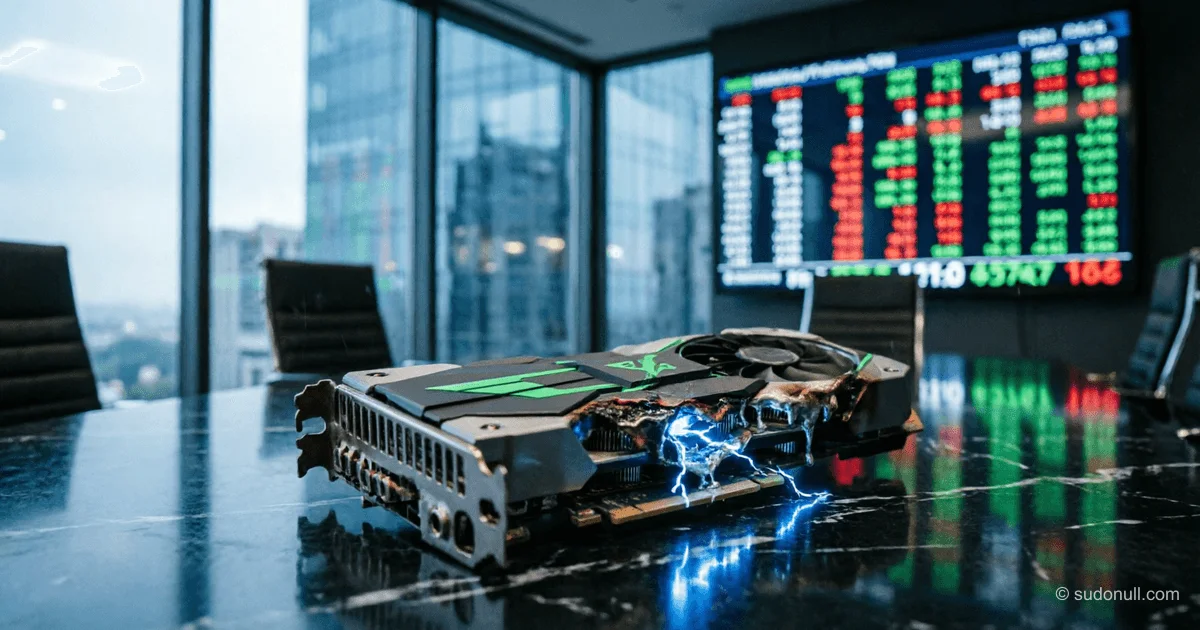
Nvidia's Q1 Earnings Report Expected This Week Amid Trade Risks
Investors await the release on Wednesday after the CEO's return from a trip to China. The US President stated that China is betting on its own AI processors instead of increasing imports of Nvidia chips.
As an analyst who watches the semiconductor sector without rose-colored glasses, I see Nvidia's upcoming report not as a financial summary, but as a moment of truth that will expose a tectonic shift in the global AI market architecture. While traders nervously shuffle options, I see the final point in the era of the "green giant's" unconditional dominance in China and, more importantly, the birth of a new, far more cynical model of corporate growth.
The Essence: What's Really Happening
The point isn't whether Nvidia beats the consensus forecast of $78.7 billion or even reaches $83 billion as analysts predict. That's already priced in and seen as routine. The real drama revolves around Jensen Huang's attempt to hide behind talk of a "trillion-dollar backlog" and an "inference revolution" the fact that his China strategy has moved from the "risk" phase to the "fiasco" phase. Everything that happened in the last two weeks—from the flight on Air Force One to statements about a "zero market share"—is a desperate attempt by Nvidia to save face on Wall Street while admitting that the door to China has slammed shut. And it wasn't Washington that shut it, but Beijing.
Timeline and Context
Here is the sequence of events that led to today:
- 2022-2024: The US imposes export restrictions. Nvidia initially loses the ability to sell A100 and H100 but finds a loophole with the cut-down A800 and H800. Revenue from China peaks at 20-25% of total Data Center revenue.
- Fall 2025: The US closes that loophole too. China's share drops to about 5%. Nvidia begins lobbying for permission to supply H200, claiming it is "obsolete" technology that does not threaten US national security.
- Early May 2026: Huang unexpectedly states that Nvidia's market share in China is zero. This shocking admission the market initially tries to ignore.
- May 12-14: Huang is urgently placed on Air Force One with Trump for a visit to Beijing. Insiders know: he wasn't originally invited; Trump's call was spontaneous after Huang raised the alarm about a complete collapse of positions.
- End of Visit: Despite high-level negotiations, Beijing demonstratively refuses to approve H200 purchases, betting on domestic manufacturers like Huawei. Trump publicly states what everyone already knew: China is building its own ecosystem.
- May 20: Nvidia's report. The market holds its breath.
Who Wins and Who Loses
Losers:
- Nvidia (strategically on the China track). The H200, which Nvidia tried to "push" into China, turned out to be politically unwanted. Beijing made it clear: either full Blackwell-level chips or nothing. But Huang already promised Trump not to supply advanced chips, becoming a hostage to US policy. Losing even 5% of revenue is about $4 billion per quarter that could have been used to compete with AMD, but now simply vanished.
- Small speculators shorting the stock. Anyone shorting the stock before the report is playing with fire. Bank of America predicts revenue up to $84 billion, which would trigger an immediate stock rally regardless of China issues.
Winners:
- Huawei and the Chinese semiconductor sector. Nvidia's exit is not just freeing up a niche; it's an order from Beijing for all tech giants to switch to domestic Ascend chips. The $50 billion market Nvidia considered its own is now fully under local control.
- Large institutional investors. As soon as the report confirms that demand for Blackwell exceeds supply and TSMC's production capacity is booked through 2027, any stock pullback will be used to build positions. The shift from "training" to "inference" in the Vera Rubin architecture guarantees Nvidia cash flow for another decade.
What the Media Isn't Saying
While everyone discusses the "China factor," no one talks about the "circular financing mechanics" Nvidia uses to sustain growth. Bank of America politely calls it "ecosystem investments," but the scheme looks like this: Nvidia gives money to startups like OpenAI or Anthropic, and those same startups use that money to buy Nvidia chips. This creates fictitious organic demand.
The volume of this "circular pump" has already exceeded $40 billion in 2026. Nvidia is essentially financing half of its own backlog. This is not illegal, but it is a giant bubble. If one of these startups collapses without repaying the "investment," Nvidia will have to write off those sums, and then it will become clear that the 75% margin was sustained by lending to its own customers. This is not a business but financial engineering that is getting away with it due to the AI hype.
Forecast: Next 30 Days and 90 Days
30 days (by June 19, 2026): The report will be "better than expected." Revenue around $83 billion. Huang will say on the call that China will "open up" over time to calm the market with false hopes. The stock will rise to $250-$270. Everyone will breathe a sigh of relief. But behind closed doors, panic will begin: what to do with $40 billion in "investments" in an overheated market?
90 days (by August 18, 2026): Once the euphoria over the Vera Rubin announcement subsides, the first lawsuits from minority shareholders unhappy that a company with net profit over $425 billion pays a dividend yield of 0.02% will surface. Pressure on Huang will multiply. He will be forced either to sharply increase payouts to justify a $5.46 trillion market cap, or explain why the company spends shareholder money on startups that compete with its own technologies. This will be a battle between "growth investors" and "value investors," and in that battle, the myth of Nvidia's invincibility will crack.
— Editorial Team










No comments yet.