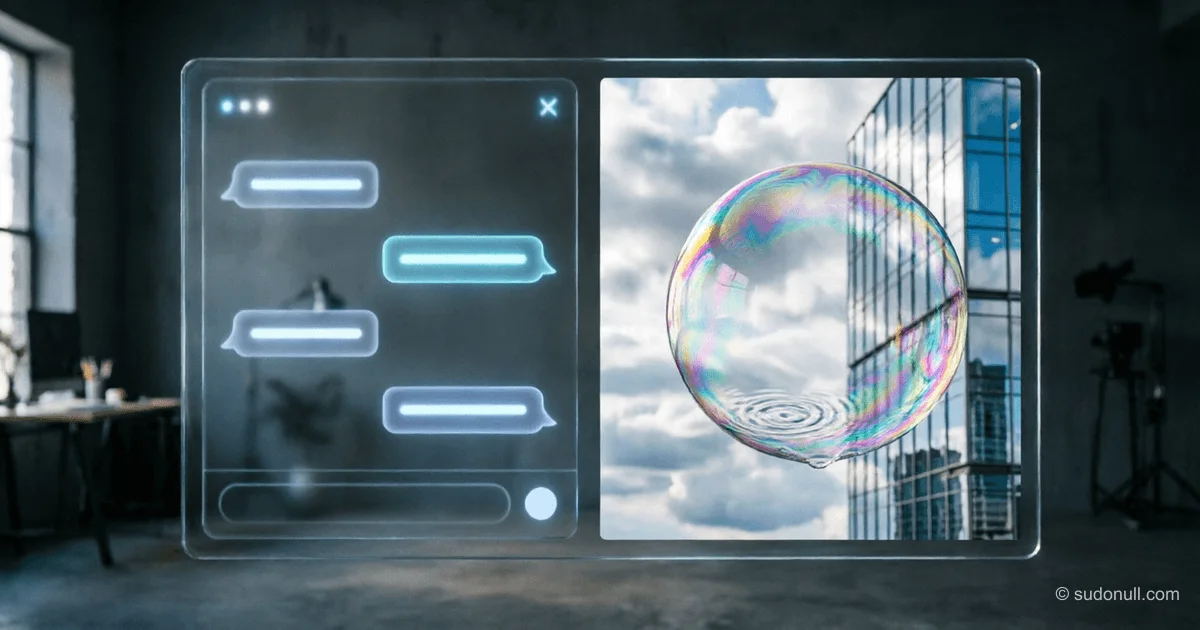
Rumors Swirl About 'Gemini Omni' — Google's New Tool for Video Generation Through Dialogue
Leaks from Google I/O point to an imminent launch of an advanced AI-powered video editor. The tool is said to allow editing clips, generating content from templates, and managing edits via chat.
Rumors about 'Gemini Omni' are a classic example of how the industry, holding its breath, looks not at the product but at the architectural shift that product symbolizes. The media will discuss the number of seconds in a clip or the subscription price, but as an analyst observing this space from within, I see here the final act of a war declared back in February 2024. This is not a race against Sora; it's the capitulation of an entire class of applications before the idea of a single all-powerful interface.
The Essence: What's Really Happening
The essence is not that Google is supposedly making a 'video editor with chat.' That's too narrow. The essence is that 'Gemini Omni' is the first real commercial product that blurs the line between 'generative AI' and 'LLM.' Previously, we had Gemini for text and code and Veo for video. These were different architectures, different teams, different products. Now we are witnessing the birth of Omni Flash — a single multimodal model capable of 'reasoning' simultaneously over text, image, audio, and video and outputting a complete video file.
Note the detail that inattentive journalists miss: the model natively, without external crutches, understands physics (gravity, fluid dynamics), history, and cultural context. This means that at its core is not just a diffusion model, but an LLM-like 'world understanding' packaged into a spatiotemporal codec. When you write 'make a claymation about protein folding,' Omni doesn't stitch together images from training data; it constructs a scene, logically deduces the movement of alpha helices, and writes the voiceover itself, which sounds in sync with the video. This is a paradigm shift from 'pixel synthesis' to 'reality simulation.'
Timeline and Context
- 2024 (Era of Fragmentation): OpenAI's Sora dazzles the imagination, but it's a model for generating 'dreams,' incapable of anything beyond text-to-video. Google keeps Veo as a powerful but still separate 'drawing tool.'
- May 2025: The launch of 'Nano Banana' (Gemini Flash Image) shows Google teaching its text models native image understanding without resorting to external converters.
- Early May 2026: In the Gemini app code, a string 'Powered by Omni' is found, sparking a flurry of speculation: is this a new Veo or something more?
- May 19-20, 2026, Google I/O: Official announcement. This is not a replacement for Veo 3.1, let alone an 'answer to Sora 2.' This is the first shot in the war to eliminate any narrowly specialized AI tools.
Who Wins and Who Loses
Winners:
- Small and medium-sized creative studios. Previously, making changes to motion design required a team of an editor, colorist, and sound engineer. Now a producer says to the chat: 'Change the glass building to a soap bubble with physics,' and the model recalculates the video, preserving the character, lighting, and audio track. The iteration budget drops from thousands to a fixed $7.99 per month for the AI Plus subscription.
- YouTube as a platform. Integrating Omni into YouTube Shorts means hundreds of millions of users will get access to generating 'personalized memes' (avatars, stickers, short sketches) without installing third-party apps.
Losers:
- OpenAI (strategically). Sora is dead. Officially. The app is closed, the API is deactivated. But the Omni announcement doesn't just trample on a competitor's grave; it shows why Sora died. Sora was a tool for generating clips; Omni is an interface for co-creation with AI, tied to Google's unified ecosystem (Chrome, YouTube, Drive). This proves that a 'bare' model without an applied ecosystem is worth $0 in 2026.
- Startups like RunwayML and Luma AI. Their valuation relied on the uniqueness of 'multimodal editing' technologies. But when Google embeds contextual 'chat-editing' and angle changes into a standard $7.99 subscription, startups will have to prove their solution offers a productivity increase comparable to a price tens of times higher.
What the Media Isn't Saying
The most significant fact drowning in the excitement over 'soap bubble videos' is the digital avatar creation tool that comes bundled. The media writes that you can generate your digital likeness for videos. But they miss how it works at the security level. To create an avatar, the user must go through a multi-step procedure: record themselves, say a set of random numbers, and verify.
This is not just protection against deepfakes. Google is building the world's first decentralized biometric verification system for identity synthesis. While you think you're making a funny meme of yourself on the Moon, Google is tying your visual and voice 'imprint' to your account with a rigor that banks would envy. This is the entry ticket to a world where your AI avatar can conduct transactions. In the next 90 days, we will hear about Google's partnership with financial institutions for verification via 'Omni Avatars.'
Forecast: The Next 30 Days and 90 Days
30 days (by June 19, 2026): We will see a surge in demand for the Omni API among developers, but Google will deliberately throttle its issuance to avoid Sora's fate — data center overload and wild inference bills. Instead, Google will bet on Flow — its AI studio where the model works in tandem with Lyria 3 Pro for music. Also expect a scandal: someone will find a way to bypass avatar protection, triggering an emergency security policy update.
90 days (by August 18, 2026): The main event will not be the release of Omni Pro (though it will be announced for the enterprise segment with clip lengths over 10 seconds), but the effective 'killing' of pre-installed video editors on Android. Why would you need Adobe Premiere Rush or CapCut if built-in Google Photos and YouTube Create allow you to change the weather in your vacation video from rain to sun via chat, and even narrate it with David Attenborough's voice? The Omni monetization package will be repackaged: we will see 'monetization through avatars,' where you can sell or license your trained biometric imprint to advertisers. Control over one's own appearance and voice will cease to be a privacy issue, becoming a matter of the commodity market.
— Editorial Team










No comments yet.