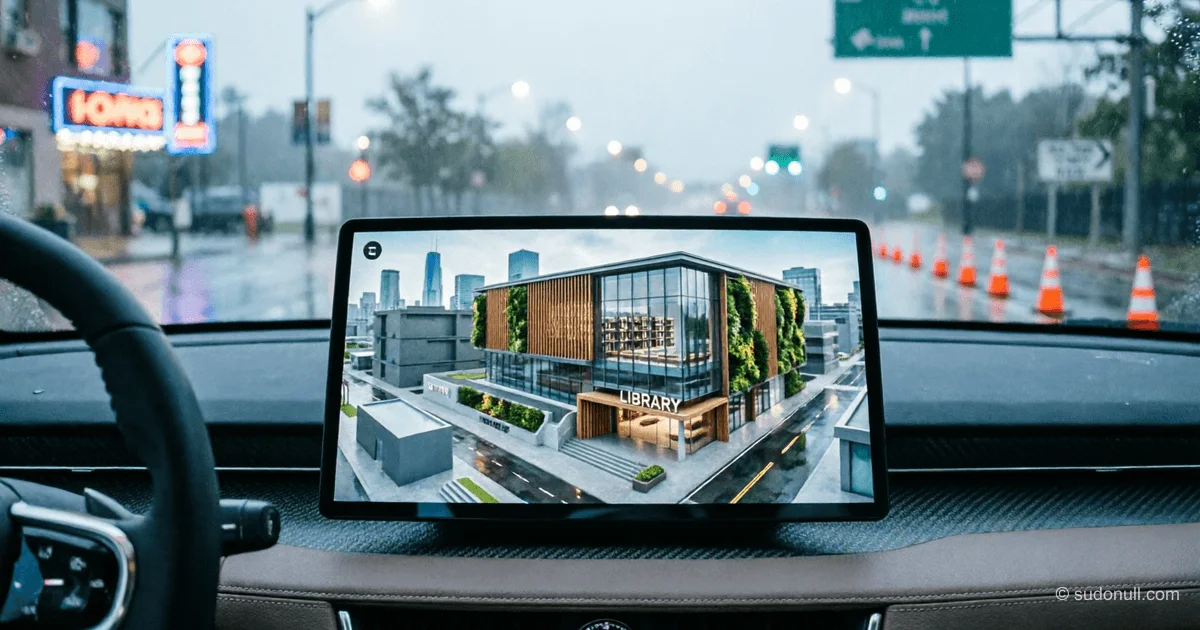
Google Announces 'Immersive Navigation' in Maps for Volvo Cars
The new mode with 3D buildings and detailed interchanges will be available on the EX60, EX90, and ES90 models. Voice prompts will be tied to real-world objects around the vehicle to simplify maneuvering.
As an analyst tracking geodata and its monetization, I see the announcement of 'Immersive Navigation' as not just a change of picture on the multimedia screen, but a strategic capture of the most valuable asset an automaker has—the window of interaction with the driver. This is a blow not to Here Maps or Apple Maps, but to the entire concept of the 'car as a private space.' Volvo, perhaps without fully realizing it, is handing Google the keys not only to the screen but also to the car's real-time visual context.
The Essence: What's Really Happening
What Google and Volvo showed in the EX60 is not just 'pretty 3D buildings' on the dashboard. The core is that Google Maps, for the first time in history, gains a constant, high-quality source of semantic validation of the real world, which is the entire sensor suite of the car. Previously, Street View was updated every few years by bulky cameras on Google's car roofs, and it was a static, albeit panoramic, photograph. Now, every Volvo with this system becomes a living, crowdsourced scanner that confirms in real time: 'This sign is still here,' 'This exit is now closed,' 'This interchange looks exactly like this.' The media writes about helping drivers park based on signs, but for Google, this is a continuous stream of up-to-date data about the physical world, obtained for free and with gratitude from the automaker.
Timeline and Context
Let's look at the chain of events leading to this announcement at Google I/O on May 19-20, 2026.
- Early 2020s: Volvo is one of the first to make a strategic bet on Android Automotive OS, effectively handing Google control over the entire infotainment system. This was the first step toward deep integration, viewed skeptically by competitors who preferred their own shells or Apple CarPlay.
- May 2025: Google announces an update to 'Immersive View' in Maps, which uses AI to create 3D models of cities. The problem is that this view relies on old aerial imagery and cloud rendering; it has no 'eyes' on the road in real time.
- Late 2025 - Early 2026: Engineers at Volvo and Google realize that Volvo has something the mapping service lacks—a powerful onboard NPU in the EX60 and full access to the car's 'vision.' Volvo gains access to the latest Gemini developments, and Google gains access to automotive sensors.
- May 2026: At I/O, the combination of 'Immersive Navigation + Gemini with camera access' is demonstrated. This is not two separate features, as the media presents, but a single organism. 3D navigation draws a beautiful picture, while cameras, through Gemini, supply real-time data for that picture. The voice prompt 'Turn after the library' comes not from a 2019 database but from the fact that the library is detected right now. Alwin Bakkenes, global head of software development at Volvo, calls the EX60 the 'ideal platform' but omits that this platform now runs on Google.
Who Wins and Who Loses
Winners:
- Google (strategically). They gain an army of free cartographers. Every sold Volvo EX60, EX90, and ES90 with the feature enabled is a constant source of telemetry and visual confirmation of changes in the world. This car doesn't just 'drive with navigation'; it digitizes the world for Google. In the long run, this will save tens of millions of dollars on the Street View program and create an incredible competitive advantage in map freshness.
- Volvo (image-wise). Emerging from the shadow of German premium brands, Volvo cements its status as the most tech-savvy European brand in the eyes of geeks. While BMW only promises Alexa+ in the second half of the year, Volvo already shows a working AI that 'sees' the world. This helps maintain pricing on models without physical hardware changes.
Losers:
- Volvo owners (and their privacy). Volvo Cars' privacy policy already states that 'cars with built-in Google may process data from external cameras to improve Google Maps.' This is a vague formulation that covers everything. The buyer pays $60,000+ for a car, and its sensors are used to enrich a corporation.
- Traditional mapping companies (Here, TomTom). Their business with automakers relied on providing maps as a static product. Google offers the automaker not just a map but an entire ecosystem with AI, voice, and visual validation. Competing with this, having only vector road data, is nearly impossible.
What the Media Isn't Saying
Everyone raves about voice prompts 'tied to landmarks.' But no one asks: why did the library or restaurant end up in the navigation prompt? This means Google's navigation engine ceases to be just 'route math' and becomes a search engine with ranking. A store that pays for Google Ads may get priority in navigation prompts ('Turn left right after Starbucks'). An independent coffee shop without an ad budget will never become a landmark, even if it's right at the intersection. We are entering a world where even the landmarks in your car are auctioned off.
The second overlooked point: legal liability. If the AI-powered 3D navigation beautifully draws an open exit that is actually closed due to construction, who is at fault in an accident? Cameras should have seen it. Gemini should have understood it. But Volvo's documentation already includes a disclaimer: 'Gemini is an AI technology that may make mistakes.' The automaker and the tech giant shift responsibility to each other, leaving the driver holding the bag.
Forecast: Next 30 Days and 90 Days
30 days (by June 19, 2026): Volvo's legal department will face the first viral incident. A user in Europe will post a video on social media where the system, due to an error in reading a sign or simply a lag, prompts a traffic violation. This will trigger a wave of questions from European regulators about certifying 'dynamic navigation advisors' based on neural network opinions rather than static maps.
90 days (by August 18, 2026): It will become known that Google is preparing a commercial API for Volvo, allowing paid partners (gas station chains, restaurants) to become 'priority visual landmarks' in 3D navigation. This will effectively launch the world's first auction for ad space not in search but in the physical world, displayed through the car's augmented reality navigation. The entry cost for businesses will be measured not in cents per click but in thousands of dollars per month for the right to be the 'library' in a prompt for premium cars.
— Editorial Team










No comments yet.