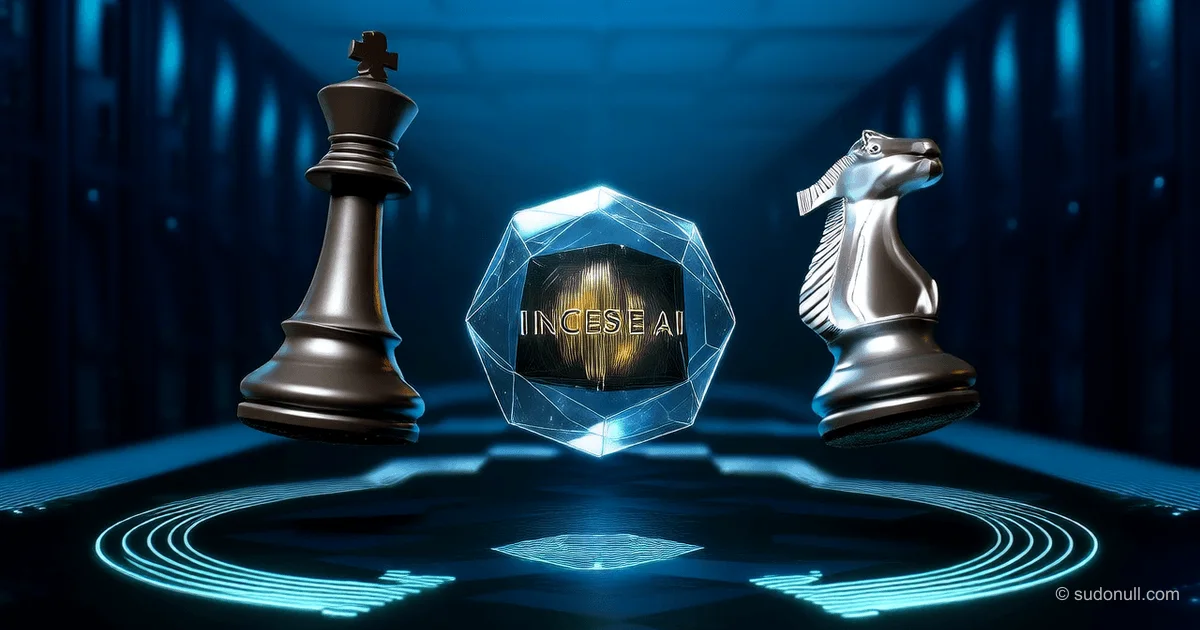
Microsoft and SpaceX Battle to Acquire AI Startup Inception
The startup's diffusion models accelerate text generation by 10x, challenging the dominance of autoregressive architectures.
Microsoft and SpaceX Clash Over Inception: How the Battle for a $1 Billion Startup Is Changing the AI Game
While the world discusses the OpenAI trial, a story unfolds in the shadows that could redefine the architecture of large language models for a decade. Microsoft and SpaceX—two trillion-dollar giants—have simultaneously latched onto the tiny startup Inception, founded in mid-2024 and having raised only $50 million in seed investments. The stakes exceed $1 billion, and this is not a bubble. This is a battle for a technological heresy that works.
The Core: What Is Really Happening
Inception is not just another OpenAI clone with a different name. The company, founded by Stanford professor Stefano Ermon and his colleagues from UCLA and Cornell, builds language models on a fundamentally different architecture—diffusion. The same one that underpins Midjourney, Stable Diffusion, and Sora. Ermon is one of the creators of this technology, the man whose work revolutionized image generation. Now he is trying to do the same with text.
The result is staggering: the Mercury 2 model outputs about 1000 tokens per second—10-14 times faster than GPT-5 Mini and Claude 4.5 Haiku. Meanwhile, quality on complex tests reaches 85-95% of flagship models at a radically lower inference cost.
This speed is what Microsoft and SpaceX are now fighting over. The former is trying to kick its addiction to OpenAI, into which it has poured over $130 billion. The latter is building a vertically integrated AI empire from chips to applications. Both need not just a product, but an alternative architecture capable of bypassing competitors' patent and technological moats.
Timeline and Context
Mid-2024 — Stefano Ermon, Aditya Grover, and Vladimir Kuleshov found Inception Labs in Palo Alto.
November 2025 — Inception raises $50 million from Menlo Ventures, NVentures (Nvidia), M12 (Microsoft), Snowflake Ventures, and Databricks. Andrej Karpathy and Andrew Ng join as angel investors.
February 2026 — Mercury 2 is released. Artificial Analysis benchmarks show a speed of 1000 tokens/s and competitive quality.
Spring 2026 — Microsoft explores acquiring Cursor for $60 billion but backs out due to conflict with GitHub Copilot. SpaceX immediately signs an option agreement to buy Cursor with a $10 billion penalty.
April 2026 — Microsoft and OpenAI renegotiate their agreement. Microsoft's exclusive license is revoked; OpenAI gains the right to work with AWS and Google Cloud. The AGI clause is removed.
May 2026 — Microsoft and SpaceX enter a direct battle for Inception. The startup hires a bank for negotiations and sets a price tag above $1 billion.
Three weeks—that is how long passed between the breakup of Microsoft's exclusive relationship with OpenAI and the leak of information about the Inception negotiations. This is no coincidence; it is a sprint for independence.
Who Wins and Who Loses
Stefano Ermon and his team win. Three professors who started with a "heretical" idea are now choosing between the two largest technology platforms on the planet. A $1 billion price tag with near-zero revenue is payment not for a product, but for an architectural shift and the people capable of executing it.
Elon Musk's SpaceX wins. If the deal goes through, Musk will get the third element of his AI stack: Cursor for code, Inception for fast inference, xAI for model training. Add his own chip project Terafab and Starlink satellite infrastructure—you get a loop independent of Nvidia (entirely) and OpenAI.
Microsoft loses in the short term. Losing Cursor and potentially Inception means the strategy of "buying startups for independence from OpenAI" is stalling. Microsoft still has the internal MAI Superintelligence team led by Mustafa Suleyman, but its goal is to create a frontier model by 2027. That is late. Inception is needed now to close the inference gap for the next 18 months.
OpenAI loses. The company loses a strategic partner that has been its main sponsor and distributor for decades. When Microsoft actively seeks alternatives, it signals to the market that even the largest investor does not believe OpenAI will remain the only correct answer to the question "whose AI to use."
What the Media Isn't Saying
Non-obvious insight: the true reason for the battle over Inception is not generation speed, but removing architectural dependence on autoregression.
Autoregressive models are the drug the entire industry is hooked on. They are reliable, well-studied, and Nvidia chips and Google ASICs are optimized for them. But they have a structural ceiling: each subsequent token waits for all previous ones. You can endlessly increase memory and clock speed, but the fundamental limit of sequential generation remains.
Inception offers a way out. The diffusion model generates a "draft" of the response in its entirety, then refines it in parallel over several iterations. This is not just acceleration—it is lifting the architectural curse. If diffusion scales to the level of GPT-5, the entire inference industry will be upended. Data centers designed for autoregression with its pipeline processing will become suboptimal.
And here is what the media does not write: the main beneficiary of the diffusion approach is not Microsoft or SpaceX, but Nvidia. Mercury 2 runs on standard GPUs, without specialized silicon. If diffusion becomes mainstream, Nvidia will sell even more accelerators because parallel token processing fits perfectly with GPU architecture. Google with its TPUs optimized for autoregression, and Cerebras with its 44 GB SRAM per request, will lose out. That is why NVentures already invested in Inception at the seed stage—Jensen Huang sees strategic interest in a paradigm shift that makes his chips even more indispensable.
Second hidden plot: SpaceX is buying Cursor and Inception not for space. Musk is building an alternative to Google Cloud.
Think about it: SpaceX has Starlink with global coverage. It has Cursor for code. It has xAI with models. It has Terafab for chips. Add Inception for fast inference—and you get a full-fledged AI cloud stack that can be deployed anywhere in the world without relying on AWS, Azure, or Google Cloud. Musk is not competing with OpenAI; he is competing with Amazon and Microsoft at the infrastructure level. Inception in this puzzle is the key element for AI agents at the edge, where latency is critical and the cloud data center is far away.
Third point—Karpathy and Ng as an indicator. When two of the most respected AI practitioners simultaneously join a startup's cap table at the angel stage, it is a sign. They have seen hype and failure for decades. Their involvement means the technical viability of diffusion LLMs is confirmed at a level sufficient for a bet. The market has not yet realized this.
Forecast: 30 Days and 90 Days
30 days (by mid-June 2026):
Inception will choose a buyer. I bet on SpaceX. The reason is simple: Microsoft has already shown indecision with Cursor, and the regulatory risks with Copilot have not gone away. SpaceX is more aggressive, makes decisions faster, and is not afraid of antitrust authorities. The deal will be structured as an option with phased buyout, similar to the Cursor deal: an initial payment of $1-1.5 billion, full buyout upon achieving technical milestones.
If Microsoft wins, it will mean Mustafa Suleyman got a blank check from Satya Nadella and is willing to pay any price. Then expect a parallel announcement of regulatory concessions (e.g., spinning off part of Copilot into an independent structure).
90 days (by mid-August 2026):
Inception's new owner will begin integrating Mercury into its product line. If it is SpaceX, models will appear in Cursor and the xAI API within a quarter. If Microsoft, Mercury will replace part of OpenAI's inference in Azure for tasks requiring low latency.
The key event—Inception will announce Mercury 3 with quality comparable to flagship autoregressive models. If the gap narrows from 5-15% to 3-5%, it will become a tipping point. The industry will seriously begin discussing diffusion as the next-generation standard.
Side effect: the price of AI inference in the cloud will drop by 30-40% due to architectural competition. Users will win regardless of who buys Inception.
Conclusion: Inception is not just another AI startup with a flashy valuation. It is an existential bet that the architecture of large language models does not have to be autoregressive. If the bet pays off, in three years we will look back at May 2026 as the moment the industry turned off the beaten path. If not, Microsoft and SpaceX will each lose a billion dollars—for both companies, not even a rounding error in a quarterly report. With such stakes, it is no wonder they are ready to fight.
— Editorial Team









No comments yet.